Agrotechnology Division, CSIR-Institute of Himalayan Bioresource Technology, Post Box No. 6, Palampur 176 061, India.
Academy of Scientific and Innovative Research (AcSIR), Ghaziabad 201 002, India.
Molecules. 2022 May 25;27(11):3391. doi: 10.3390/molecules27113391.
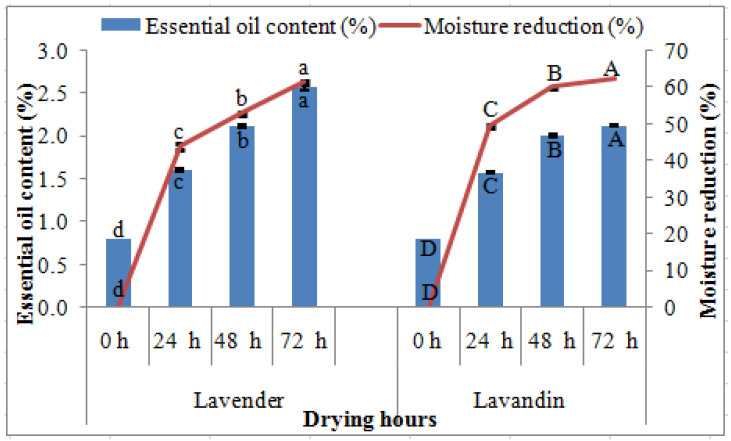
The increase in the utilization of essential oil in industries led to an impressive rise in the demand for quality essential oils. However, a post-harvest drying of species can be a decisive factor to determine the quantity and quality of essential oil. The study was conducted in western Himalayan conditions to assess the essential oil content and composition of two species viz., lavender ( Mill.), and lavandin ( × Emeric ex Loisel), at four different drying duration (0 h, 24 h, 48 h and 72 h after the harvest). The higher growth attributes viz., plant height (71.7 cm), ear length (8.8 cm), number of spikes (18.1), and number of flowers per ear (47.5) were higher in lavandin, while the number of branches (17.1) was higher in lavender. Essential oil content (%) and moisture reduction (%) were significantly higher at 72 h than at 0 h. The major components of lavender and lavandin essential oil were linalool (33.6-40.5%), linalyl acetate (10.8-13.6%), lavandulyl acetate (2.8-14.5%), and linalyl propionate (5.3-14.1%) in both the species. There was a decreasing trend in linalool and an increasing trend in linalyl acetate content in lavandin, with an increase in drying duration up to 72 h; while in lavender, no regular trend was observed in linalool and linalyl acetate content. It was observed that linalool and linalyl acetate levels were the highest at 24 and 0 h of drying in lavender and lavandin, respectively, and essential oil extraction can be done according to the desire of the constituent at varied drying duration.
随着精油在各行业中的广泛应用,对优质精油的需求大幅增加。然而,收获后的干燥过程可能是决定精油产量和质量的关键因素。本研究在喜马拉雅山西部地区进行,旨在评估 2 种精油植物(薰衣草和杂交薰衣草)在 4 种不同干燥时间(收获后 0、24、48 和 72 小时)下精油含量和成分。在lavandin 中,较高的生长属性,如株高(71.7 厘米)、穗长(8.8 厘米)、穗数(18.1)和每穗花数(47.5)较高,而在薰衣草中,分枝数(17.1)较高。精油含量(%)和水分减少(%)在 72 小时时显著高于 0 小时。薰衣草和 lavandin 精油的主要成分是芳樟醇(33.6-40.5%)、乙酸芳樟酯(10.8-13.6%)、薰衣草醇乙酸酯(2.8-14.5%)和乙酸芳樟酯(5.3-14.1%)。在 lavandin 中,芳樟醇和乙酸芳樟酯的含量呈下降趋势,随着干燥时间的增加,直至 72 小时;而在薰衣草中,芳樟醇和乙酸芳樟酯的含量没有明显的规律。观察到薰衣草和 lavandin 中芳樟醇和乙酸芳樟酯的含量在 24 小时和 0 小时时最高,精油提取可以根据不同干燥时间对成分的需求进行。