Hepatitis Unit, National Centre of Microbiology, Instituto de Salud Carlos III, Majadahonda, Madrid, Spain.
Servicio de Microbiología, Hospital Universitario Ramón y Cajal and Instituto Ramón y Cajal de Investigación Sanitaria (IRYCIS), Madrid, Spain.
Euro Surveill. 2022 Jun;27(23). doi: 10.2807/1560-7917.ES.2022.27.23.2100542.
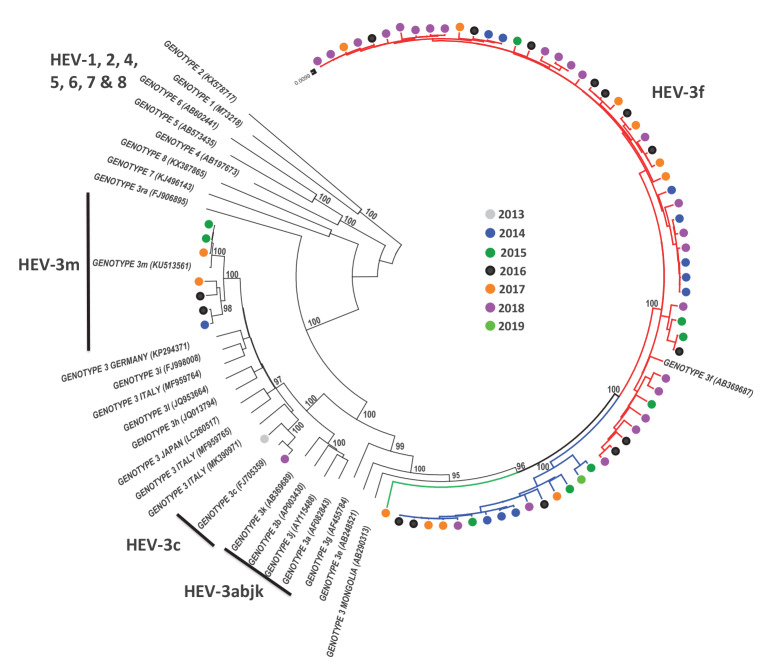
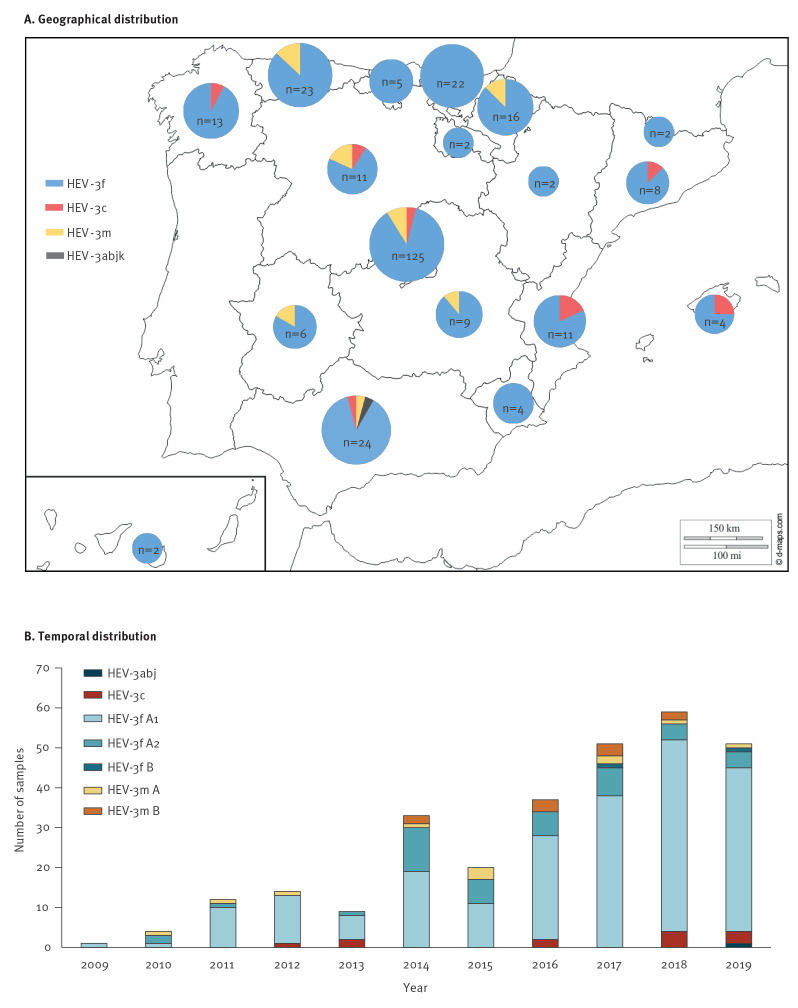
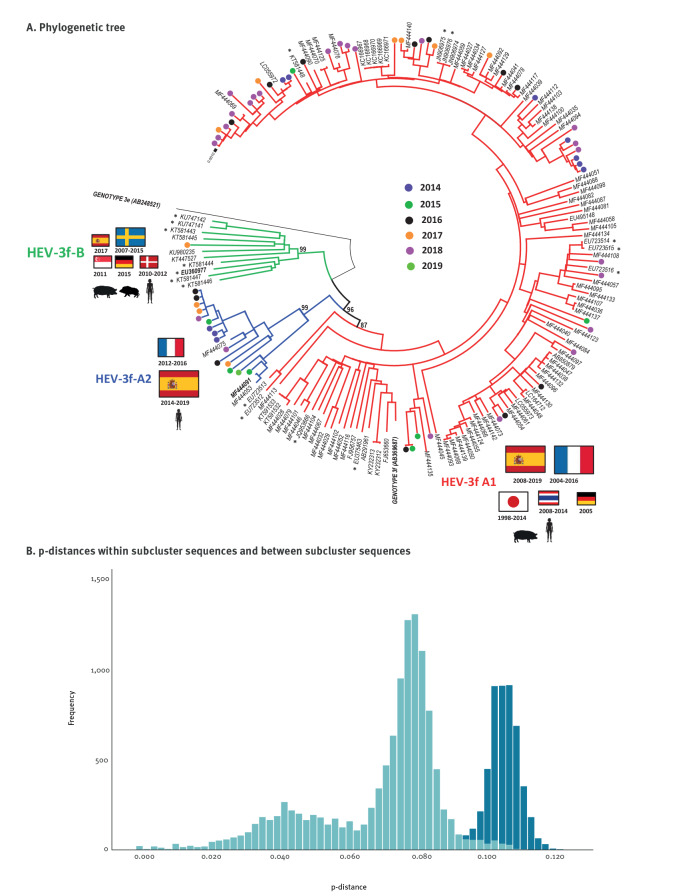
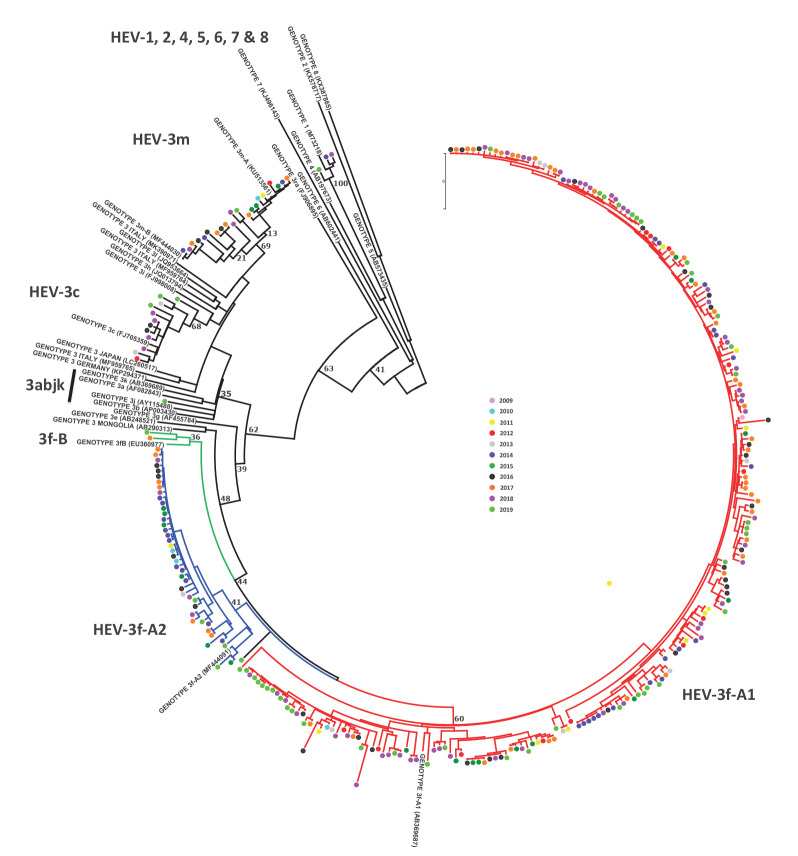
BackgroundHepatitis E virus genotype 3 (HEV-3) is widely distributed throughout Europe, with incidence of infections increasing in many countries. Belgium, Bulgaria, France, Germany, Italy, the Netherlands and the United Kingdom have reported the distribution of HEV-3 subtypes in cohorts of patients with hepatic disease.AimTo describe the distribution of the HEV-3 subtypes in Spain at national and autonomous community (AC) levels between 2009 and 2019. The study was also extended to Andorra.MethodsOf 5,197 samples received by the National Reference Laboratory during the study, 409 were HEV-RNA-positive. Among these, 294 (71.9%) were further typed based on an ORF2 sequence fragment, or, for a subset of 74, based on the full-coding genome sequence.ResultsHEV-3 was detected in 291 samples. The dominant subtype in Spain was HEV-3f (88.3%; 257/291), which occurred in all ACs, with no change in detection level over time. Within this subtype, three subclusters were characterised: HEV-3f-B, HEV-3f-A1 and HEV-3f-A2. The second most common HEV subtype was the recently described HEV-3m (7%; 21/291), with two subclusters identified: HEV-3m-A, which has been known since 2010, and HEV-3m-B, since 2014. The third most encountered subtype was HEV-3c (4.1%; 12/291), with a frequency not increasing over time, unlike observations in some European countries.ConclusionThe importance of the surveillance of HEV-3 subtype and subcluster circulation is yet to be assessed. This surveillance together with the comprehensive epidemiological characterisation of clinical cases, could support the identification of sources of transmission and the establishment of control measures nationally and internationally.
背景
戊型肝炎病毒基因型 3(HEV-3)广泛分布于欧洲,许多国家的感染发病率都在上升。比利时、保加利亚、法国、德国、意大利、荷兰和英国报告了在肝病患者队列中 HEV-3 亚型的分布。
目的
描述 2009 年至 2019 年期间西班牙全国和自治区(AC)水平上 HEV-3 亚型的分布。该研究还扩展到了安道尔。
方法
在研究期间,国家参考实验室共收到 5197 份样本,其中 409 份为 HEV-RNA 阳性。在这些样本中,基于 ORF2 序列片段对 294 份(71.9%)进行了进一步分型,或者对 74 份样本的子集基于全编码基因组序列进行了分型。
结果
在 291 份样本中检测到 HEV-3。西班牙的主要亚型是 HEV-3f(88.3%;257/291),这种亚型在所有自治区均有发现,且随着时间的推移其检出水平没有变化。在该亚型内,还鉴定出了三个亚群:HEV-3f-B、HEV-3f-A1 和 HEV-3f-A2。第二种常见的 HEV 亚型是最近描述的 HEV-3m(7%;21/291),鉴定出了两个亚群:自 2010 年以来已知的 HEV-3m-A 和自 2014 年以来已知的 HEV-3m-B。第三种最常见的亚型是 HEV-3c(4.1%;12/291),其频率没有随着时间的推移而增加,这与一些欧洲国家的观察结果不同。
结论
HEV-3 亚型和亚群传播的监测的重要性仍有待评估。这种监测以及对临床病例的全面流行病学特征描述,可以支持在国家和国际层面确定传播源并制定控制措施。