Center for Population Biology, University of California, Davis, CA, USA.
Department of Evolution and Ecology, University of California, Davis, CA, USA.
Heredity (Edinb). 2022 Jul;129(1):48-55. doi: 10.1038/s41437-022-00545-x. Epub 2022 Jun 11.
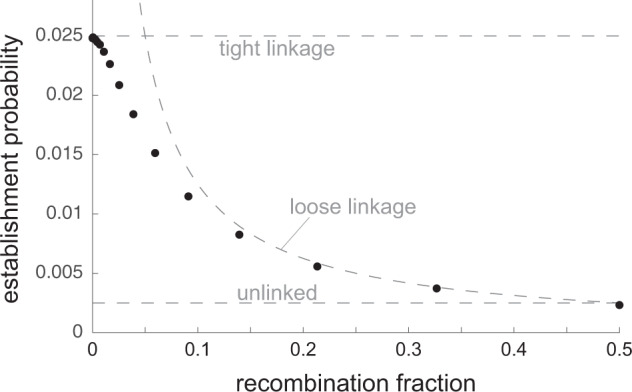
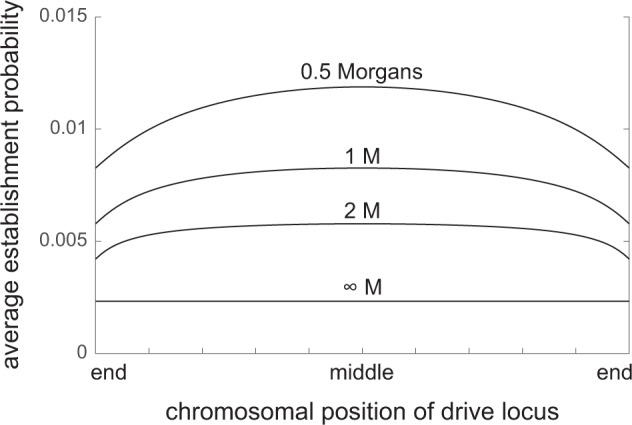
Mendel's First Law requires explanation because of the possibility of 'meiotic drivers', genes that distort fair segregation for selfish gain. The suppression of drive, and the restoration of fair segregation, is often attributed to genes at loci unlinked to the drive locus-such genes cannot benefit from drive but do suffer its associated fitness costs. However, selection can also favour suppressors at loci linked to the drive locus, raising the question of whether suppression of drive usually comes from linked or unlinked loci. Here, I study linked and unlinked suppression in a two-locus model with initial stable polymorphism at the drive locus. I find that the invasion rate of suppressors is a decreasing function of the recombination fraction between the drive and suppressor loci. Surprisingly, the relative likelihood of unlinked vs. linked suppression increases with the strength of drive and is insensitive to the fitness costs of the driver allele. I find that the chromosomal position of the driver influences how rapidly it is suppressed, with a driver in the middle of a chromosome suppressed more rapidly than a driver near the tip. When drive is strong, only a small number of chromosomes are required for suppression usually to derive from unlinked loci. In contrast, when drive is weak, and especially when suppressor alleles are associated with fitness costs, suppression will usually come from linked loci unless the genome comprises many chromosomes.
孟德尔第一定律需要解释,因为存在“减数分裂驱动基因”的可能性,这些基因为了自身利益而扭曲公平分离。驱动的抑制和公平分离的恢复通常归因于与驱动基因座不连锁的基因座上的基因——这些基因不能从驱动中受益,但会遭受其相关的适应度成本。然而,选择也可以有利于与驱动基因座连锁的抑制基因座上的抑制基因,这就提出了一个问题,即驱动的抑制通常是来自连锁还是非连锁基因座。在这里,我在一个具有初始驱动基因座稳定多态性的双基因座模型中研究了连锁和非连锁抑制。我发现,抑制基因的入侵率是驱动和抑制基因座之间重组分数的递减函数。令人惊讶的是,非连锁与连锁抑制的相对可能性随着驱动强度的增加而增加,并且不依赖于驱动等位基因的适应度成本。我发现,驱动基因的染色体位置影响其被抑制的速度,位于染色体中间的驱动基因比位于染色体末端的驱动基因被抑制得更快。当驱动很强时,通常只需要少量的染色体就可以抑制驱动,通常来自非连锁基因座。相比之下,当驱动较弱时,尤其是当抑制等位基因与适应度成本相关时,抑制通常来自连锁基因座,除非基因组包含许多染色体。