Clark Frances E, Greenberg Naomi L, Silva Duilio M Z A, Trimm Emily, Skinner Morgan, Walton R Zaak, Rosin Leah F, Lampson Michael A, Akera Takashi
Cell and Developmental Biology Center, National Heart, Lung, and Blood Institute, National Institutes of Health; Bethesda, Maryland 20894, USA.
Department of Biology, School of Arts and Sciences, University of Pennsylvania, Philadelphia, Pennsylvania 19104, USA.
bioRxiv. 2024 Feb 23:2024.02.22.581453. doi: 10.1101/2024.02.22.581453.
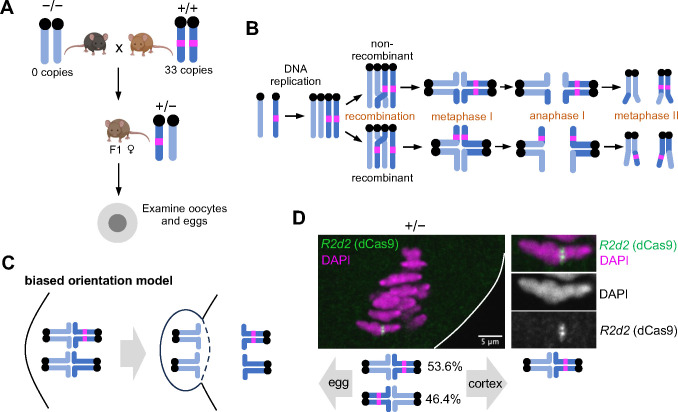
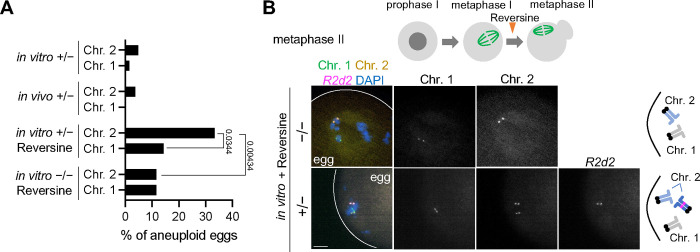
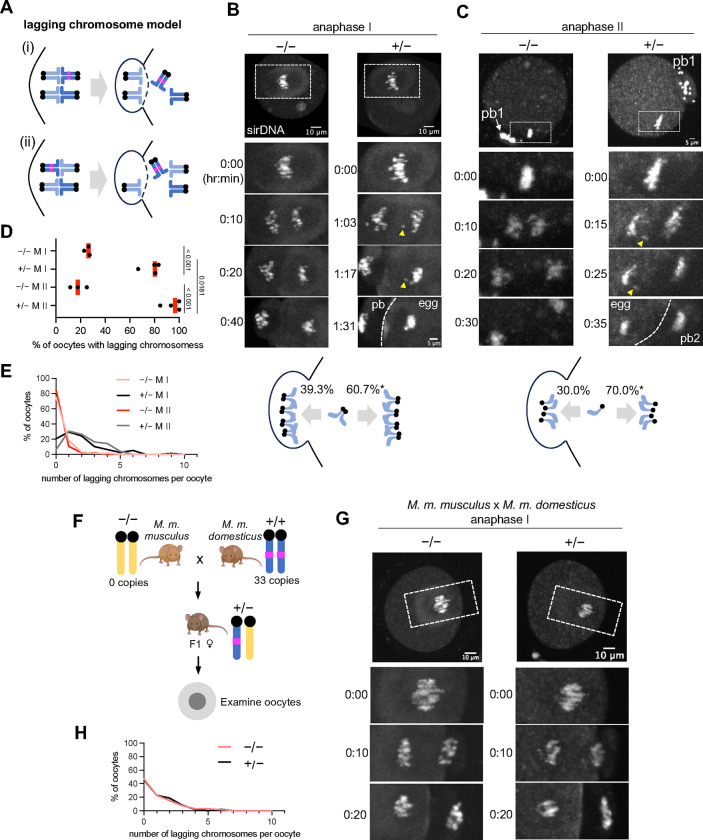
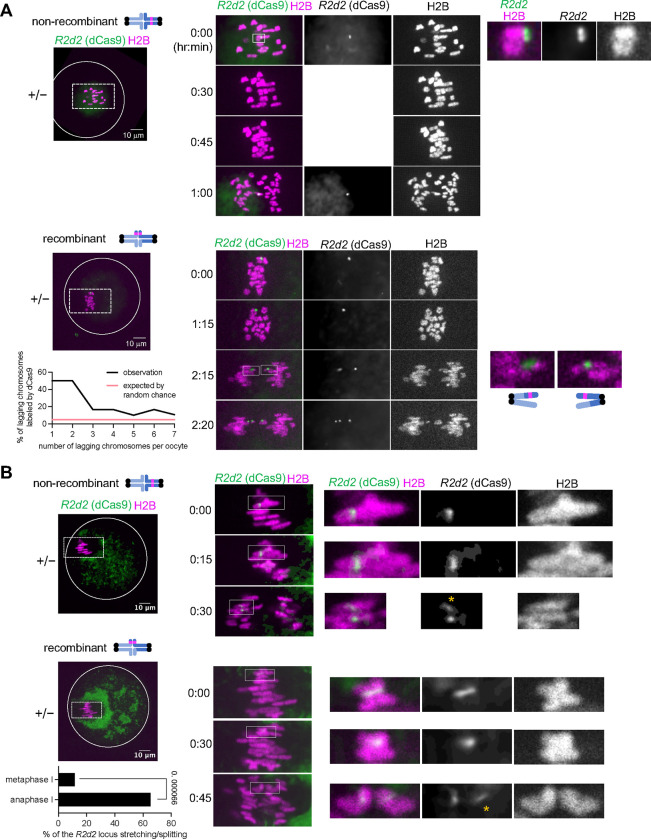
During meiosis, homologous chromosomes segregate so that alleles are transmitted equally to haploid gametes, following Mendel's Law of Segregation. However, some selfish genetic elements drive in meiosis to distort the transmission ratio and increase their representation in gametes. The established paradigms for drive are fundamentally different for female vs male meiosis. In male meiosis, selfish elements typically kill gametes that do not contain them. In female meiosis, killing is predetermined, and selfish elements bias their segregation to the single surviving gamete (i.e., the egg in animal meiosis). Here we show that a selfish element on mouse chromosome 2, , drives using a hybrid mechanism in female meiosis, incorporating elements of both male and female drivers. If is destined for the polar body, it manipulates segregation to sabotage the egg by causing aneuploidy that is subsequently lethal in the embryo, so that surviving progeny preferentially contain . In heterozygous females, orients randomly on the metaphase spindle but lags during anaphase and preferentially remains in the egg, regardless of its initial orientation. Thus, the egg genotype is either euploid with or aneuploid with both homologs of chromosome 2, with only the former generating viable embryos. Consistent with this model, heterozygous females produce eggs with increased aneuploidy for chromosome 2, increased embryonic lethality, and increased transmission of . In contrast to a male meiotic driver, which kills its sister gametes produced as daughter cells in the same meiosis, eliminates "cousins" produced from meioses in which it should have been excluded from the egg.
在减数分裂过程中,同源染色体分离,使得等位基因按照孟德尔分离定律平均传递到单倍体配子中。然而,一些自私遗传元件在减数分裂中发挥作用,扭曲传递比例并增加它们在配子中的占比。已确立的驱动模式在雌性减数分裂和雄性减数分裂中存在根本差异。在雄性减数分裂中,自私元件通常会杀死不含它们的配子。在雌性减数分裂中,致死是预先确定的,自私元件会使它们偏向于分离到唯一存活的配子(即动物减数分裂中的卵子)中。在这里,我们表明小鼠2号染色体上的一个自私元件 在雌性减数分裂中采用一种混合机制驱动,融合了雄性和雌性驱动元件的特征。如果 注定进入极体,它会操纵分离过程,通过导致非整倍体来破坏卵子,这种非整倍体随后在胚胎中是致命的,从而使存活的后代优先携带 。在杂合雌性中, 在中期纺锤体上随机定向,但在后期滞后,并优先留在卵子中,无论其初始定向如何。因此,卵子的基因型要么是携带 的整倍体,要么是2号染色体两条同源染色体均为非整倍体,只有前者能产生存活的胚胎。与该模型一致, 杂合雌性产生的卵子中2号染色体非整倍体增加、胚胎致死率增加,且 的传递增加。与雄性减数分裂驱动元件不同,后者会杀死在同一减数分裂中作为子细胞产生的姐妹配子, 会消除那些本应被排除在卵子之外的减数分裂产生的“堂亲”配子。