The Center for Applied Genomics, Children's Hospital of Philadelphia, Philadelphia, PA, 19104, USA.
Department of Pediatrics, Perelman School of Medicine, University of Pennsylvania, Philadelphia, PA, 19104, USA.
J Neurodev Disord. 2022 Jun 11;14(1):37. doi: 10.1186/s11689-022-09447-9.
In over half of pediatric cases, ADHD presents with comorbidities, and often, it is unclear whether the symptoms causing impairment are due to the comorbidity or the underlying ADHD. Comorbid conditions increase the likelihood for a more severe and persistent course and complicate treatment decisions. Therefore, it is highly important to establish an algorithm that identifies ADHD and comorbidities in order to improve research on ADHD using biorepository and other electronic record data.
It is feasible to accurately distinguish between ADHD in isolation from ADHD with comorbidities using an electronic algorithm designed to include other psychiatric disorders. We sought to develop an EHR phenotype algorithm to discriminate cases with ADHD in isolation from cases with ADHD with comorbidities more effectively for efficient future searches in large biorepositories. We developed a multi-source algorithm allowing for a more complete view of the patient's EHR, leveraging the biobank of the Center for Applied Genomics (CAG) at Children's Hospital of Philadelphia (CHOP). We mined EHRs from 2009 to 2016 using International Statistical Classification of Diseases and Related Health Problems (ICD) codes, medication history and keywords specific to ADHD, and comorbid psychiatric disorders to facilitate genotype-phenotype correlation efforts. Chart abstractions and behavioral surveys added evidence in support of the psychiatric diagnoses. Most notably, the algorithm did not exclude other psychiatric disorders, as is the case in many previous algorithms. Controls lacked psychiatric and other neurological disorders. Participants enrolled in various CAG studies at CHOP and completed a broad informed consent, including consent for prospective analyses of EHRs. We created and validated an EHR-based algorithm to classify ADHD and comorbid psychiatric status in a pediatric healthcare network to be used in future genetic analyses and discovery-based studies.
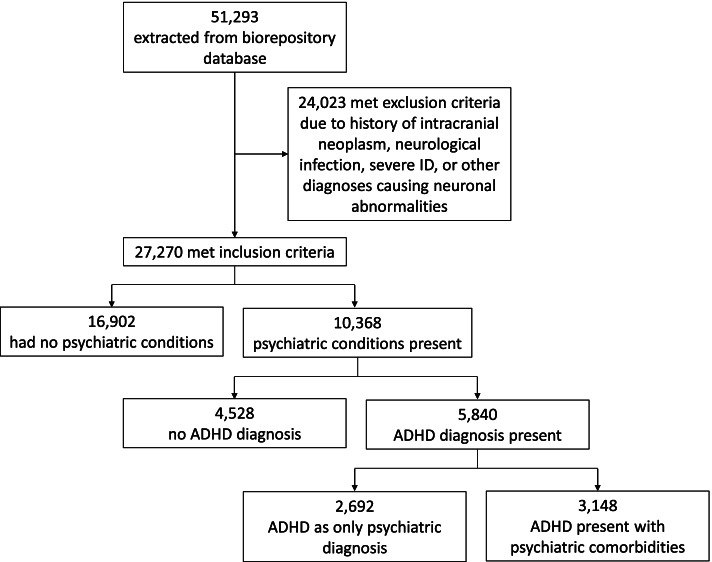
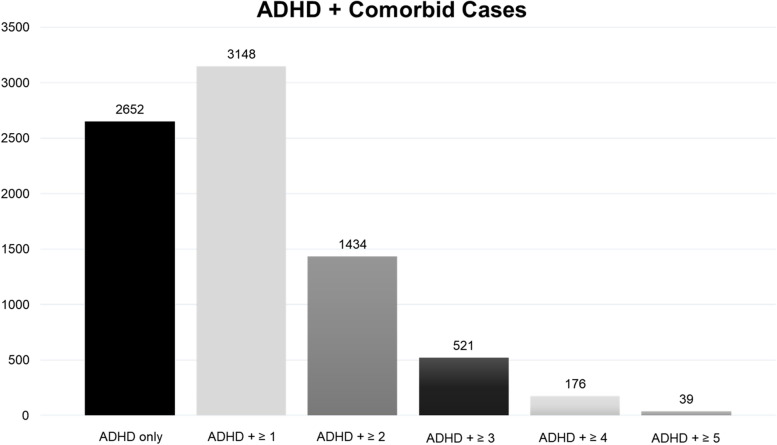
In this retrospective case-control study that included data from 51,293 subjects, 5840 ADHD cases were discovered of which 46.1% had ADHD alone and 53.9% had ADHD with psychiatric comorbidities. Our primary study outcome was to examine whether the algorithm could identify and distinguish ADHD exclusive cases from ADHD comorbid cases. The results indicate ICD codes coupled with medication searches revealed the most cases. We discovered ADHD-related keywords did not increase yield. However, we found including ADHD-specific medications increased our number of cases by 21%. Positive predictive values (PPVs) were 95% for ADHD cases and 93% for controls.
We established a new algorithm and demonstrated the feasibility of the electronic algorithm approach to accurately diagnose ADHD and comorbid conditions, verifying the efficiency of our large biorepository for further genetic discovery-based analyses.
ClinicalTrials.gov, NCT02286817 . First posted on 10 November 2014.
gov, NCT02777931 . First posted on 19 May 2016.
gov, NCT03006367 . First posted on 30 December 2016.
gov, NCT02895906 . First posted on 12 September 2016.
在一半以上的儿科病例中,ADHD 伴有合并症,而且,通常情况下,导致损害的症状是由合并症还是潜在的 ADHD 引起的并不清楚。合并症增加了更严重和持续病程的可能性,并使治疗决策复杂化。因此,建立一种能够识别 ADHD 和合并症的算法非常重要,以便利用生物库和其他电子记录数据来改进 ADHD 的研究。
使用旨在纳入其他精神障碍的电子算法,从孤立的 ADHD 中准确区分 ADHD 与伴有合并症的 ADHD 是可行的。我们试图开发一种电子病历表型算法,以便更有效地从伴有合并症的 ADHD 病例中区分出孤立的 ADHD 病例,以便在大型生物库中进行有效的未来搜索。我们开发了一种多源算法,可以更全面地了解患者的电子病历表,利用费城儿童医院(CHOP)应用基因组学中心(CAG)的生物库。我们使用国际疾病分类(ICD)代码、药物史和特定于 ADHD 的关键词,从 2009 年到 2016 年挖掘电子病历表,以促进基因型-表型相关性研究。图表摘要和行为调查增加了支持精神诊断的证据。值得注意的是,该算法并没有排除许多以前的算法中存在的其他精神障碍。对照组没有精神和其他神经障碍。在 CHOP 参加各种 CAG 研究的参与者完成了广泛的知情同意,包括对电子病历表进行前瞻性分析的同意。我们创建并验证了一种基于电子病历表的算法,以在儿科医疗网络中对 ADHD 和合并的精神状态进行分类,以便在未来的遗传分析和基于发现的研究中使用。
在这项包括 51293 名受试者数据的回顾性病例对照研究中,发现了 5840 例 ADHD 病例,其中 46.1%为单纯 ADHD,53.9%为伴有精神合并症的 ADHD。我们的主要研究结果是检查该算法是否能识别和区分单纯 ADHD 病例和伴有合并症的 ADHD 病例。结果表明,ICD 代码与药物搜索相结合显示出最多的病例。我们发现,ADHD 相关关键词并没有增加产量。然而,我们发现包含 ADHD 特定药物可使我们的病例增加 21%。ADHD 病例的阳性预测值(PPV)为 95%,对照组为 93%。
我们建立了一种新的算法,并证明了电子算法方法准确诊断 ADHD 和合并症的可行性,验证了我们的大型生物库在进一步的基于遗传发现的分析中的效率。
ClinicalTrials.gov,NCT02286817。首次于 2014 年 11 月 10 日注册。
ClinicalTrials.gov,NCT02777931。首次于 2016 年 5 月 19 日注册。
ClinicalTrials.gov,NCT03006367。首次于 2016 年 12 月 30 日注册。
ClinicalTrials.gov,NCT02895906。首次于 2016 年 9 月 12 日注册。