Department of Central Laboratory, Guangzhou Twelfth People's Hospital, Guangzhou, China.
Key Laboratory of Occupational Environment and Health, Guangzhou Twelfth People's Hospital, Guangzhou, China.
Arthritis Res Ther. 2022 Jun 11;24(1):138. doi: 10.1186/s13075-022-02829-3.
Rheumatic heart disease (RHD) is a critical public health issue worldwide, and its epidemiological patterns have changed over the decades. This article aimed to estimate the global trends of RHD, and attributable risks from 1990 to 2019.
Data on RHD burden were explored from the Global Burden of Disease Study 2019. Trends of the RHD burden were estimated using the estimated annual percentage change (EAPC) and age-standardized rate (ASR).
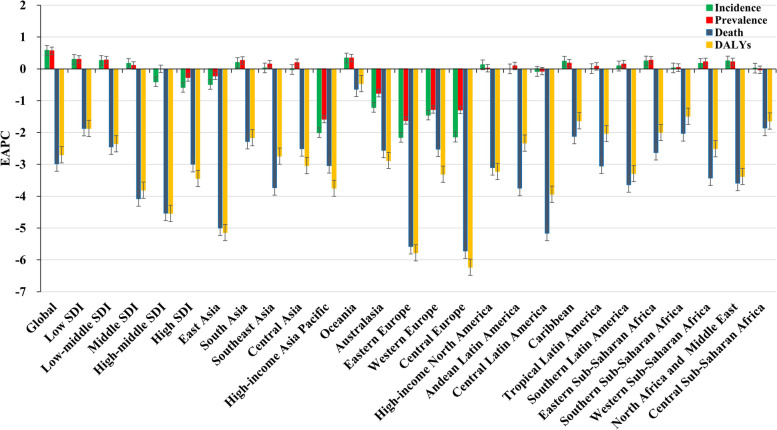
During 1990-2019, increasing trends in the ASR of incidence and prevalence of RHD were observed worldwide, with the respective EAPCs of 0.58 (95% confidence interval [CI] 0.52 to 0.63) and 0.57 (95%CI 0.50 to 0.63). Meanwhile, increasing trends commonly occurred in low and middle Socio-Demographic Index (SDI) regions and countries. The largest increasing trends in the ASR of incidence and prevalence were seen in Fiji, with the respective EAPCs being 2.17 (95%CI 1.48 to 2.86) and 2.22 (95%CI 1.53 to 2.91). However, death and disability-adjusted life years (DALYs) due to RHD showed pronounced decreasing trends of ASR globally, in which the EAPCs were - 2.98 (95%CI - 3.03 to - 2.94) and - 2.70 (95%CI - 2.75 to - 2.65), respectively. Meanwhile, decreasing trends were also observed in all SDI areas and geographic regions. The largest decreasing trends of death were observed in Thailand (EAPC = - 9.55, 95%CI - 10.48 to - 8.61). Among the attributable risks, behavioral risk-related death and DALYs caused by RHD had pronounced decreasing trends worldwide and in SDI areas.
Pronounced decreasing trends of death and DALYs caused by RHD were observed in regions and countries from 1990 to 2019, but the RHD burden remains a substantial challenge globally. The results would inform the strategies for more effective prevention and control of RHD.
风湿性心脏病(Rheumatic Heart Disease,RHD)是全球范围内的一个重大公共卫生问题,其流行病学模式在过去几十年中发生了变化。本文旨在评估 1990 年至 2019 年全球 RHD 的趋势及其归因风险。
从 2019 年全球疾病负担研究中获取 RHD 负担数据。使用估计的年百分比变化(EAPC)和年龄标准化率(ASR)来估计 RHD 负担趋势。
1990 年至 2019 年期间,全球范围内 RHD 的发病率和患病率的 ASR 呈上升趋势,分别为 0.58(95%置信区间[CI]0.52-0.63)和 0.57(95%CI0.50-0.63)。同时,中低社会人口指数(Socio-Demographic Index,SDI)地区和国家的趋势普遍呈上升趋势。发病率和患病率的 ASR 上升幅度最大的国家是斐济,相应的 EAPC 分别为 2.17(95%CI1.48-2.86)和 2.22(95%CI1.53-2.91)。然而,风湿性心脏病导致的死亡和伤残调整生命年(Disability-Adjusted Life Years,DALYs)的 ASR 全球呈显著下降趋势,EAPC 分别为-2.98(95%CI-3.03-2.94)和-2.70(95%CI-2.75-2.65)。同时,所有 SDI 地区和地理区域也观察到了下降趋势。泰国的死亡归因风险下降幅度最大(EAPC=-9.55,95%CI-10.48 至-8.61)。在归因风险中,与行为风险相关的死亡和由 RHD 导致的 DALYs 呈全球和 SDI 地区显著下降趋势。
1990 年至 2019 年期间,各地区和国家风湿性心脏病导致的死亡和 DALYs 呈显著下降趋势,但全球范围内 RHD 负担仍然是一个重大挑战。研究结果将为制定更有效的风湿性心脏病预防和控制策略提供信息。