Tuyttens Frank A M, Molento Carla F M, Benaissa Said
Flanders Research Institute for Agriculture, Fisheries and Food (ILVO), Merelbeke, Belgium.
Department of Veterinary and Biosciences, Faculty of Veterinary Medicine, Ghent University, Merelbeke, Belgium.
Front Vet Sci. 2022 May 27;9:889623. doi: 10.3389/fvets.2022.889623. eCollection 2022.
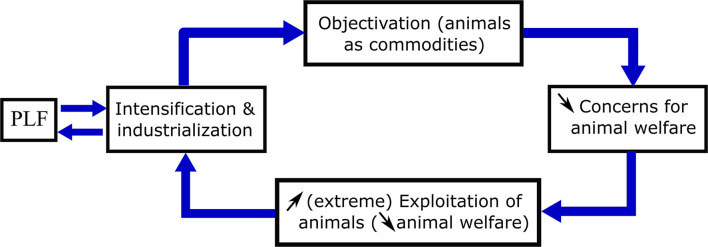
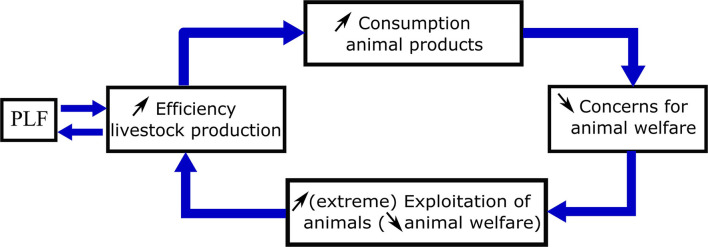
Research and development of Precision Livestock Farming (PLF) is booming, partly due to hopes and claims regarding the benefits of PLF for animal welfare. These claims remain largely unproven, however, as only few PLF technologies focusing on animal welfare have been commercialized and adopted in practice. The prevailing enthusiasm and optimism about PLF innovations may be clouding the perception of possible threats that PLF may pose to farm animal welfare. Without claiming to be exhaustive, this paper lists 12 potential threats grouped into four categories: direct harm, indirect harm via the end-user, via changes to housing and management, and via ethical stagnation or degradation. PLF can directly harm the animals because of (1) technical failures, (2) harmful effects of exposure, adaptation or wearing of hardware components, (3) inaccurate predictions and decisions due to poor external validation, and (4) lack of uptake of the most meaningful indicators for animal welfare. PLF may create indirect effects on animal welfare if the farmer or stockperson (5) becomes under- or over-reliant on PLF technology, (6) spends less (quality) time with the animals, and (7) loses animal-oriented husbandry skills. PLF may also compromise the interests of the animals by creating transformations in animal farming so that the housing and management are (8) adapted to optimize PLF performance or (9) become more industrialized. Finally, PLF may affect the moral status of farm animals in society by leading to (10) increased speciesism, (11) further animal instrumentalization, and (12) increased animal consumption and harm. For the direct threats, possibilities for prevention and remedies are suggested. As the direction and magnitude of the more indirect threats are harder to predict or prevent, they are more difficult to address. In order to maximize the potential of PLF for improving animal welfare, the potential threats as well as the opportunities should be acknowledged, monitored and addressed.
精准畜牧养殖(PLF)的研发正在蓬勃发展,部分原因是人们对PLF给动物福利带来的益处抱有希望并提出了相关主张。然而,这些主张在很大程度上仍未得到证实,因为只有少数关注动物福利的PLF技术已实现商业化并在实践中得到应用。对PLF创新普遍存在的热情和乐观态度,可能会掩盖人们对PLF可能给农场动物福利带来的潜在威胁的认识。本文并不力求详尽无遗,而是列出了12种潜在威胁,分为四类:直接伤害、通过终端用户造成的间接伤害、通过养殖环境和管理方式的改变造成的间接伤害以及通过道德停滞或退化造成的间接伤害。PLF可能会直接伤害动物,原因包括:(1)技术故障;(2)硬件组件的接触、适应或佩戴产生的有害影响;(3)由于外部验证不足导致的预测和决策不准确;(4)缺乏对动物福利最有意义指标的采用。如果农民或饲养员(5)对PLF技术过度依赖或依赖不足,(6)与动物相处的(质量)时间减少,以及(7)失去以动物为导向的饲养技能,PLF可能会对动物福利产生间接影响。PLF还可能通过改变畜牧养殖方式来损害动物的利益,从而使养殖环境和管理(8)为优化PLF性能而进行调整,或(9)变得更加工业化。最后,PLF可能会导致(10)物种歧视加剧、(11)动物工具化进一步加深以及(12)动物消费和伤害增加,从而影响社会中农场动物的道德地位。对于直接威胁,本文提出了预防和补救的可能性。由于更间接威胁的方向和程度更难预测或预防,因此更难以应对。为了最大限度地发挥PLF改善动物福利的潜力,应认识到、监测并应对潜在威胁和机遇。