Department of Endocrinology, Shandong Provincial Hospital Affiliated to Shandong First Medical University, Jinan, China.
Shandong Clinical Research Center of Diabetes and Metabolic Diseases, Jinan, China.
Front Endocrinol (Lausanne). 2022 May 25;13:880230. doi: 10.3389/fendo.2022.880230. eCollection 2022.
Some studies have demonstrated a bidirectional association between obesity and depression, whereas others have not. This discordance might be due to the metabolic health status. We aimed to determine whether the relationship between obesity and depression is dependent on metabolic health status.
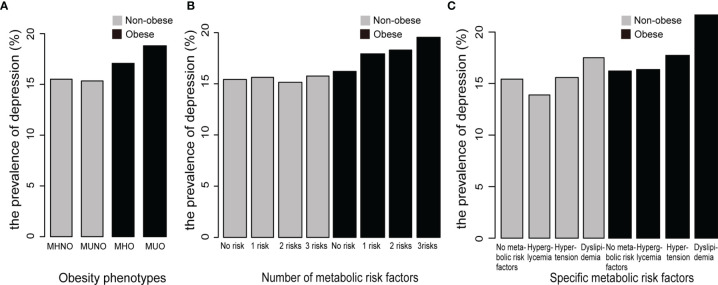
In total, 9,022,089 participants were enrolled and classified as one of four obesity phenotypes: metabolically healthy nonobesity (MHNO), metabolically unhealthy nonobesity (MUNO), metabolically healthy obesity (MHO), and metabolically unhealthy obesity (MUO). We then divided the population into eight phenotypes based on obesity and the number of metabolic risk factors. Furthermore, the associations of eight phenotypes, based on obesity and specific metabolic risk factors, with depression were assessed.
Among all participants, a higher risk of depression was observed for MUNO, MHO and MUO than for MHNO. The risk was highest for MUO (OR = 1.442; 95% CI = 1.432, 1.451). However, the association between MHO and depression was different for men and women (OR = 0.941, men; OR = 1.132, women). The risk of depression increased as the number of metabolic risk factors increased. Dyslipidemia was the strongest metabolic risk factor. These relationships were consistent among patients ≥ 45 years of age.
The increased risk of obesity-related depression appears to partly depend on metabolic health status. The results highlight the importance of a favorable metabolic status, and even nonobese populations should be screened for metabolic disorders.
一些研究表明肥胖和抑郁之间存在双向关联,而另一些研究则没有。这种不一致可能是由于代谢健康状况的不同。我们旨在确定肥胖和抑郁之间的关系是否取决于代谢健康状况。
共纳入 9022089 名参与者,并将其分为以下四种肥胖表型之一:代谢健康非肥胖(MHNO)、代谢不健康非肥胖(MUNO)、代谢健康肥胖(MHO)和代谢不健康肥胖(MUO)。然后,我们根据肥胖和代谢风险因素的数量将人群分为八个体型。此外,评估了基于肥胖和特定代谢风险因素的八种表型与抑郁的关联。
在所有参与者中,与 MHNO 相比,MUNO、MHO 和 MUO 患抑郁症的风险更高。MUO 的风险最高(OR=1.442;95%CI=1.432,1.451)。然而,MHO 与抑郁的关联在男性和女性之间存在差异(OR=0.941,男性;OR=1.132,女性)。随着代谢风险因素数量的增加,患抑郁症的风险增加。血脂异常是最强的代谢风险因素。这些关系在≥45 岁的患者中是一致的。
肥胖相关抑郁风险的增加似乎部分取决于代谢健康状况。研究结果强调了良好代谢状态的重要性,即使是非肥胖人群也应筛查代谢紊乱。