Chen Huimin, Wu Xiaohan, Xu Chunjin, Lin Jian, Liu Zhanju
Center for Inflammatory Bowel Disease Research, the Shanghai Tenth People's Hospital, Tongji University School of Medicine, Shanghai 200072, China.
Department of Gastroenterology, the First People's Hospital of Shangqiu City Affiliated to Xinxiang Medical University, Shangqiu 476100, China.
Precis Clin Med. 2021 Nov 15;4(4):246-257. doi: 10.1093/pcmedi/pbab025. eCollection 2021 Dec.
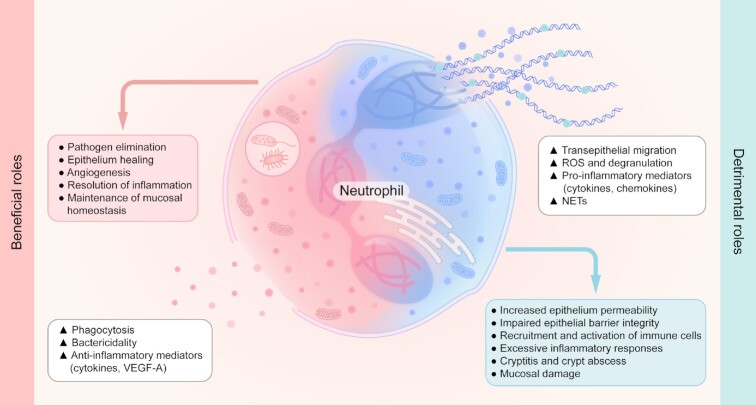
Neutrophils are considered as complex innate immune cells and play a critical role in maintaining intestinal mucosal homeostasis. They exert robust pro-inflammatory effects and recruit other immune cells in the acute phase of pathogen infection and intestinal inflammation, but paradoxically, they also limit exogenous microbial invasion and facilitate mucosal restoration. Hyperactivation or dysfunction of neutrophils results in abnormal immune responses, leading to multiple autoimmune and inflammatory diseases including systemic lupus erythematosus, rheumatoid arthritis, and inflammatory bowel diseases (IBD). As a refractory intestinal inflammatory disease, the pathogenesis and progression of IBD are associated with complicated immune response processes in which neutrophils are profoundly involved. However, the consensus on potential roles of neutrophils in modulating pathogenic and repair processes of IBD remains not fully understood. Accumulated infiltrating neutrophils cross the epithelial barrier and contribute to microbial dysbiosis, aggravated intestinal architectural damage, compromised resolution of intestinal inflammation and increased risk of thrombosis during IBD. Paradoxically, activated neutrophils are also associated with effective elimination of invaded microbiota, promoted angiogenesis and tissue restoration of gut mucosa in IBD. Here, we discuss the beneficial and detrimental roles of neutrophils in the onset and resolution of intestinal mucosal inflammation, hoping to provide a precise overview of neutrophil functions in the pathogenesis of IBD.
中性粒细胞被认为是复杂的固有免疫细胞,在维持肠道黏膜稳态中起关键作用。它们在病原体感染和肠道炎症的急性期发挥强大的促炎作用并募集其他免疫细胞,但矛盾的是,它们也限制外源性微生物入侵并促进黏膜修复。中性粒细胞的过度激活或功能障碍会导致异常免疫反应,引发多种自身免疫性和炎症性疾病,包括系统性红斑狼疮、类风湿性关节炎和炎症性肠病(IBD)。作为一种难治性肠道炎症性疾病,IBD的发病机制和进展与复杂的免疫反应过程有关,中性粒细胞在其中深度参与。然而,关于中性粒细胞在调节IBD致病和修复过程中的潜在作用仍未完全达成共识。在IBD期间,积聚的浸润性中性粒细胞穿过上皮屏障,导致微生物群落失调、肠道结构损伤加重、肠道炎症消退受损以及血栓形成风险增加。矛盾的是,活化的中性粒细胞也与IBD中有效清除入侵的微生物群、促进血管生成和肠道黏膜组织修复有关。在此,我们讨论中性粒细胞在肠道黏膜炎症发生和消退中的有益和有害作用,希望能对中性粒细胞在IBD发病机制中的功能提供一个准确的概述。