Taha Anas, Enodien Bassey, Frey Daniel M, Taha-Mehlitz Stephanie
Department of Biomedical Engineering, Faculty of Medicine, University of Basel, Allschwil, Switzerland.
Department of Surgery, GZO- Hospital, Wetzikon, Switzerland.
Front Surg. 2022 May 26;9:908014. doi: 10.3389/fsurg.2022.908014. eCollection 2022.
Artificial intelligence simulates human intelligence in machines that have undergone programming to make them think like human beings and imitate their activities. Artificial intelligence has dominated the medical sector to perform various patient diagnosis activities and improve communication between professionals and patients. The main goal of this study is to perform a scoping review to evaluate the development of artificial intelligence in all forms of hernia surgery except the diaphragm and upside-down hernia.
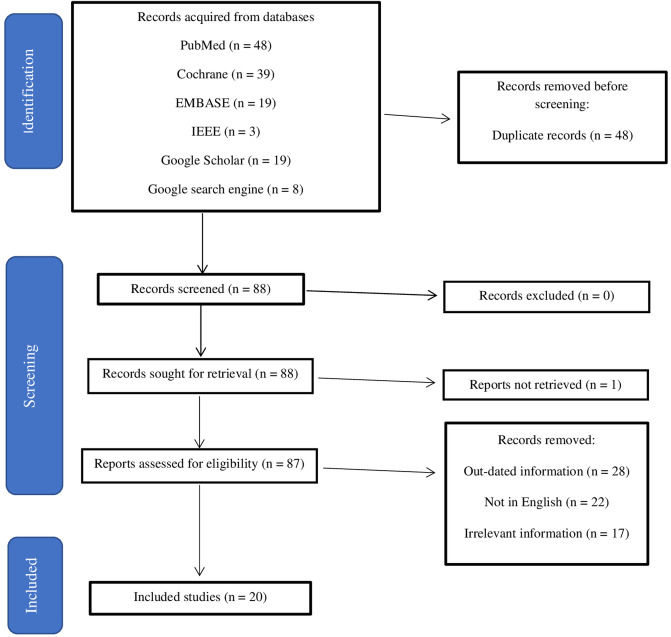
The study used the Preferred Reporting Items for Systematic and Meta-analyses for Scoping Review (PRISMA-ScR) to guide the structuring of the manuscript and fulfill all the requirements of every subheading. The sources used to gather data are the PubMed, Cochrane, and EMBASE databases, IEEE and Google and Google Scholar search engines. AMSTAR tool is the most appropriate for assessing the methodological quality of the included studies.
The study exclusively included twenty articles, whereby seven focused on artificial intelligence in inguinal hernia surgery, six focused on abdominal hernia surgery, five on incisional hernia surgery, and two on AI in medical imaging and robotics in hernia surgery.
The outcomes of this study reveal a significant literature gap on artificial intelligence in hernia surgery. The results also indicate that studies focus on inguinal hernia surgery more than any other types of hernia surgery since the articles addressing the topic are more. The study implies that more research is necessary for the field to develop and enjoy the benefits associated with AI. Thus, this situation will allow the integration of AI in activities like medical imaging and surgeon training.
人工智能在经过编程的机器中模拟人类智能,使其能够像人类一样思考并模仿人类活动。人工智能已在医疗领域占据主导地位,用于执行各种患者诊断活动,并改善专业人员与患者之间的沟通。本研究的主要目的是进行一项范围综述,以评估除膈肌和倒位疝之外的所有形式疝修补手术中人工智能的发展情况。
本研究采用系统综述和范围综述的首选报告项目(PRISMA-ScR)来指导稿件的结构安排,并满足每个小标题的所有要求。用于收集数据的来源包括PubMed、Cochrane和EMBASE数据库、IEEE以及谷歌和谷歌学术搜索引擎。AMSTAR工具最适合评估纳入研究的方法学质量。
该研究仅纳入了20篇文章,其中7篇聚焦于腹股沟疝修补手术中的人工智能,6篇聚焦于腹疝修补手术,5篇聚焦于切口疝修补手术,2篇聚焦于疝修补手术中的医学影像和机器人技术中的人工智能。
本研究结果揭示了疝修补手术中人工智能方面存在显著的文献空白。结果还表明,由于涉及该主题的文章更多,研究更多地集中在腹股沟疝修补手术上,而不是其他类型的疝修补手术。该研究意味着该领域需要更多研究来发展并享受与人工智能相关的益处。因此,这种情况将有助于人工智能融入医学影像和外科医生培训等活动中。