Pillai Kanchana S, Vibha Deepti, Gupta Pranjal, Sudheer Pachipala, Mishra Biswamohan, Oinam Rahul S, Mohan Ayush, Tayade Kamalesh, Srivastava Padma, Tripathi Manjari, Srivastava Achal K, Bhatia Rohit, Rajan Roopa, Pandit Awadh K, Singh Rajesh K, Elavarasi Arunmozhimaran, Agarwal Ayush, Gupta Anu, Das Animesh, Radhakrishnan Divya M, Ramanujam Bhargavi, Soni Kapil D, Aggarwal Richa, Wig Naveet, Trikha Anjan
Department of Neurology, All India Institute of Medical Sciences, New Delhi, India.
Department of Anaesthesia, All India Institute of Medical Sciences, New Delhi, India.
Ann Indian Acad Neurol. 2022 Mar-Apr;25(2):218-223. doi: 10.4103/aian.aian_602_21. Epub 2022 Mar 1.
Neurological emergencies saw a paradigm shift in approach during the coronavirus disease-2019 (COVID-19) pandemic with the challenge to manage patients with and without COVID-19. We aimed to compare the various neurological disorders and 3 months outcome in patients with and without SARS-CoV-2 infection.
In an ambispective cohort study design, we enrolled patients with and without SARS CoV-2 infection coming to a medical emergency with neurological disorders between April 2020 and September 2020. Demographic, clinical, biochemical, and treatment details of these patients were collected and compared. Their outcomes, both in-hospital and at 3 months were assessed by the modified Rankin Scale (mRS).
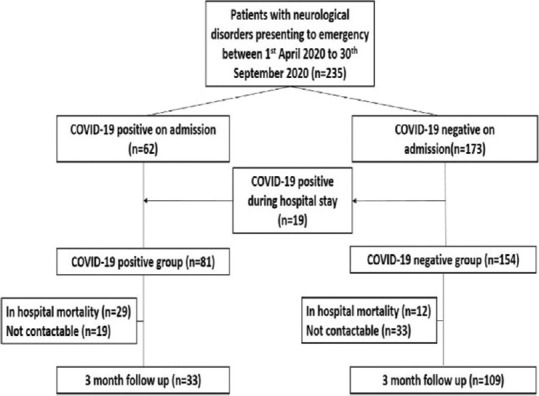
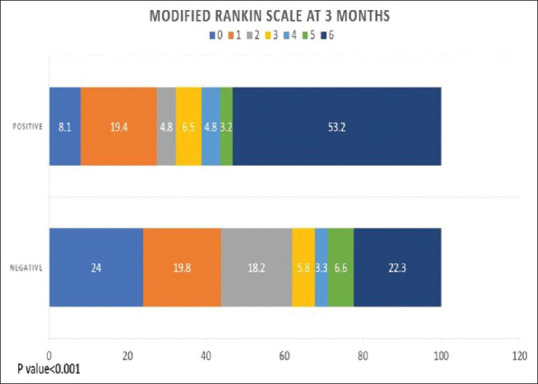
Two thirty-five patients (235) were enrolled from emergency services with neurological disorders. Of them, 81 (34.5%) were COVID-19 positive. The mean (SD) age was 49.5 (17.3) years, and the majority of the patients were male (63.0%). The commonest neurological diagnosis was acute ischemic stroke (AIS) (43.0%). The in-hospital mortality was higher in the patients who were COVID-19 positive (COVID-19 positive: 29 (35.8%) versus COVID-19 negative: 12 (7.8%), value: <0.001). The 3 months telephonic follow-up could be completed in 73.2% of the patients (142/194). Four (12.1%) deaths occurred on follow-up in the COVID-19 positive versus fifteen (13.8%) in the COVID-19 negative patients ( value: 1.00). The 3-month mRS was worse in the COVID-19 positive group ( value <0.001). However, this was driven by higher in-hospital morbidity and mortality in COVID-19 positive patients.
Patients with neurological disorders presenting with COVID-19 infection had worse outcomes, including in-hospital and 3 months disability.
在2019年冠状病毒病(COVID-19)大流行期间,神经系统急症的治疗方法发生了范式转变,面临着管理感染和未感染COVID-19患者的挑战。我们旨在比较感染和未感染严重急性呼吸综合征冠状病毒2(SARS-CoV-2)的患者的各种神经系统疾病及3个月的预后情况。
在一项前瞻性队列研究设计中,我们纳入了2020年4月至2020年9月期间因神经系统疾病前来就诊的感染和未感染SARS-CoV-2的患者。收集并比较了这些患者的人口统计学、临床、生化和治疗细节。通过改良Rankin量表(mRS)评估他们在住院期间和3个月时的预后情况。
从急诊服务中纳入了235例患有神经系统疾病的患者。其中,81例(34.5%)COVID-19呈阳性。平均(标准差)年龄为49.5(17.3)岁,大多数患者为男性(63.0%)。最常见的神经系统诊断为急性缺血性卒中(AIS)(43.0%)。COVID-19呈阳性的患者住院死亡率更高(COVID-19阳性:29例(35.8%),而COVID-19阴性:12例(7.8%),P值:<0.001)。73.2%的患者(142/194)完成了3个月的电话随访。随访期间,COVID-19阳性患者中有4例(12.1%)死亡,而COVID-19阴性患者中有15例(13.8%)死亡(P值:1.00)。COVID-19阳性组的3个月mRS更差(P值<0.001)。然而,这是由COVID-19阳性患者更高的住院发病率和死亡率导致的。
患有神经系统疾病且感染COVID-19的患者预后更差,包括住院期间和3个月时的残疾情况。