Department of Gastroenterology and Hepatology, University of Groningen, University Medical Center Groningen, Groningen, Netherlands.
Department of Medical Microbiology, University of Groningen, University Medical Center Groningen, Groningen, Netherlands.
Front Immunol. 2022 May 25;13:842911. doi: 10.3389/fimmu.2022.842911. eCollection 2022.
Inflammatory bowel disease (IBD) is characterized by a disturbed gut microbiota composition. Patients with IBD have both elevated mucosal and serum levels of IgG-antibodies directed against bacterial antigens, including flagellins. In this study, we aimed to determine to which intestinal bacteria the humoral immune response is directed to in patients with IBD.
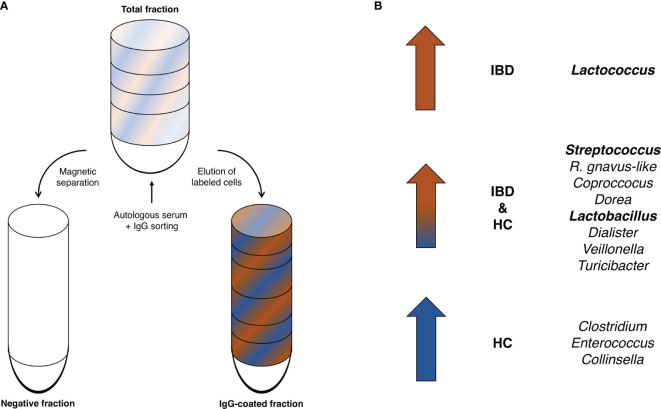
Fecal and serum samples were collected from patients with IBD (=55) and age- and sex-matched healthy controls (=55). Fecal samples were incubated with autologous serum and IgG-coated fractions were isolated by magnetic-activated cell sorting (MACS) and its efficiency was assessed by flow cytometry. The bacterial composition of both untreated and IgG-coated fecal samples was determined by 16S rRNA-gene Illumina sequencing.
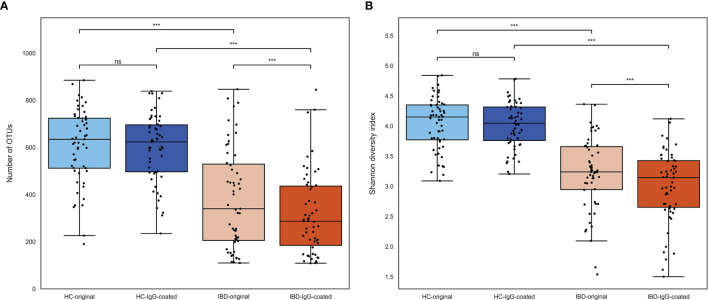
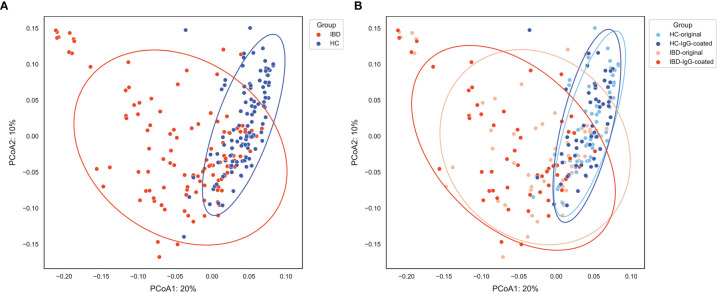
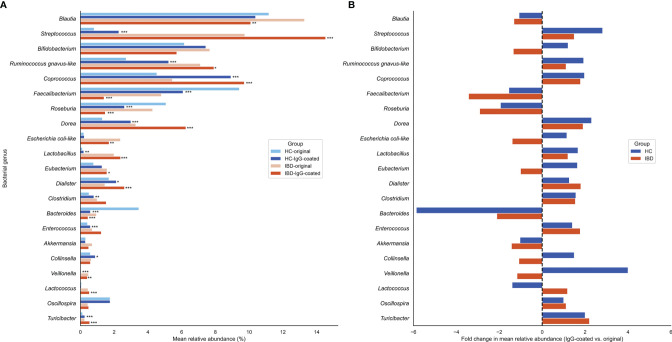
IgG-coated fecal samples were characterized by significantly lower microbial diversity compared to the fecal microbiome. Both in patients with IBD and controls, serum IgG responses were primarily directed to , , , , and , as well as against specific bacteria, including and (all <0.001), and to -like bacteria (<0.05). In contrast, serological IgG responses against typical commensal, anaerobic and colonic microbial species were rather low, e.g. to the members and , to , as well as to . Patients with IBD showed more IgG-coating of , , and bacteria compared to healthy controls (all <0.05). No differences in IgG-coated bacterial fractions were observed between Crohn's disease and ulcerative colitis, between active or non-active disease, nor between different disease locations.
The IgG immune response is specifically targeted at distinct intestinal bacterial genera that are typically associated with the small intestinal microbiota, whereas responses against more colonic-type commensals are lower, which was particularly the case for patients with IBD. These findings may be indicative of a strong immunological exposure to potentially pathogenic intestinal bacteria in concordance with relative immune tolerance against commensal bacteria.
炎症性肠病(IBD)的特征是肠道微生物群落组成发生紊乱。IBD 患者的黏膜和血清中,针对包括鞭毛蛋白在内的细菌抗原的 IgG 抗体水平升高。在这项研究中,我们旨在确定 IBD 患者的体液免疫反应针对的是哪些肠道细菌。
收集 IBD 患者(=55 例)和年龄、性别匹配的健康对照者(=55 例)的粪便和血清样本。粪便样本与自体血清孵育,然后通过磁激活细胞分选(MACS)分离 IgG 包被的部分,并通过流式细胞术评估其效率。未处理和 IgG 包被的粪便样本的细菌组成通过 16S rRNA 基因 Illumina 测序确定。
与粪便微生物组相比,IgG 包被的粪便样本的微生物多样性显著降低。在 IBD 患者和对照组中,血清 IgG 反应主要针对 、 、 、 、 和 ,以及针对特定的 细菌,包括 和 (均 <0.001),以及类似于 的细菌(<0.05)。相比之下,针对典型共生、厌氧和结肠微生物物种的血清 IgG 反应相对较低,例如对 成员 和 、 、 以及 。与健康对照组相比,IBD 患者的 、 和 细菌的 IgG 包被更多(均 <0.05)。在克罗恩病和溃疡性结肠炎、活动期或非活动期疾病以及不同的疾病部位之间,未观察到 IgG 包被细菌部分的差异。
IgG 免疫反应特异性靶向于特定的肠道细菌属,这些细菌通常与小肠微生物群落相关,而对更多结肠型共生菌的反应较低,这在 IBD 患者中尤为明显。这些发现可能表明对潜在致病性肠道细菌存在强烈的免疫暴露,同时对共生菌存在相对免疫耐受。