Department of Sports Science and Clinical Biomechanics, Research Unit for Exercise Epidemiology, Centre of Research in Childhood Health, University of Southern Denmark, Campusvej 55, DK-5230, Odense M, Denmark.
Lolland-Falster Health Study, Centre for Epidemiological Research, Nykøbing F. Hospital, Fjordvej 15, 4800, Nykøbing F., Denmark.
Int J Behav Nutr Phys Act. 2020 Dec 4;17(1):161. doi: 10.1186/s12966-020-01067-7.
Evidence of intra-family resemblance in physical activity (PA) is lacking. The association between parent and child PA appears weak, the influence of age and gender on this association is uncertain, and no studies have investigated the degree of resemblance in family members' PA behaviours such as walking, sitting/lying, and biking. Thus, the aims of the study were to examine the degree of resemblance in PA within families, specifically between parents and children, and to explore the size of resemblance across age of children, gender of parents and children, and intensity and type of PA.
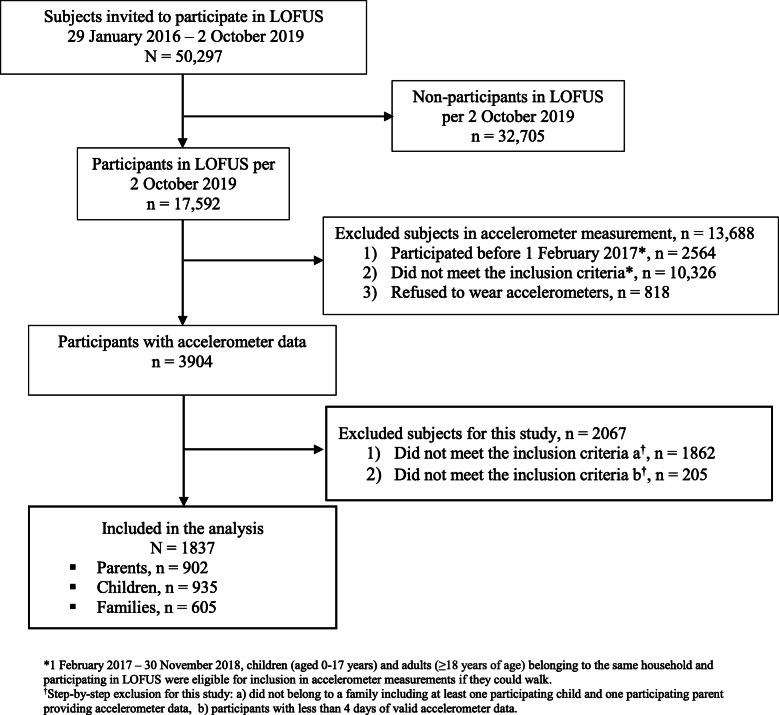
The study is a cross-sectional analysis of a subsample (902 parents and 935 children nested within 605 families) of the Danish population study Lolland-Falster Health Study. PA was measured using a dual-accelerometer system (Axivity AX3) with subsequent processing of time spent in light PA (LPA), moderate-to-vigorous PA (MVPA), and vigorous PA and classification of PA behaviour types. Families with at least one son/daughter aged 0-22 years and one parent providing minimum 4 days of valid accelerometer data were included in the analysis. A linear mixed model regression analysis was used to determine the intraclass correlation coefficient (ICC) of clustering among family members for PA intensities and PA behaviours, adjusted for sex, age, parental education, and the interaction between sex and age.
In the analysis of within-family variation in PA, the ICCs across PA intensities and PA behaviours ranged from 0.06 to 0.34. We found stronger clustering in family members' PA for LPA and behaviours requiring low energy expenditure (LPA: ICC 0.22 (95% confidence interval (CI) 0.17; 0.28), sitting/lying: ICC 0.34 (95% CI 0.28; 0.40)), and walking: ICC 0.24 (95% CI 0.19; 0.30) than for higher intensities (e.g. MVPA: ICC 0.07 (95% CI 0.03; 0.14)). The ICC for biking was 0.23 (95% CI 0.18; 0.29). Analyses on parent-child dyads gave similar results. No interaction effects for gender and age (except for biking) were found.
Parents and children's time spent in PA behaviours requiring low energy expenditure had moderate resemblance within families, whereas engagement in PA with higher intensities showed small or close-to-zero resemblance.
关于身体活动(PA)的家族内相似性的证据尚缺乏。父母与子女之间的 PA 关联似乎较弱,年龄和性别对这种关联的影响尚不确定,且尚无研究调查家庭成员 PA 行为(如步行、坐/躺和骑车)的相似程度。因此,本研究的目的是检查家庭内 PA 的相似程度,特别是父母与子女之间的相似程度,并探讨儿童年龄、父母和儿童性别、PA 强度和类型对 PA 相似程度的影响。
本研究是丹麦洛兰-法尔斯特健康研究的一个亚样本(嵌套在 605 个家庭中的 902 名父母和 935 名儿童)的横断面分析。使用双加速度计系统(Axivity AX3)测量 PA,随后对轻体力活动(LPA)、中等到剧烈体力活动(MVPA)和剧烈体力活动所花费的时间以及 PA 行为类型进行处理。分析纳入了至少有一个 0-22 岁的儿子/女儿和一个提供至少 4 天有效加速度计数据的父母的家庭。采用线性混合模型回归分析来确定 PA 强度和 PA 行为的家族成员聚类的组内相关系数(ICC),调整了性别、年龄、父母教育程度以及性别和年龄之间的交互作用。
在分析家庭内 PA 的变异性时,PA 强度和 PA 行为的 ICC 范围为 0.06 至 0.34。我们发现,家庭成员的 LPA 和低能量消耗行为(LPA:ICC 0.22(95%置信区间(CI)0.17;0.28),坐姿/躺姿:ICC 0.34(95% CI 0.28;0.40))和步行(ICC 0.24(95% CI 0.19;0.30))的聚类程度比高强度(如 MVPA:ICC 0.07(95% CI 0.03;0.14))更强。骑车的 ICC 为 0.23(95% CI 0.18;0.29)。对父母-子女对子的分析得出了类似的结果。未发现性别和年龄(骑车除外)的交互作用。
父母和子女在低能量消耗的 PA 行为上的时间具有中等程度的家族内相似性,而高强度的 PA 活动则表现出较小或接近零的相似性。