Chien Jun-Yi, Gu Yong-Chun, Tsai Hsin-Mei, Liu Chun-Hao, Yen Chia-Yuan, Wang Yuh-Lin, Wang Juen-Kai, Lin Chi-Hung
Institute of Atomic and Molecular Sciences, Academia Sinica, Taipei, Taiwan.
Department of Health, New Taipei City Government, New Taipei City, Taiwan.
J Food Drug Anal. 2020 Jun 15;28(2):302-308. doi: 10.38212/2224-6614.1064.
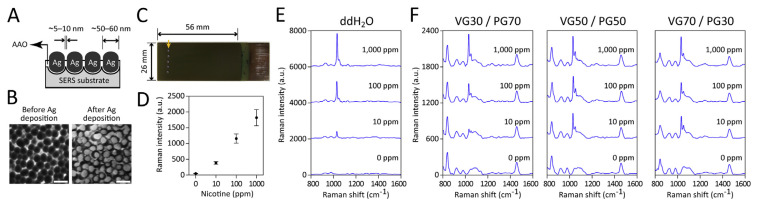
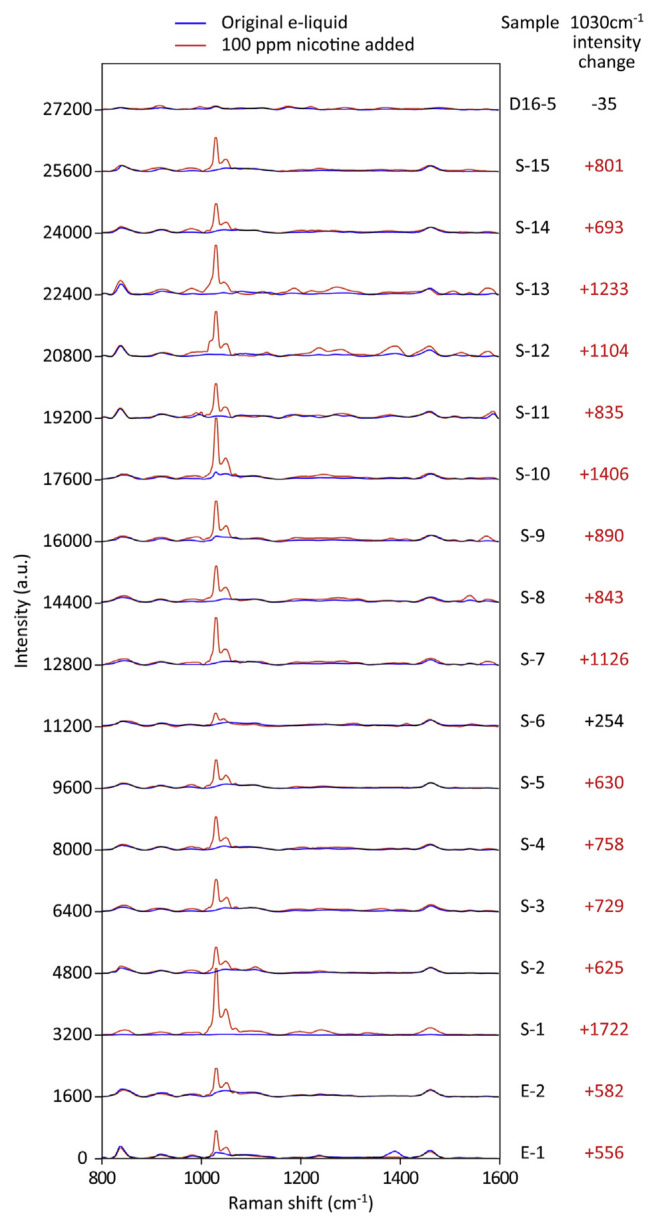
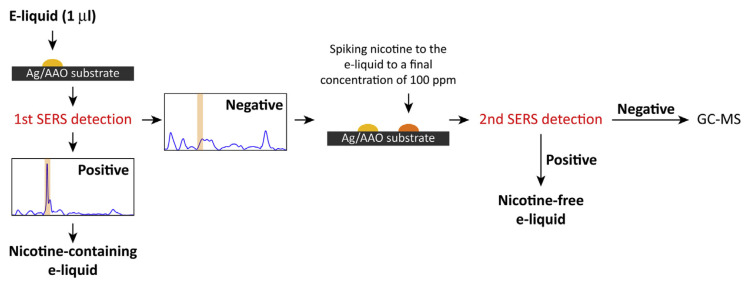
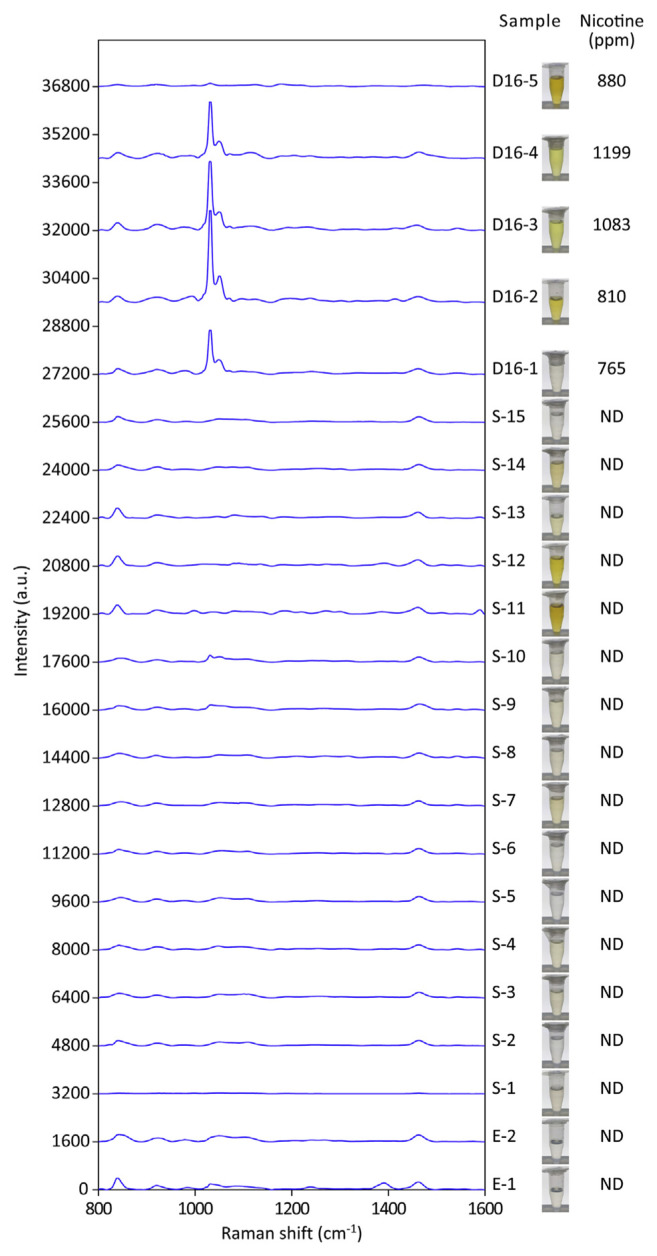
Nicotine-containing electronic cigarette liquid (e-liquid) is prohibited in many countries, creating requirements for rapid detection approaches for on-site inspection or screening for large amounts of samples. Here, we demonstrate a simple way to identify nicotine using surface-enhanced Raman scattering (SERS) with substrates made of silver nanoparticle arrays imbedded in anodic aluminum oxide nanochannels (Ag/AAO). Compared with the reported colloidal nanoparticle-based SERS, that required serial dilutions to enable colloid aggregation in the viscous e-liquid, a small amount of undiluted e-liquid sample can be directly added onto our solid-phase Ag/AAO substrate without any pre-treatment. The sensitivity of our SERS measurements is 2-3 orders of magnitude higher than that required for identification of nicotine in e-liquid, which is typically around 1000-18,000 ppm. Using such nanoparticle array-based SERS, we have tested 22 commercially available e-liquid products, using the corresponding gas chromatography-mass spectrometry (GC-MS) reports as the reference. The SERS measurements were done within one hour and successfully identified 20 samples. Only 2 samples showed SERS interference from ingredients that were not suitable for SERS analysis.
许多国家禁止含有尼古丁的电子烟液(电子烟油),这就需要快速检测方法来对大量样品进行现场检查或筛查。在此,我们展示了一种利用表面增强拉曼散射(SERS)来识别尼古丁的简单方法,所使用的基底是嵌入阳极氧化铝纳米通道(Ag/AAO)的银纳米颗粒阵列。与已报道的基于胶体纳米颗粒的SERS相比,后者需要进行系列稀释以使胶体在粘性电子烟油中聚集,而我们的方法可以将少量未稀释的电子烟油样品直接添加到我们的固相Ag/AAO基底上,无需任何预处理。我们的SERS测量灵敏度比识别电子烟油中尼古丁所需的灵敏度高2 - 3个数量级,尼古丁在电子烟油中的含量通常约为1000 - 18,000 ppm。使用这种基于纳米颗粒阵列的SERS,我们以相应的气相色谱 - 质谱联用(GC - MS)报告为参考,对22种市售电子烟油产品进行了测试。SERS测量在一小时内完成,成功识别出20个样品。只有2个样品显示出因不适合SERS分析的成分而产生的SERS干扰。