Faculty of Medicine, Universitas Padjadjaran, Bandung, Indonesia.
Department of Biomedical Sciences, Faculty of Medicine, Universitas Padjadjaran, Bandung, Indonesia.
PLoS One. 2022 Jun 13;17(6):e0269706. doi: 10.1371/journal.pone.0269706. eCollection 2022.
The incidence of childhood ALL in Indonesia is still largely unknown. The widely mentioned statistics from other countries turn out to be only estimated figures. Other data do not specify the types of leukemia and are not specifically focused on children. Therefore, this study aims to pool incidence and mortality statistics from available studies in Indonesia.
We searched five different academic databases, including Pubmed, MEDLINE, Cochrane Library, Science Direct, and Google Scholar. Three Indonesian databases, such as the Indonesian Scientific Journal Database (ISJD), Neliti, and Indonesia One Search, were also utilized. Incidence was expressed as per 100,000 children. We used the Newcastle-Ottawa scale (NOS) to assess the quality of cohort studies. The inclusion criteria are cohort studies published in the languages of English or Indonesian. For this analysis, we define children as 0-18 years old.
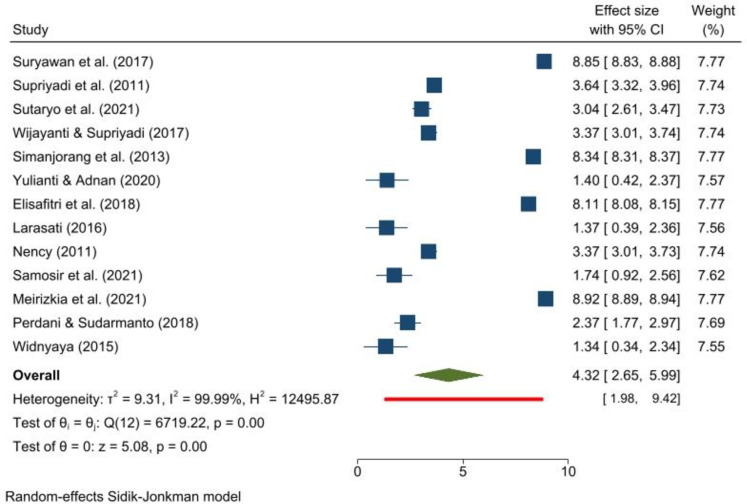
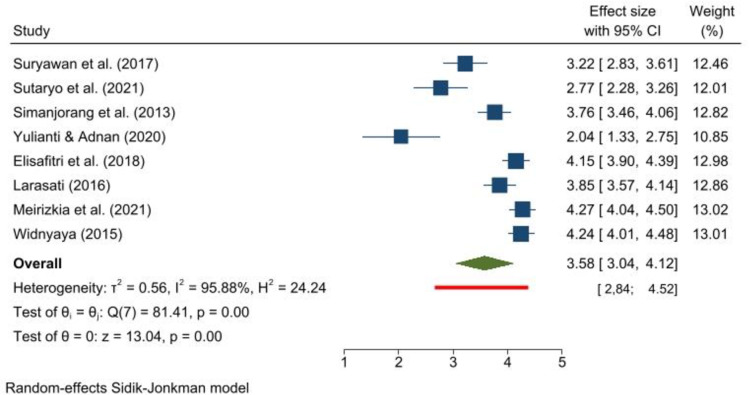
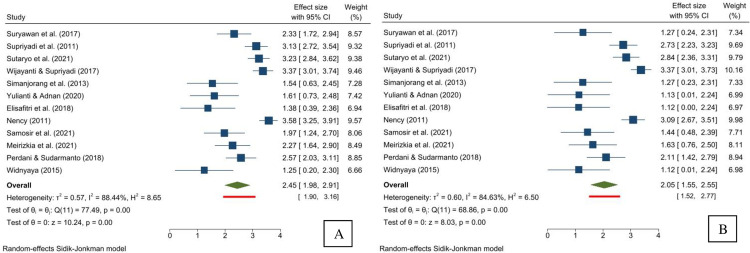
The incidence rate for childhood ALL was found to be 4.32 per 100,000 children (95% CI 2.65-5.99) with a prediction interval of 1.98 to 9.42 per 100,000 children. The incidence rate is higher in males, with 2.45 per 100,000 children (95% CI 1.98-2.91) and a prediction interval of 1.90 to 3.16 per 100,000 children. As for females, the incidence rate is 2.05 per 100,000 children (95% CI 1.52-2.77) with a prediction interval of 1.52 to 2.77 per 100,000 children. The mortality of childhood ALL ranges from 0.44 to 5.3 deaths per 100,000 children, while the CFR is 3.58% with varying true effect sizes of 2.84% to 4.52%.
With 79.5 million children living in Indonesia in 2018, this means that there were roughly 3,434 new cases of childhood ALL. An organized effort between multiple sectors is needed to improve the registries of childhood ALL in Indonesia.
印度尼西亚儿童急性淋巴细胞白血病的发病率仍知之甚少。其他国家广泛提到的统计数据实际上只是估计数字。其他数据没有具体说明白血病的类型,也没有专门针对儿童。因此,本研究旨在汇总印度尼西亚现有研究的发病率和死亡率统计数据。
我们在五个不同的学术数据库(包括 Pubmed、MEDLINE、Cochrane Library、Science Direct 和 Google Scholar)中进行了搜索。还利用了三个印度尼西亚数据库,如印度尼西亚科学期刊数据库(ISJD)、Neliti 和印尼一号搜索。发病率以每 10 万名儿童为单位表示。我们使用纽卡斯尔-渥太华量表(NOS)评估队列研究的质量。纳入标准为发表在英语或印度尼西亚语的队列研究。在这项分析中,我们将儿童定义为 0-18 岁。
儿童急性淋巴细胞白血病的发病率为每 10 万名儿童 4.32 例(95%CI 2.65-5.99),预测区间为每 10 万名儿童 1.98-9.42 例。男性的发病率较高,为每 10 万名儿童 2.45 例(95%CI 1.98-2.91),预测区间为每 10 万名儿童 1.90-3.16 例。而女性的发病率为每 10 万名儿童 2.05 例(95%CI 1.52-2.77),预测区间为每 10 万名儿童 1.52-2.77 例。儿童急性淋巴细胞白血病的死亡率范围为每 10 万名儿童 0.44-5.3 例死亡,而病死率为 3.58%,真实效应大小为 2.84%-4.52%。
2018 年,印度尼西亚有 7950 万儿童,这意味着大约有 3434 例新的儿童急性淋巴细胞白血病病例。需要多个部门共同努力,以改善印度尼西亚儿童急性淋巴细胞白血病的登记工作。