Patil Abhishek, Chanakya K, Shenoy Padmanabha, Chandrashekara S, Haridas Vikram, Kumar Sharath, Daware Manisha, Janardana Ramya, Pinto Benzeeta, Subramanian Ramaswamy, Nagaraj S, Singh Yogesh Preet, Singhai Shweta, Jois Ramesh, Jain Vikramraj, Srinivasa C, Dharmanand B G, Dharmapalaiah Chethana, Sangeetha K N, Rao Vijay K, Shobha Vineeta
Manipal Hospital, Bangalore, India.
Department of Clinical Immunology and Rheumatology, St. John's Medical College Hospital, Sarjapur Road, Bengaluru, 560034, India.
BMC Rheumatol. 2022 Jun 14;6(1):32. doi: 10.1186/s41927-022-00264-0.
We conducted this study to identify the influence of prolonged use of hydroxychloroquine (HCQ), glucocorticoids and other immunosuppressants (IS) on occurrence and outcome of COVID-19 in patients with autoimmune rheumatic diseases (AIRDs).
This was a prospective, multicenter, non-interventional longitudinal study across 15 specialist rheumatology centers. Consecutive AIRD patients on treatment with immunosuppressants were recruited and followed up longitudinally to assess parameters contributing to development of COVID-19 and its outcome.
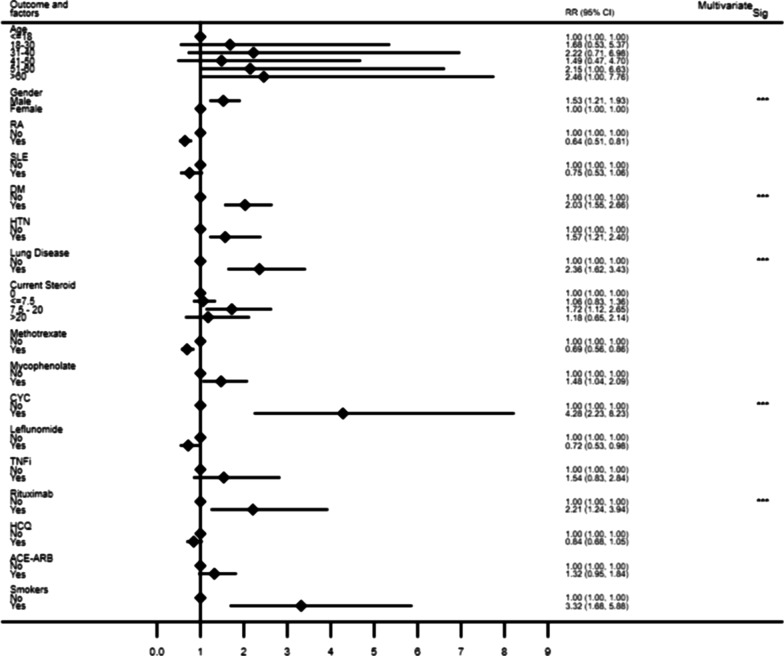
COVID-19 occurred in 314 (3.45%) of 9212 AIRD patients during a median follow up of 177 (IQR 129, 219) days. Long term HCQ use had no major impact on the occurrence or the outcome of COVID-19. Glucocorticoids in moderate dose (7.5-20 mg/day) conferred higher risk (RR = 1.72) of infection. Among the IS, Mycophenolate mofetil (MMF), Cyclophosphamide (CYC) and Rituximab (RTX) use was higher in patients with COVID 19. However, the conventional risk factors such as male sex (RR = 1.51), coexistent diabetes mellitus (RR = 1.64), pre-existing lung disease (RR = 2.01) and smoking (RR = 3.32) were the major contributing risk factors for COVID-19. Thirteen patients (4.14%) died, the strongest risk factor being pre-existing lung disease (RR = 6.36, p = 0.01). Incidence (17.5 vs 5.3 per 1 lakh (Karnataka) and 25.3 vs 7.9 per 1 lakh (Kerala)) and case fatality (4.1% vs 1.3% (Karnataka) and 4.3% vs 0.4% (Kerala)) rate of COVID-19 was significantly higher (p < 0.001) compared to the general population of the corresponding geographic region.
Immunosuppressants have a differential impact on the risk of COVID-19 occurrence in AIRD patients. Older age, males, smokers, hypertensive, diabetic and underlying lung disease contributed to higher risk. The incidence rate and the case fatality rate in AIRD patients is much higher than that in the general population.
我们开展这项研究以确定长期使用羟氯喹(HCQ)、糖皮质激素及其他免疫抑制剂(IS)对自身免疫性风湿疾病(AIRD)患者感染2019冠状病毒病(COVID-19)的发生情况及预后的影响。
这是一项在15个专业风湿病中心进行的前瞻性、多中心、非干预性纵向研究。招募正在接受免疫抑制剂治疗的连续性AIRD患者,并进行纵向随访,以评估与COVID-19发生及其预后相关的参数。
在9212例AIRD患者中,314例(3.45%)在中位随访177天(四分位间距129,219天)期间发生COVID-19。长期使用HCQ对COVID-19的发生或预后无重大影响。中等剂量(7.5 - 20毫克/天)的糖皮质激素使感染风险更高(相对风险[RR]=1.72)。在免疫抑制剂中,使用霉酚酸酯(MMF)、环磷酰胺(CYC)和利妥昔单抗(RTX)的COVID-19患者更多。然而,传统风险因素如男性(RR = 1.51)、并存糖尿病(RR = 1.64)、既往肺部疾病(RR = 2.01)和吸烟(RR = 3.32)是COVID-19的主要危险因素。13例患者(4.14%)死亡,最强的危险因素是既往肺部疾病(RR = 6.36,p = 0.01)。与相应地理区域的普通人群相比,COVID-19的发病率(每10万人中分别为17.5对5.3(卡纳塔克邦)和25.3对7.9(喀拉拉邦))和病死率(4.1%对1.3%(卡纳塔克邦)和4.3%对0.4%(喀拉拉邦))显著更高(p < 0.001)。
免疫抑制剂对AIRD患者发生COVID-19的风险有不同影响。年龄较大、男性、吸烟者、高血压患者、糖尿病患者及有基础肺部疾病者风险更高。AIRD患者的发病率和病死率远高于普通人群。