School of Pharmacy, Jiangsu University, Zhenjiang, 212013, Jiangsu, People's Republic of China.
Int J Nanomedicine. 2022 Jun 7;17:2577-2591. doi: 10.2147/IJN.S365570. eCollection 2022.
Sonodynamic therapy (SDT) and its synergistic cancer therapy derivatives, such as combined chemotherapy-SDT (chemo-SDT), are promising approaches for tumor treatment. However, the main drawbacks restricting their applications are hypoxia in tumors and the reducing microenvironment or high glutathione (GSH) levels.
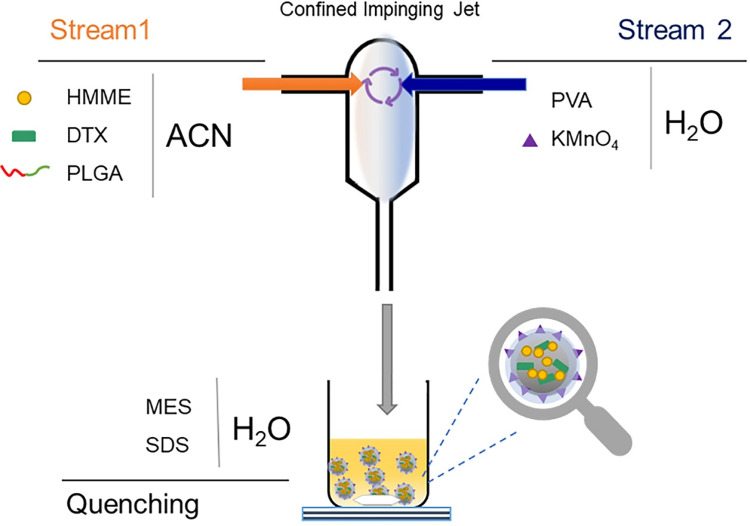
In this study, a hybrid metal MnO was deposited onto nanoparticles fabricated using poly(lactic-co-glycolic acid) (PLGA), carrying docetaxel (DTX) and the sonosensitizer hematoporphyrin monomethyl ether (HMME) (PHD@MnO) via a one-step flash nanoprecipitation (FNP) method. Characterization and in vitro and in vivo experiments were conducted to explore the chemo-SDT effect of PHD@MnO and evaluate the synergetic antitumor treatment of this nanosystem.
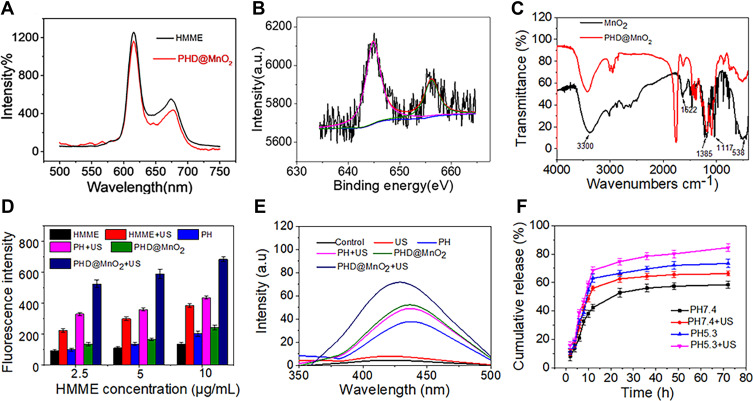
When low-power ultrasound is applied, the acquired PHD@MnO, whether in solution or in MCF-7 cells, generated ROS more efficiently than other groups without MnO or those treated via monotherapy. Specifically, GSH-depletion was observed when MnO was introduced into the system. PHD@MnO presented good biocompatibility and biosafety in vitro and in vivo. These results indicated that the PHD@MnO nanoparticles overcame hypoxia in tumor tissue and suppressed the expression of hypoxia-inducible factor 1 alpha (HIF-1α), achieving enhanced chemo-SDT.
This study provides a paradigm that rationally engineered multifunctional metal-hybrid nanoparticles can serve as an effective platform for augmenting the antitumor therapeutic efficiency of chemo-SDT.
声动力学疗法(SDT)及其协同癌症治疗衍生物,如联合化疗-SDT(chemo-SDT),是肿瘤治疗的有前途的方法。然而,限制其应用的主要缺点是肿瘤中的缺氧和减少的微环境或高谷胱甘肽(GSH)水平。
在这项研究中,通过一步快速纳米沉淀(FNP)方法,将载有多西他赛(DTX)和声敏剂血卟啉单甲醚(HMME)的聚(乳酸-共-乙醇酸)(PLGA)制成的纳米颗粒上沉积了混合金属 MnO(PHD@MnO)。进行了表征和体外及体内实验,以探索 PHD@MnO 的化疗-SDT 效果,并评估该纳米系统的协同抗肿瘤治疗作用。
当应用低功率超声时,与其他没有 MnO 或单独进行治疗的组相比,在溶液中或 MCF-7 细胞中的所获得的 PHD@MnO 更有效地产生了 ROS。具体而言,当系统中引入 MnO 时,观察到 GSH 耗竭。PHD@MnO 在体外和体内均表现出良好的生物相容性和生物安全性。这些结果表明,PHD@MnO 纳米颗粒克服了肿瘤组织中的缺氧,并抑制了缺氧诱导因子 1α(HIF-1α)的表达,从而增强了化疗-SDT。
这项研究提供了一个范例,即合理设计的多功能金属混合纳米粒子可以作为增强化疗-SDT 抗肿瘤治疗效率的有效平台。