Shaabi Afaf
Neurological Surgery, King Faisal Medical City, Abha, SAU.
Cureus. 2022 May 10;14(5):e24887. doi: 10.7759/cureus.24887. eCollection 2022 May.
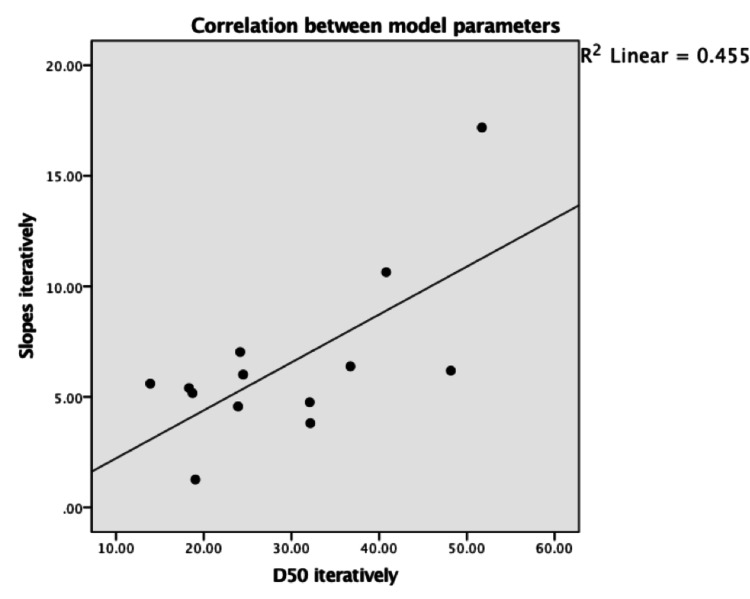
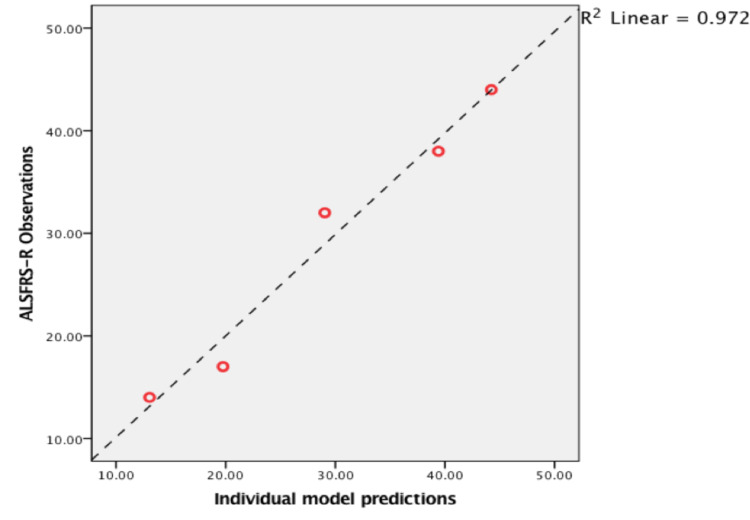
Background Amyotrophic lateral sclerosis functional rating scale-revised (ALSFRS-R) has emerged as a clinical prognostic marker for clinical and research purposes in amyotrophic lateral sclerosis (ALS). However, tools for predicting disease progression are still underdeveloped. The aim of this study was to mathematically model ALS progression to provide a reliable and personalized approach to the prognosis for ALS patients. Also, it aimed to provide a reliable prediction tool for the current and newly diagnosed patients. Methods Twenty patients from the South-East England Amyotrophic Lateral Sclerosis register (SEALS) database were included in the analysis. A non-linear logistic regression model was used to describe disease progression from baseline health to the theoretical maximum disease. The reliability of predicted variables and correlation between model parameters were assessed separately for each subject. Results The logistic regression model best described the disease progression in patients with a high progression rate. Most notably, the model fitted better when a patient has progressed enough to approximately the midpoint of the functional rating scale. The model failed to characterize the disease course in patients defined as slow progressors. Furthermore, the linear relationship between the rate of progression and time since onset at ALFRS-R score of 24 was evident in 65% of patients. Conclusion These results indicate that the rate of disease progression and time when ALSFRS-R declines to half the maximum score are correlated with functional outcomes. Nonetheless, the logistic model failed to describe disease course in patients with slow progression rates. Different rates of progression can be attributed to the genetic heterogeneity of ALS. Thus, clinicians and patients can benefit from adding a gene factor to the equation. With the outlined limitations, the model can provide a good prognostic tool.
肌萎缩侧索硬化功能评定量表修订版(ALSFRS-R)已成为肌萎缩侧索硬化(ALS)临床和研究中用于临床预后的标志物。然而,预测疾病进展的工具仍不完善。本研究的目的是通过数学模型模拟ALS的进展,为ALS患者的预后提供可靠且个性化的方法。此外,旨在为现患和新诊断患者提供可靠的预测工具。方法:分析纳入了来自英格兰东南部肌萎缩侧索硬化登记数据库(SEALS)的20名患者。使用非线性逻辑回归模型描述从基线健康状态到理论最大疾病状态的疾病进展。对每个受试者分别评估预测变量的可靠性和模型参数之间的相关性。结果:逻辑回归模型能最好地描述疾病进展速度快的患者的疾病进展情况。最值得注意的是,当患者进展到功能评定量表大约中点时,该模型拟合效果更好。该模型未能描述疾病进展缓慢患者的病程。此外,在65%的患者中,ALFRS-R评分为24时,进展速度与发病以来的时间之间存在明显的线性关系。结论:这些结果表明,疾病进展速度以及ALSFRS-R降至最高分一半时的时间与功能结局相关。尽管如此,逻辑模型未能描述疾病进展速度缓慢患者的病程。不同的进展速度可归因于ALS的基因异质性。因此,临床医生和患者可通过在方程中加入基因因素而受益。尽管存在上述局限性,该模型仍可提供良好的预后工具。