Medstar Georgetown University HospitalMedstar Georgetown Transplant InstituteWashingtonDistrict of ColumbiaUSA.
Gastroenterology and HepatologyUniversity of New MexicoAlbuquerqueNew MexicoUSA.
Hepatol Commun. 2022 Aug;6(8):1842-1854. doi: 10.1002/hep4.2012. Epub 2022 Jun 14.
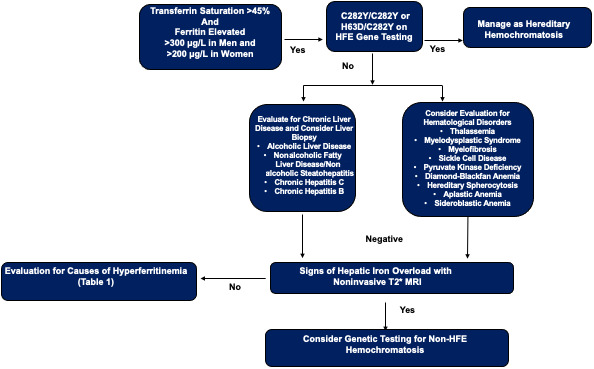
Iron overload disorders represent a variety of conditions that lead to increased total body iron stores and resultant end-organ damage. An elevated ferritin and transferrin-iron saturation can be commonly encountered in the evaluation of elevated liver enzymes. Confirmatory homeostatic iron regulator (HFE) genetic testing for C282Y and H63D, mutations most encountered in hereditary hemochromatosis, should be pursued in evaluation of hyperferritinemia. Magnetic resonance imaging with quantitative assessment of iron content or liver biopsy (especially if liver disease is a cause of iron overload) should be used as appropriate. A secondary cause for iron overload should be considered if HFE genetic testing is negative for the C282Y homozygous or C282Y/H63D compound heterozygous mutations. Differential diagnosis of secondary iron overload includes hematologic disorders, iatrogenic causes, or chronic liver diseases. More common hematologic disorders include thalassemia syndromes, myelodysplastic syndrome, myelofibrosis, sideroblastic anemias, sickle cell disease, or pyruvate kinase deficiency. If iron overload has been excluded, evaluation for causes of hyperferritinemia should be pursued. Causes of hyperferritinemia include chronic liver disease, malignancy, infections, kidney failure, and rheumatic conditions, such as adult-onset Still's disease or hemophagocytic lymphohistiocytosis. In this review, we describe the diagnostic testing of patients with suspected hereditary hemochromatosis, the evaluation of patients with elevated serum ferritin levels, and signs of secondary overload and treatment options for those with secondary iron overload.
铁过载疾病表现为多种导致体内铁总量增加并由此引发靶器官损伤的病症。在评估肝酶升高时,通常会遇到升高的铁蛋白和转铁蛋白铁饱和度。在评估高血铁蛋白症时,应进行常见于遗传性血色素沉着症的铁调素(HFE)基因 C282Y 和 H63D 突变的确认性内稳态调节因子(HFE)基因检测。如果 HFE 基因检测对 C282Y 纯合子或 C282Y/H63D 复合杂合突变呈阴性,应考虑铁过载的继发原因。如果排除铁过载,应进一步评估高血铁蛋白症的病因。高血铁蛋白症的病因包括慢性肝病、医源性原因或慢性肝脏疾病。更常见的血液系统疾病包括地中海贫血综合征、骨髓增生异常综合征、骨髓纤维化、铁幼粒细胞性贫血、镰状细胞病或丙酮酸激酶缺乏症。如果已经排除铁过载,则应进一步评估高血铁蛋白症的病因。高血铁蛋白症的病因包括慢性肝病、恶性肿瘤、感染、肾衰竭和风湿性疾病,如成人Still 病或噬血细胞性淋巴组织细胞增多症。在本综述中,我们描述了疑似遗传性血色素沉着症患者的诊断性检测、血清铁蛋白水平升高患者的评估以及继发过载的迹象和继发铁过载的治疗选择。