Department of Biophysics and Cell Biology, Faculty of Medicine, Research Center for Molecular Medicine, University of Debrecen, Debrecen, Hungary.
Departamento de Medicina Molecular y Bioprocesos, Instituto de Biotecnologia, Universidad Nacional Autónoma de México, Cuernavaca, Mexico.
J Gen Physiol. 2022 Aug 1;154(8). doi: 10.1085/jgp.202213146. Epub 2022 Jun 14.
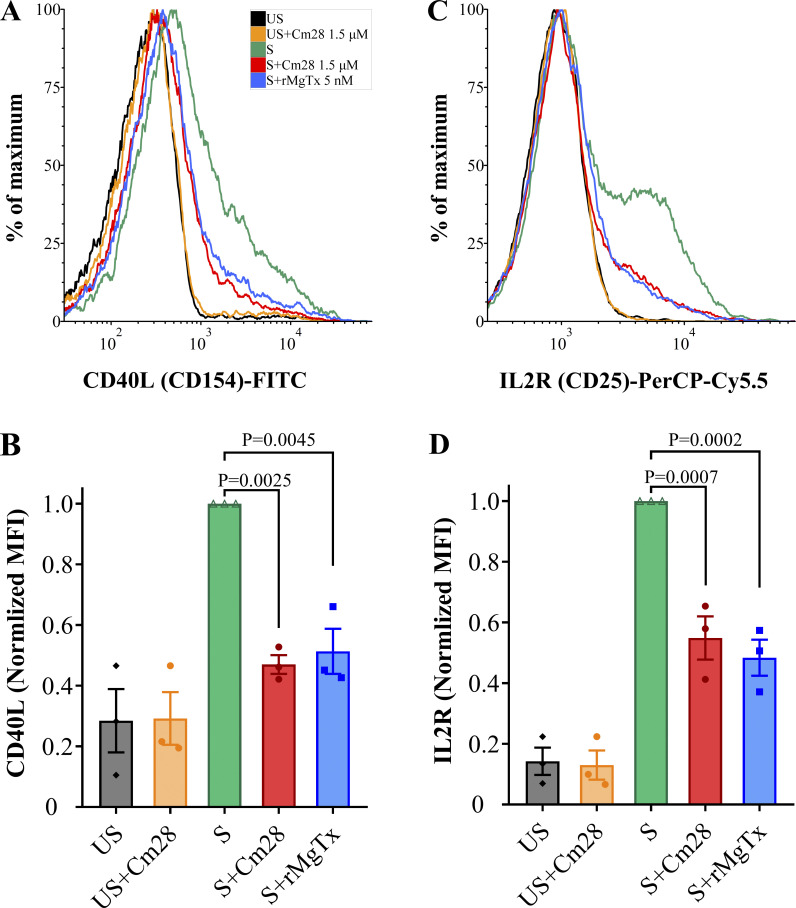
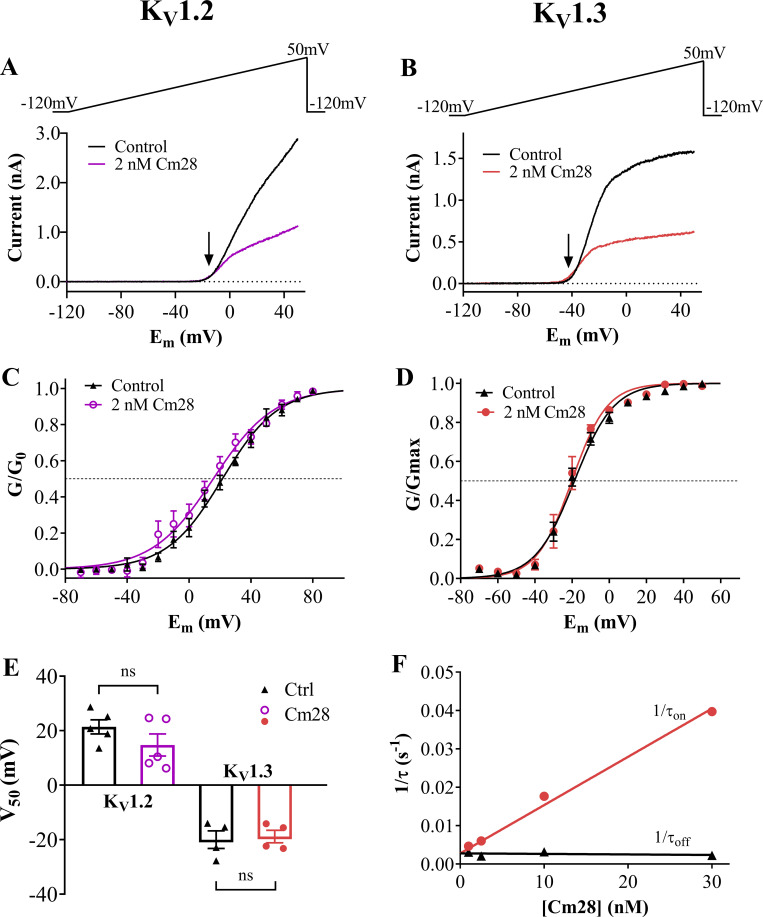
The Cm28 in the venom of Centruroides margaritatus is a short peptide consisting of 27 amino acid residues with a mol wt of 2,820 D. Cm28 has <40% similarity with other known α-KTx from scorpions and lacks the typical functional dyad (lysine-tyrosine) required to block KV channels. However, its unique sequence contains the three disulfide-bond traits of the α-KTx scorpion toxin family. We propose that Cm28 is the first example of a new subfamily of α-KTxs, registered with the systematic number α-KTx32.1. Cm28 inhibited voltage-gated K+ channels KV1.2 and KV1.3 with Kd values of 0.96 and 1.3 nM, respectively. There was no significant shift in the conductance-voltage (G-V) relationship for any of the channels in the presence of toxin. Toxin binding kinetics showed that the association and dissociation rates are consistent with a bimolecular interaction between the peptide and the channel. Based on these, we conclude that Cm28 is not a gating modifier but rather a pore blocker. In a selectivity assay, Cm28 at 150 nM concentration (>100× Kd value for KV1.3) did not inhibit KV1.5, KV11.1, KCa1.1, and KCa3.1 K+ channels; NaV1.5 and NaV1.4 Na+ channels; or the hHV1 H+ channel but blocked ∼27% of the KV1.1 current. In a biological functional assay, Cm28 strongly inhibited the expression of the activation markers interleukin-2 receptor and CD40 ligand in anti-CD3-activated human CD4+ effector memory T lymphocytes. Cm28, due to its unique structure, may serve as a template for the generation of novel peptides targeting KV1.3 in autoimmune diseases.
蛛形纲动物 Centruroides margaritatus 的毒液中的 Cm28 是一种由 27 个氨基酸残基组成的短肽,分子量为 2820D。Cm28 与其他已知的来自蝎子的α-KTx 具有<40%的相似性,并且缺乏阻断 KV 通道所需的典型功能二联体(赖氨酸-酪氨酸)。然而,它独特的序列包含α-KTx 蝎毒素家族的三个二硫键特征。我们提出 Cm28 是新型α-KTx 亚家族的第一个例子,其注册系统编号为α-KTx32.1。Cm28 以 0.96 和 1.3 nM 的 Kd 值分别抑制电压门控 K+通道 KV1.2 和 KV1.3。在毒素存在的情况下,任何通道的电导-电压(G-V)关系都没有明显的移动。毒素结合动力学表明,关联和离解速率与肽和通道之间的双分子相互作用一致。基于这些,我们得出结论,Cm28 不是门控调节剂,而是一种孔阻滞剂。在选择性测定中,浓度为 150 nM 的 Cm28(对 KV1.3 的 Kd 值>100×)不会抑制 KV1.5、KV11.1、KCa1.1 和 KCa3.1 K+通道;NaV1.5 和 NaV1.4 Na+通道;或 hHV1 H+通道,但可阻断约 27%的 KV1.1 电流。在生物功能测定中,Cm28 强烈抑制抗 CD3 激活的人 CD4+效应记忆 T 淋巴细胞中激活标志物白细胞介素 2 受体和 CD40 配体的表达。由于其独特的结构,Cm28 可能成为针对自身免疫性疾病中 KV1.3 的新型肽的模板。