Department of Disease Control, Faculty of Infectious and Tropical Diseases, London School of Hygiene and Tropical Medicine, London, UK.
Centro de Investigaciones en Microbiología y Biotecnología-UR (CIMBIUR), Facultad de Ciencias Naturales, Universidad del Rosario, Bogotá, Colombia.
Sci Rep. 2022 Jun 14;12(1):9849. doi: 10.1038/s41598-022-14051-x.
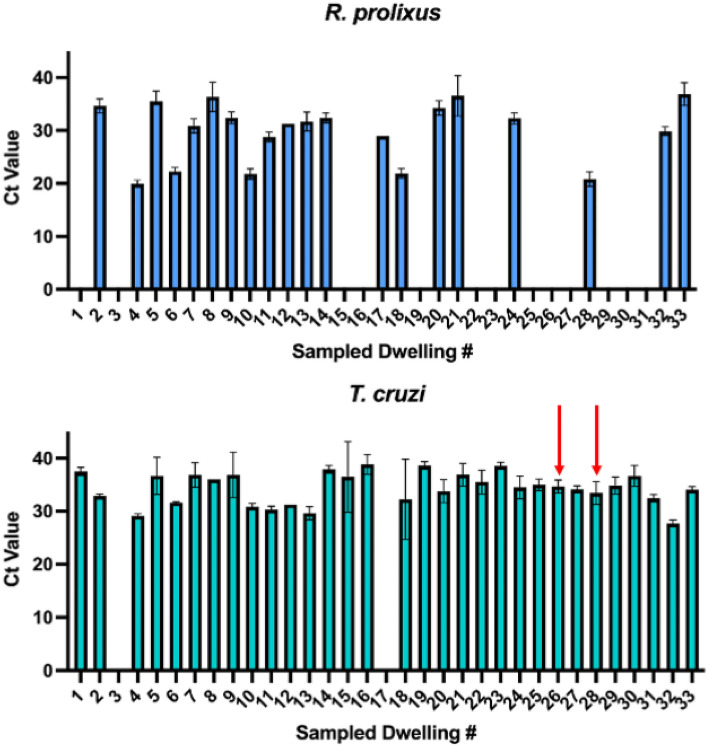
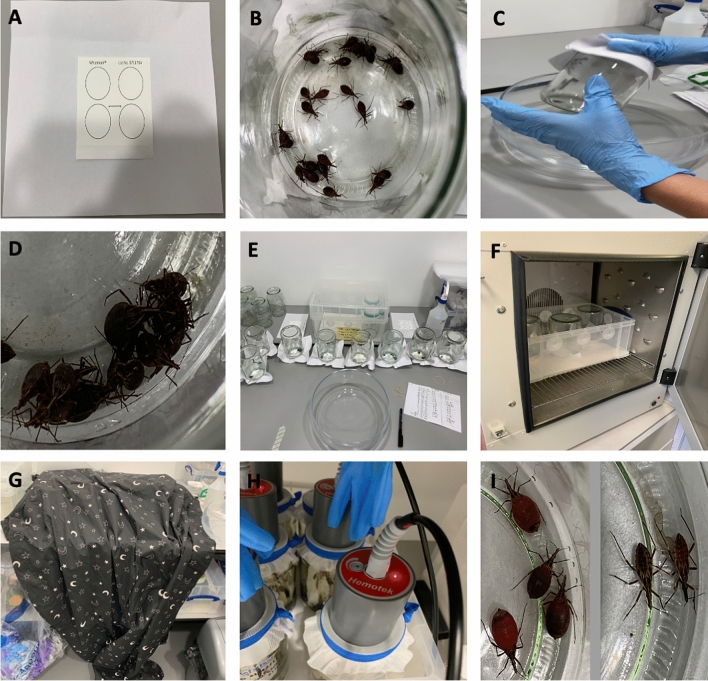
Chagas disease vector control relies on prompt, accurate identification of houses infested with triatomine bugs for targeted insecticide spraying. However, most current detection methods are laborious, lack standardization, have substantial operational costs and limited sensitivity, especially when triatomine bug densities are low or highly focal. We evaluated the use of FTA cards or cotton-tipped swabs to develop a low-technology, non-invasive method of detecting environmental DNA (eDNA) from both triatomine bugs and Trypanosoma cruzi for use in household surveillance in eastern Colombia, an endemic region for Chagas disease. Study findings demonstrated that Rhodnius prolixus eDNA, collected on FTA cards, can be detected at temperatures between 21 and 32 °C, when deposited by individual, recently blood-fed nymphs. Additionally, cotton-tipped swabs are a feasible tool for field sampling of both T. cruzi and R. prolixus eDNA in infested households and may be preferable due to their lower cost. eDNA detection should not yet replace current surveillance tools, but instead be evaluated in parallel as a more sensitive, higher-throughput, lower cost alternative. eDNA collection requires virtually no skills or resources in situ and therefore has the potential to be implemented in endemic communities as part of citizen science initiatives to control Chagas disease transmission.
恰加斯病的病媒控制依赖于迅速、准确地识别受三锥虫栖息的房屋,以便进行有针对性的杀虫剂喷洒。然而,大多数当前的检测方法都很费力,缺乏标准化,运营成本高,灵敏度有限,尤其是在三锥虫密度较低或高度集中的情况下。我们评估了使用 FTA 卡或棉签拭子来开发一种低技术、非侵入性的方法,从哥伦比亚东部恰加斯病流行地区的家庭环境中检测三锥虫和克氏锥虫的环境 DNA(eDNA)。研究结果表明,在 21 至 32°C 的温度下,当单个最近吸食过血液的若虫将其 eDNA 沉积在 FTA 卡上时,可以检测到 Rhodnius prolixus eDNA。此外,棉签拭子是一种可行的工具,可用于在受感染的家庭中采集 T. cruzi 和 R. prolixus eDNA,由于其成本较低,可能更具吸引力。eDNA 检测不应替代当前的监测工具,而应作为一种更敏感、高通量、低成本的替代方法进行平行评估。eDNA 采集几乎不需要现场的技能或资源,因此有可能作为控制恰加斯病传播的公民科学倡议的一部分,在流行地区的社区中实施。