Avirappattu George, Pach Iii Alfred, Locklear Clarence E, Briggs Anthony Q
Center for Data Analytics, School of Mathematical Sciences, Kean University, NJ, USA.
Department of Medical Sciences, Hackensack Meridian School of Medicine, Nutley, NJ, USA.
Prev Med Rep. 2022 Aug;28:101858. doi: 10.1016/j.pmedr.2022.101858. Epub 2022 Jun 10.
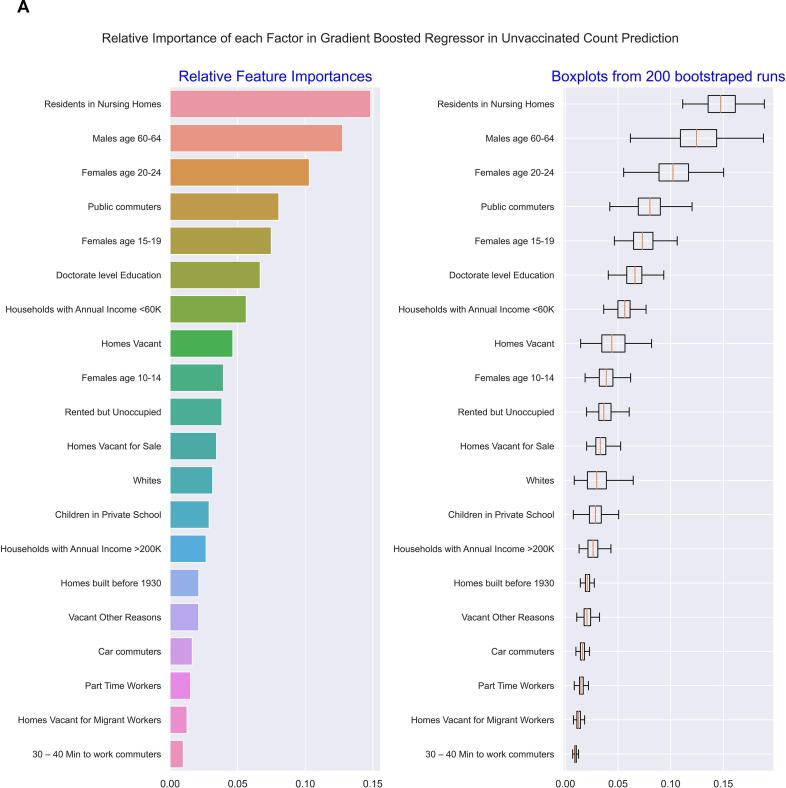
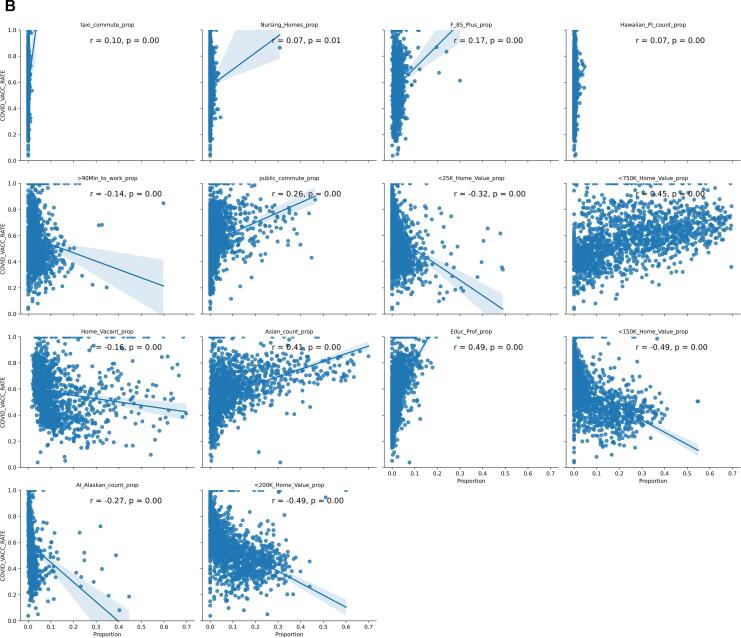
There is an urgent need for an in-depth and systematic assessment of a wide range of predictive factors related to populations most at risk for delaying and refusing COVID-19 vaccination as cases of the disease surge across the United States. Many studies have assessed a limited number of general sociodemographic and health-related factors related to low vaccination rates. Machine learning methods were used to assess the association of 151 social and health-related risk factors derived from the American Community Survey 2019 and the Centers for Disease Control and Prevention (CDC) BRFSS with the response variables of vaccination rates and unvaccinated counts in 1,555 ZIP Codes in California. The performance of various analytical models was evaluated according to their ability to regress between predictive variables and vaccination levels. Machine learning modeling identified the Gradient Boosting Regressor (GBR) as the predictive model with a higher percentage of the explained variance than the variance identified through linear and generalized regression models. A set of 20 variables explained 72.90% of the variability of unvaccinated counts among ZIP Codes in California. ZIP Codes were shown to be a more meaningful geo-local unit of analysis than county-level assessments. Modeling vaccination rates was not as effective as modeling unvaccinated counts. The public health utility of this model provides for the analysis of state and local conditions related to COVID-19 vaccination use and future public health problems and pandemics.
随着美国新冠肺炎病例激增,迫切需要对与延迟和拒绝接种新冠疫苗风险最高人群相关的一系列预测因素进行深入系统的评估。许多研究评估了与低疫苗接种率相关的有限数量的一般社会人口和健康相关因素。机器学习方法被用于评估从2019年美国社区调查和疾病控制与预防中心(CDC)行为危险因素监测系统(BRFSS)得出的151个社会和健康相关风险因素与加利福尼亚州1555个邮政编码区域的疫苗接种率和未接种人数响应变量之间的关联。根据各种分析模型在预测变量和疫苗接种水平之间进行回归的能力来评估其性能。机器学习建模确定梯度提升回归器(GBR)为预测模型,其解释方差的百分比高于通过线性和广义回归模型确定的方差。一组20个变量解释了加利福尼亚州邮政编码区域未接种人数变异性的72.90%。邮政编码区域被证明是比县级评估更有意义的地理分析单位。对疫苗接种率进行建模不如对未接种人数进行建模有效。该模型的公共卫生效用有助于分析与新冠疫苗接种使用以及未来公共卫生问题和大流行相关的州和地方情况。