Division of Gastroenterology and Hepatology, Department of Internal Medicine, Keio University School of Medicine, Shinjuku-ku, Tokyo, Japan.
Department of Surgery, Keio University School of Medicine, Tokyo, Japan.
Front Immunol. 2022 May 30;13:867351. doi: 10.3389/fimmu.2022.867351. eCollection 2022.
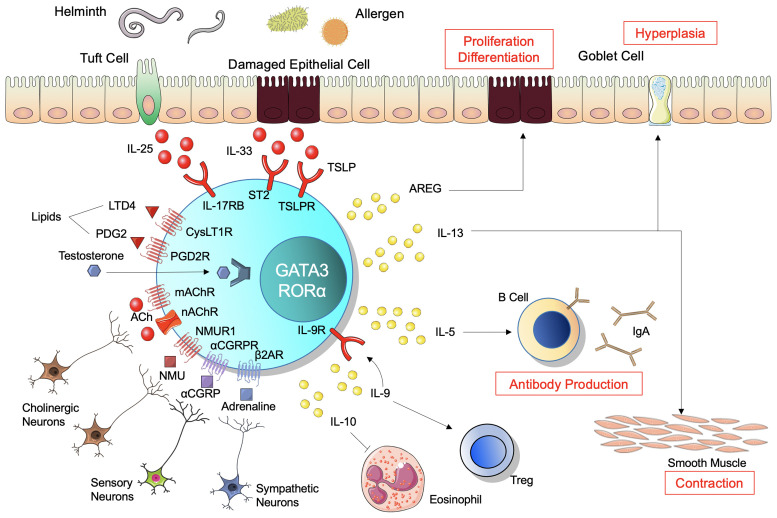
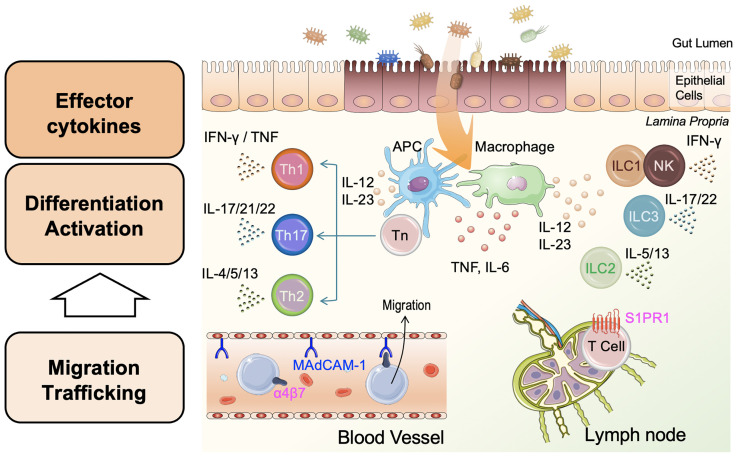
Group 2 innate lymphoid cells (ILC2s) were identified in 2010 as a novel lymphocyte subset lacking antigen receptors, such as T-cell or B-cell receptors. ILC2s induce local immune responses characterized by producing type 2 cytokines and play essential roles for maintaining tissue homeostasis. ILC2s are distributed across various organs, including the intestine where immune cells are continuously exposed to external antigens. Followed by luminal antigen stimulation, intestinal epithelial cells produce alarmins, such as IL-25, IL-33, and thymic stromal lymphopoietin, and activate ILC2s to expand and produce cytokines. In the context of parasite infection, the tuft cell lining in the epithelium has been revealed as a dominant source of intestinal IL-25 and possesses the capability to regulate ILC2 homeostasis. Neuronal systems also regulate ILC2s through neuropeptides and neurotransmitters, and interact with ILC2s bidirectionally, a process termed "neuro-immune crosstalk". Activated ILC2s produce type 2 cytokines, which contribute to epithelial barrier function, clearance of luminal antigens and tissue repair, while ILC2s are also involved in chronic inflammation and tissue fibrosis. Recent studies have shed light on the contribution of ILC2s to inflammatory bowel diseases, mainly comprising ulcerative colitis and Crohn's disease, as defined by chronic immune activation and inflammation. Modern single-cell analysis techniques provide a tissue-specific picture of ILC2s and their roles in regulating homeostasis in each organ. Particularly, single-cell analysis helps our understanding of the uniqueness and commonness of ILC2s across tissues and opens the novel research area of ILC2 heterogeneity. ILC2s are classified into different phenotypes depending on tissue and phase of inflammation, mainly inflammatory and natural ILC2 cells. ILC2s can also switch phenotype to ILC1- or ILC3-like subsets. Hence, recent studies have revealed the heterogeneity and plasticity of ILC2, which indicate dynamicity of inflammation and the immune system. In this review, we describe the regulatory mechanisms, function, and pathological roles of ILC2s in the intestine.
2 型固有淋巴细胞(ILC2)于 2010 年被鉴定为一种新型淋巴细胞亚群,缺乏抗原受体,如 T 细胞或 B 细胞受体。ILC2 诱导以产生 2 型细胞因子为特征的局部免疫反应,并在维持组织稳态方面发挥重要作用。ILC2 分布在各种器官中,包括肠道,免疫细胞不断暴露于外部抗原。在腔抗原刺激后,肠道上皮细胞产生警报素,如 IL-25、IL-33 和胸腺基质淋巴生成素,并激活 ILC2 以扩增和产生细胞因子。在寄生虫感染的情况下,上皮细胞的簇细胞衬里已被揭示为肠道中 IL-25 的主要来源,并具有调节 ILC2 稳态的能力。神经系统也通过神经肽和神经递质调节 ILC2,并与 ILC2 双向相互作用,这一过程称为“神经免疫串扰”。激活的 ILC2 产生 2 型细胞因子,有助于上皮屏障功能、腔抗原清除和组织修复,而 ILC2 也参与慢性炎症和组织纤维化。最近的研究揭示了 ILC2 对炎症性肠病(主要包括溃疡性结肠炎和克罗恩病)的贡献,这些疾病的特征是慢性免疫激活和炎症。现代单细胞分析技术提供了 ILC2 及其在调节每个器官稳态中的作用的组织特异性图片。特别是,单细胞分析有助于我们理解 ILC2 在组织间的独特性和共性,并开辟了 ILC2 异质性的新研究领域。根据组织和炎症阶段,ILC2 分为不同的表型,主要是炎症性和天然 ILC2 细胞。ILC2 还可以向 ILC1 或 ILC3 样亚群转化表型。因此,最近的研究揭示了 ILC2 的异质性和可塑性,这表明了炎症和免疫系统的动态性。在这篇综述中,我们描述了 ILC2 在肠道中的调节机制、功能和病理作用。