Department of Obstetrics, Shanghai Key Laboratory of Maternal Fetal Medicine, Shanghai First Maternity and Infant Hospital, School of Medicine, Tongji University, Shanghai, China.
J Clin Lab Anal. 2022 Jul;36(7):e24559. doi: 10.1002/jcla.24559. Epub 2022 Jun 16.
T-helper (Th) cells regulate inflammation and immunity, which is implicated in psychological disorders. The current study aimed to explore the clinical role of blood Th1, Th2, and Th17 cells and their main secreted cytokines in postpartum depression (PPD) and postpartum anxiety (PPA).
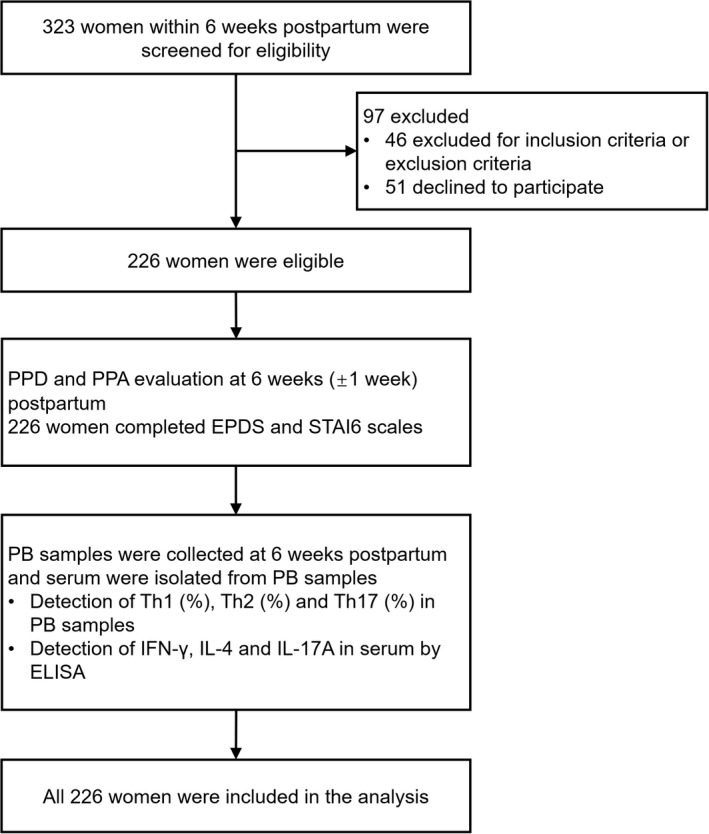
A total of 226 postpartum women were included. At 6 weeks postpartum, Edinburgh Postnatal Depression Scale (EPDS) and State Trait Anxiety Inventory 6 item version (STAI6) scores were assessed; meanwhile, blood Th1, Th2, and Th17 cells were detected by flow cytometry, serum interferon-gamma (IFN-γ), interleukin-4 (IL-4), and IL-17A were detected by enzyme-linked immunosorbent assay.
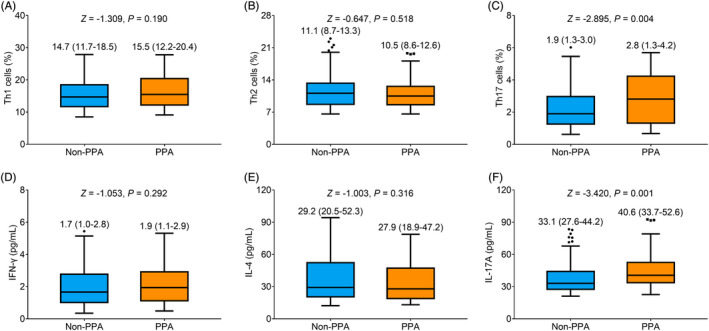
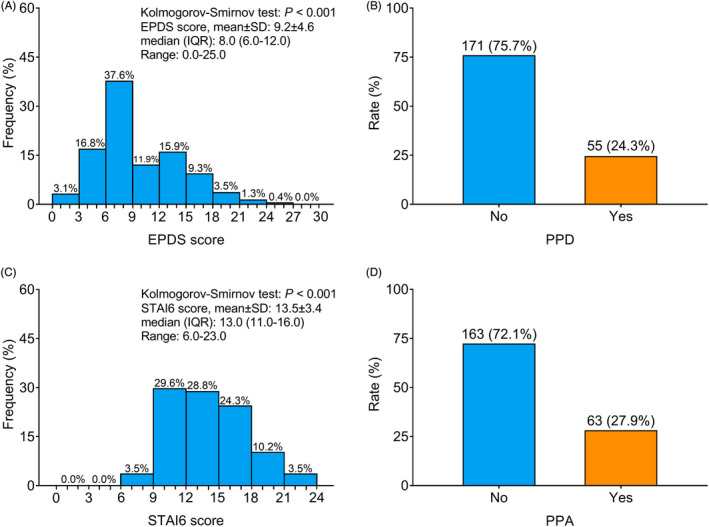
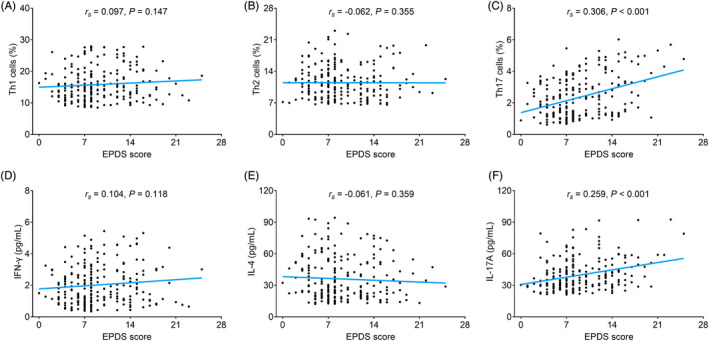
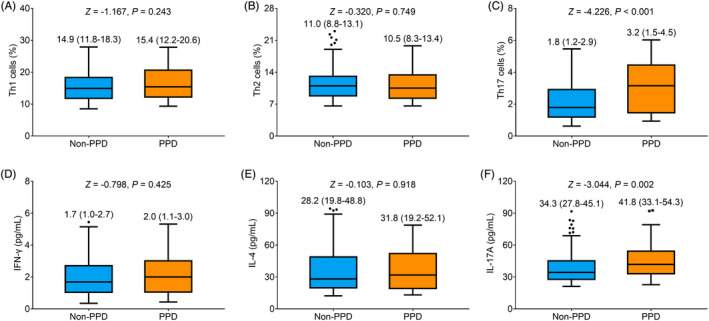
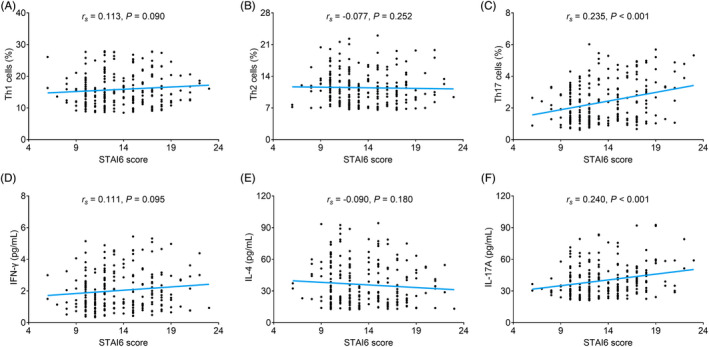
The incidence of PPD and PPA were 24.3% and 27.9%, respectively. Th17 cells and IL-17A were positively correlated with EPDS score and STAI6 score (all p < 0.001). Besides, Th17 cells (p < 0.001) and IL-17A (p = 0.002) were increased in PPD cases vs. non-PPD cases, and they were also elevated in PPA cases vs. non-PPA cases (both p < 0.05). However, Th1 cells, Th2 cells, IFN-γ, and IL-4 were not linked with EPDS score or STAI6 score (all p > 0.05); besides, they did not vary in PPD cases vs. non-PPD cases or in PPA cases vs. non-PPA cases (all p > 0.05). Multivariate logistic regression model analysis showed that Th17 cells were independently associated with an elevated risk of PPD (odds ratio [OR] = 1.600, p = 0.001) and PPA (OR = 1.371, p = 0.022).
Blood Th17 cells and IL-17A are positively linked with the risk of PPD and PPA, indicating which may be involved in the development of PPD and PPA.
辅助性 T 细胞(Th)调节炎症和免疫,这与心理障碍有关。本研究旨在探讨产后抑郁症(PPD)和产后焦虑症(PPA)患者血液 Th1、Th2 和 Th17 细胞及其主要分泌细胞因子的临床作用。
共纳入 226 名产后妇女。产后 6 周时,采用爱丁堡产后抑郁量表(EPDS)和状态特质焦虑量表 6 项版(STAI6)进行评估;同时,采用流式细胞术检测血液 Th1、Th2 和 Th17 细胞,酶联免疫吸附试验检测血清干扰素-γ(IFN-γ)、白细胞介素-4(IL-4)和白细胞介素-17A(IL-17A)。
PPD 和 PPA 的发生率分别为 24.3%和 27.9%。Th17 细胞和 IL-17A 与 EPDS 评分和 STAI6 评分呈正相关(均 p<0.001)。此外,PPD 组 Th17 细胞(p<0.001)和 IL-17A(p=0.002)高于非 PPD 组,PPA 组 Th17 细胞(p<0.001)和 IL-17A(p=0.002)高于非 PPA 组(均 p<0.05)。然而,Th1 细胞、Th2 细胞、IFN-γ 和 IL-4 与 EPDS 评分或 STAI6 评分无关(均 p>0.05);此外,它们在 PPD 组与非 PPD 组之间或 PPA 组与非 PPA 组之间没有差异(均 p>0.05)。多因素 logistic 回归模型分析表明,Th17 细胞与 PPD(比值比[OR] = 1.600,p = 0.001)和 PPA(OR = 1.371,p = 0.022)的发病风险升高独立相关。
血液 Th17 细胞和 IL-17A 与 PPD 和 PPA 的发病风险呈正相关,表明其可能参与了 PPD 和 PPA 的发生发展。