Cardiovascular Epidemiology Unit, University of Cambridge, Cambridge, UK.
Department of Public Health and Primary Care, School of Clinical Medicine, University of Cambridge, Cambridge, UK; Centre for Infectious Disease Genomics and One Health, Faculty of Health Sciences, Simon Fraser University, Burnaby, BC, Canada.
Lancet Planet Health. 2022 Jun;6(6):e504-e523. doi: 10.1016/S2542-5196(22)00088-2.
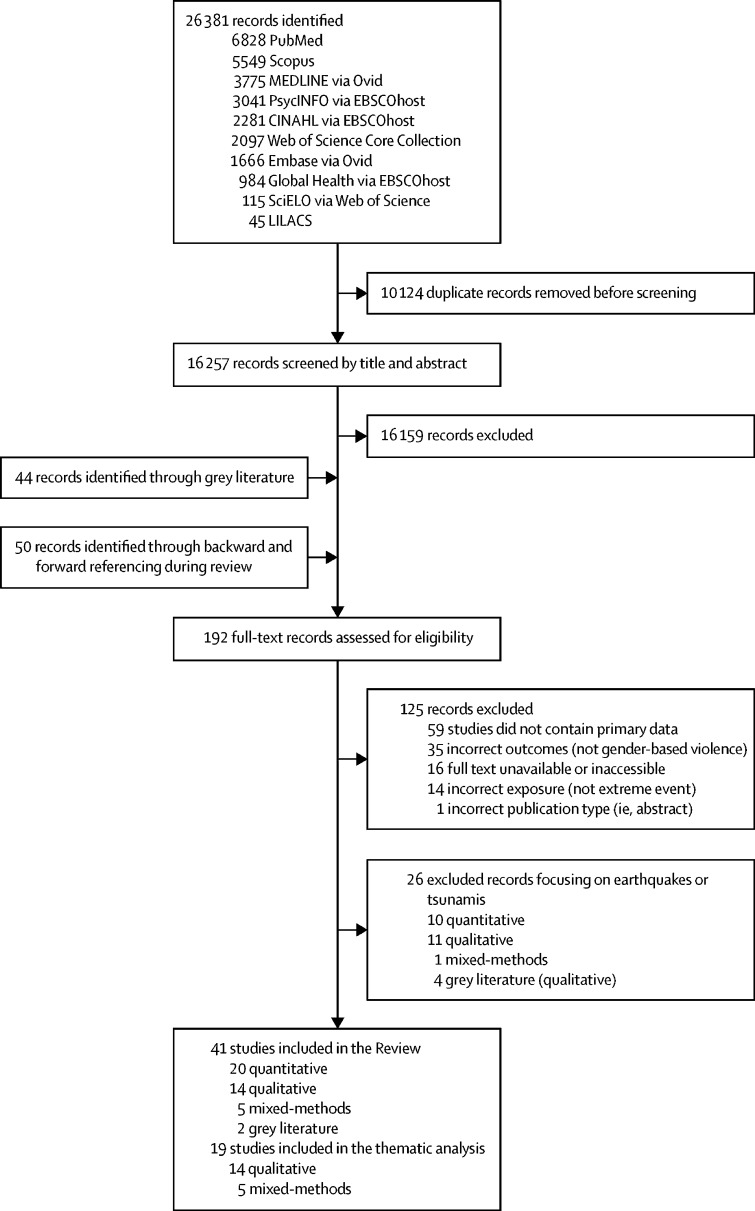
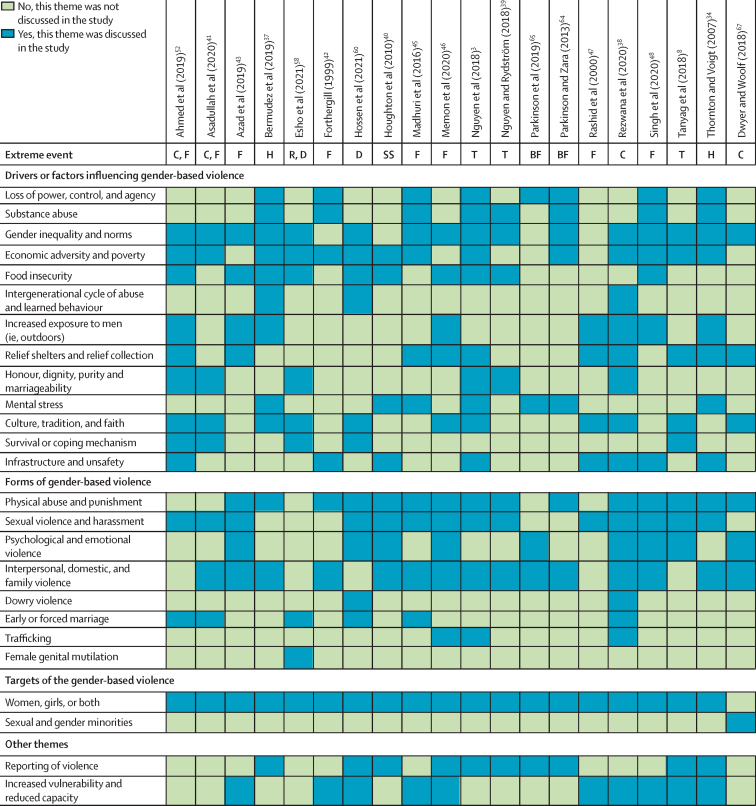
The intensity and frequency of extreme weather and climate events are expected to increase due to anthropogenic climate change. This systematic review explores extreme events and their effect on gender-based violence (GBV) experienced by women, girls, and sexual and gender minorities. We searched ten databases until February, 2022. Grey literature was searched using the websites of key organisations working on GBV and Google. Quantitative studies were described narratively, whereas qualitative studies underwent thematic analysis. We identified 26 381 manuscripts. 41 studies were included exploring several types of extreme events (ie, storms, floods, droughts, heatwaves, and wildfires) and GBV (eg, sexual violence and harassment, physical violence, witch killing, early or forced marriage, and emotional violence). Studies were predominantly cross-sectional. Although most qualitative studies were of reasonable quality, most quantitative studies were of poor quality. Only one study included sexual and gender minorities. Most studies showed an increase in one or several GBV forms during or after extreme events, often related to economic instability, food insecurity, mental stress, disrupted infrastructure, increased exposure to men, tradition, and exacerbated gender inequality. These findings could have important implications for sexual-transformative and gender-transformative interventions, policies, and implementation. High-quality evidence from large, ethnographically diverse cohorts is essential to explore the effects and driving factors of GBV during and after extreme events.
由于人为气候变化,预计极端天气和气候事件的强度和频率将会增加。本系统评价探讨了极端事件及其对妇女、女孩和性少数群体及性别少数群体经历的基于性别的暴力(GBV)的影响。我们搜索了十个数据库,截至 2022 年 2 月。使用专门从事 GBV 工作的主要组织的网站和谷歌搜索了灰色文献。定量研究以叙述性方式进行描述,而定性研究则进行了主题分析。我们确定了 26381 篇手稿。纳入了 41 项研究,探讨了几种类型的极端事件(如风暴、洪水、干旱、热浪和野火)和 GBV(如性暴力和骚扰、身体暴力、女巫杀害、早婚或强迫婚姻以及情绪暴力)。研究主要是横断面研究。尽管大多数定性研究的质量都相当好,但大多数定量研究的质量都很差。只有一项研究包括性少数群体和性别少数群体。大多数研究表明,在极端事件期间或之后,一种或几种 GBV 形式有所增加,这通常与经济不稳定、粮食不安全、精神压力、基础设施中断、更多接触男性、传统和加剧的性别不平等有关。这些发现可能对性变革和性别变革干预措施、政策和实施具有重要意义。需要来自大的、人种学上多样化的队列的高质量证据来探讨极端事件期间和之后 GBV 的影响和驱动因素。