Tan Jing-Yu Benjamin, Zhai Jianxia, Wang Tao, Zhou Hong-Juan, Zhao Isabella, Liu Xian-Liang
Charles Darwin University, College of Nursing and Midwifery, Casuarina, NT, Australia.
Charles Darwin University, College of Nursing and Midwifery, Melbourne Hub, Melbourne, VIC, Australia.
Front Oncol. 2022 May 30;12:866284. doi: 10.3389/fonc.2022.866284. eCollection 2022.
A growing number of clinical practice guidelines (CPGs) regarding non-pharmacological interventions for breast cancer survivors are available. However, given the limitations in guideline development methodologies and inconsistent recommendations, it remains uncertain how best to design and implement non-pharmacological strategies to tailor interventions for breast cancer survivors with varied health conditions, healthcare needs, and preferences.
To critically appraise and summarise available non-pharmacological interventions for symptom management and health promotion that can be self-managed by breast cancer survivors based on the recommendations of the CPGs.
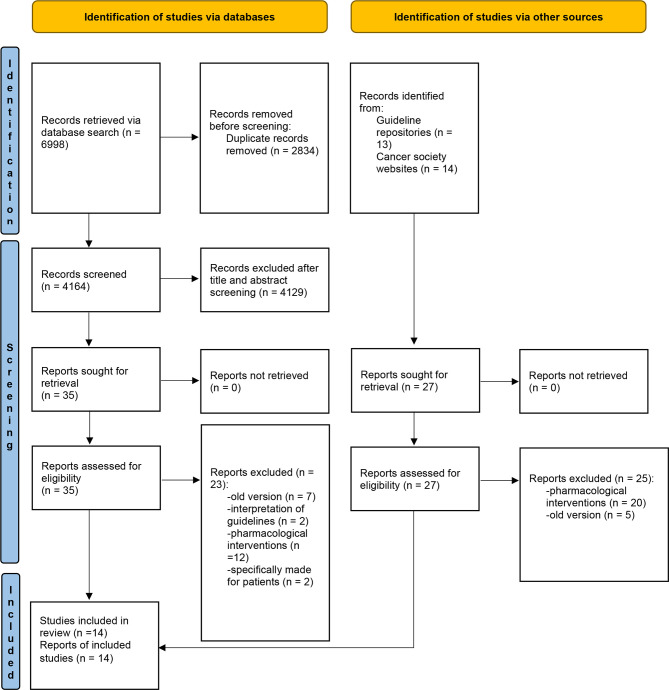
CPGs, which were published between January 2016 and September 2021 and described non-pharmacological interventions for breast cancer survivors, were systematically searched in six electronic databases, nine relevant guideline databases, and five cancer care society websites. The quality of the included CPGs was assessed by four evaluators using The Appraisal of Guidelines for Research and Evaluation, second edition tool. Content analysis was conducted to synthesise the characteristics of the non-pharmacological interventions recommended by the included CPGs, such as the intervention's form, duration and frequency, level of evidence, grade of recommendation, and source of evidence.
A total of 14 CPGs were included. Among which, only five were appraised as high quality. The "range and purpose" domain had the highest standardized percentage (84.61%), while the domain of "applicability" had the lowest (51.04%). Five CPGs were rated "recommended", seven were "recommended with modifications", and the other two were rated "not recommended". The content analysis findings summarised some commonly recommended self-managed non-pharmacological interventions in the 14 guidelines, including physical activity/exercise, meditation, hypnosis, yoga, music therapy, stress management, relaxation, massage and acupressure. Physical activity/exercise was the most frequently recommended approach to managing psychological and physical symptoms by the included guidelines. However, significant variations in the level of evidence and grade of recommendation were identified among the included CPGs.
Recommendations for the self-managed non-pharmacological interventions were varied and limited among the 14 CPGs, and some were based on medium- and low-quality evidence. More rigorous methods are required to develop high-quality CPGs to guide clinicians in offering high-quality and tailored breast cancer survivorship care.
关于乳腺癌幸存者非药物干预措施的临床实践指南(CPG)数量日益增多。然而,鉴于指南制定方法的局限性以及建议的不一致性,如何最好地设计和实施非药物策略,为健康状况、医疗需求和偏好各异的乳腺癌幸存者量身定制干预措施,仍不明确。
根据CPG的建议,批判性地评估和总结可由乳腺癌幸存者自我管理的、用于症状管理和健康促进的非药物干预措施。
在六个电子数据库、九个相关指南数据库和五个癌症护理协会网站中系统检索2016年1月至2021年9月期间发表的、描述乳腺癌幸存者非药物干预措施的CPG。由四名评估人员使用《研究与评价指南评估》第二版工具对纳入的CPG质量进行评估。进行内容分析,以综合纳入的CPG推荐的非药物干预措施的特点,如干预形式、持续时间和频率、证据水平、推荐等级以及证据来源。
共纳入14项CPG。其中,只有五项被评定为高质量。“范围和目的”领域的标准化百分比最高(84.61%),而“适用性”领域最低(51.04%)。五项CPG被评为“推荐”,七项“经修改后推荐”,另外两项被评为“不推荐”。内容分析结果总结了14项指南中一些常见的推荐自我管理非药物干预措施,包括体育活动/锻炼、冥想、催眠、瑜伽、音乐疗法、压力管理、放松、按摩和指压。体育活动/锻炼是纳入指南中最常推荐的用于管理心理和身体症状的方法。然而,纳入的CPG之间在证据水平和推荐等级上存在显著差异。
14项CPG中关于自我管理非药物干预措施的建议各不相同且有限,有些基于中低质量证据。需要更严格的方法来制定高质量CPG,以指导临床医生提供高质量的、量身定制的乳腺癌幸存者护理。