Department of Epidemiology and Biostatistics, School of Public Health, Xi'an Jiaotong University Health Science Center, Xi'an, Shaanxi, China.
Center for Chronic Diseases Control and Prevention, Global Health Institute, School of Public Health, Xi'an Jiaotong University Health Science Center, Xi'an, Shaanxi, China.
Matern Child Nutr. 2022 Oct;18(4):e13390. doi: 10.1111/mcn.13390. Epub 2022 Jun 16.
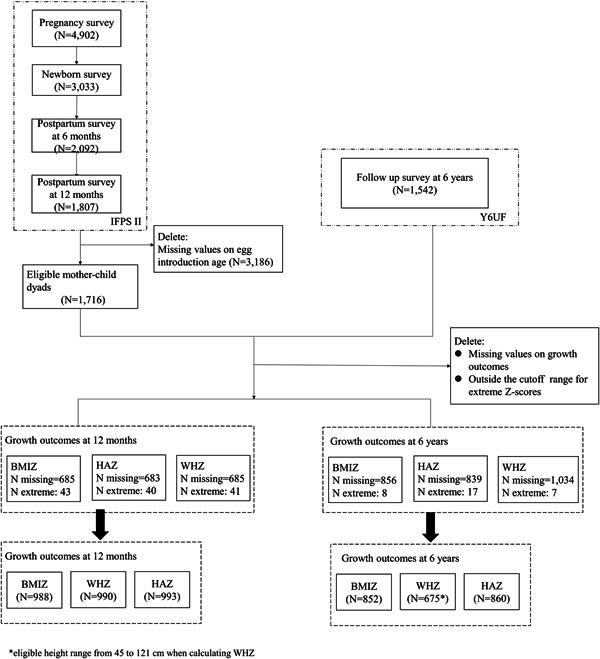
To evaluate the relationship between infant age of egg introduction and malnutrition-related growth outcomes in the United States, we analysed secondary data of 1716 mother-child dyads in the Infant Feeding Practices Study II and its Year 6 Follow-Up Study. Malnutrition-related growth outcomes included body mass index z-score (BMIZ), obesity (weight-for-height z-score [WHZ] ≥3 or BMIZ ≥ 2), WHZ, wasting (WHZ < -2), height-for-age z-score (HAZ), and stunting (HAZ < -2). Infant age at egg introduction was analysed as a continuous variable. We used generalised estimating equations to estimate the mean difference in continuous outcomes and relative risk [RR]) for binary outcomes, adjusting for related maternal and child confounders. We also explored interactions with child sex, maternal race/ethnicity, maternal educational level, ever breastfeeding, and formula feeding. In the total sample, a later infant age at egg introduction was associated with a lower mean difference in HAZ (confounder-adjusted mean difference = -0.08, 95% confidence interval [CI]: -0.12 to -0.03 per month) and a higher risk of stunting (confounder-adjusted RR = 1.17, 95% CI: 1.03-1.33 per month) at 6 years. The associations between infant age at egg introduction and 12-month growth outcomes differed by child sex. Among females but not among males, later introduction of eggs was associated with a lower mean WHZ (-0.06 [-0.12 to 0.00] per month) at 12 months. Later egg introduction during infancy was associated with a lower mean HAZ and a higher risk of stunting in 6-year-old children. Besides this, it was associated with a lower WHZ among females at 12 months.
为了评估美国婴儿引入蛋类年龄与营养相关生长结果之间的关系,我们分析了婴儿喂养实践研究 II 及其第 6 年随访研究中的 1716 对母婴对子的数据。营养相关生长结果包括体重指数 z 分数(BMIZ)、肥胖(体重身高 z 分数 [WHZ]≥3 或 BMIZ≥2)、WHZ、消瘦(WHZ<-2)、身高年龄 z 分数(HAZ)和发育迟缓(HAZ<-2)。婴儿引入蛋类的年龄被分析为连续变量。我们使用广义估计方程来估计连续结果的均值差异和二项结果的相对风险 [RR],同时调整了相关的母婴混杂因素。我们还探讨了与儿童性别、母亲种族/民族、母亲教育程度、母乳喂养和配方奶喂养的交互作用。在总样本中,婴儿引入蛋类的年龄较晚与 HAZ 的平均差异较小(调整混杂因素后的平均差异= -0.08,95%置信区间 [CI]:-0.12 至 -0.03 每月)和 6 岁时发育迟缓的风险较高(调整混杂因素后的 RR=1.17,95% CI:每月 1.03-1.33)相关。婴儿引入蛋类年龄与 12 个月生长结果之间的关联因儿童性别而异。在女性中,但不在男性中,较晚引入蛋类与 12 个月时较低的平均 WHZ(-0.06[-0.12 至 0.00]每月)相关。婴儿期较晚引入蛋类与 6 岁儿童的 HAZ 较低和发育迟缓风险较高有关。除此之外,它还与 12 个月时女性的较低 WHZ 相关。