Research Triangle Institute International, Durham, NC, USA.
Department of Community Health Sciences, Aga Khan University, Karachi, Pakistan.
Lancet Glob Health. 2022 Jul;10(7):e970-e977. doi: 10.1016/S2214-109X(22)00180-2.
South Asia contributes more than a third of all global stillbirths, yet the causes remain largely unstudied in this region. New investigations, including novel assessments of placental and fetal tissues, facilitate more precise determination of the underlying causes of stillbirth. We sought to assess underlying and contributing causes of stillbirth from settings in India and Pakistan.
In this prospective cohort study (PURPOSe), we report the cause of death in stillbirths in hospitals in central India and south Pakistan (Davangere, India [three public and private hospitals] and Karachi, Pakistan [one public maternity and one children's hospital]). Women aged 15 years or older and with a known stillbirth (defined as a pregnancy at 20 or more weeks of gestation with the in-utero death of a fetus) weighing 1000 g or more were included in the study. Maternal clinical factors, placental evaluation, fetal tissue evaluation (from minimally invasive tissue sampling), and PCR for microbial pathogens were used to identify the causes of death. An expert panel reviewed available data for all stillbirths to identify the primary and contributing maternal, placental, and fetal causes of stillbirth.
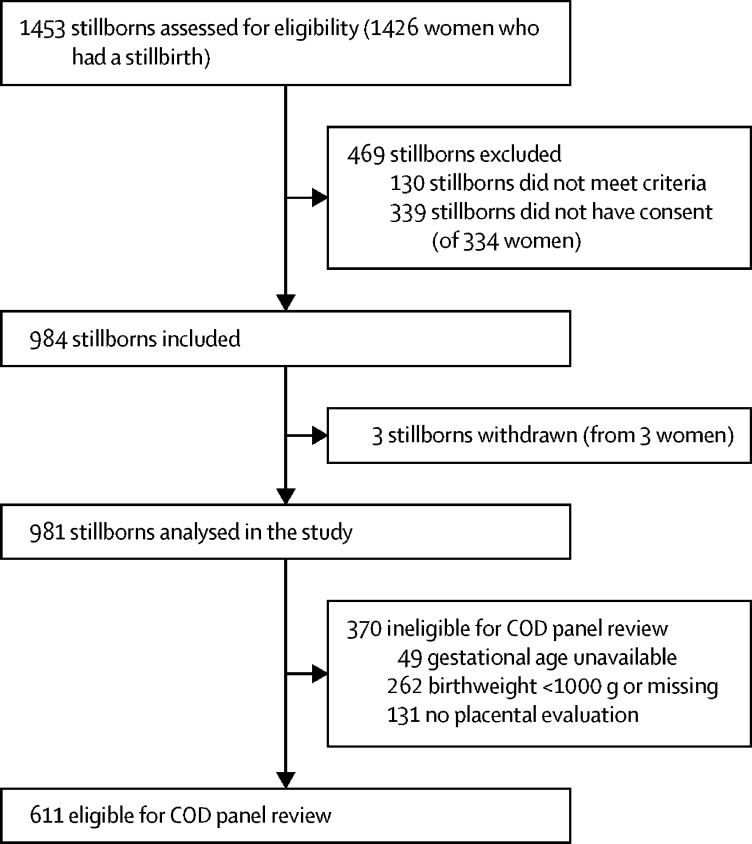
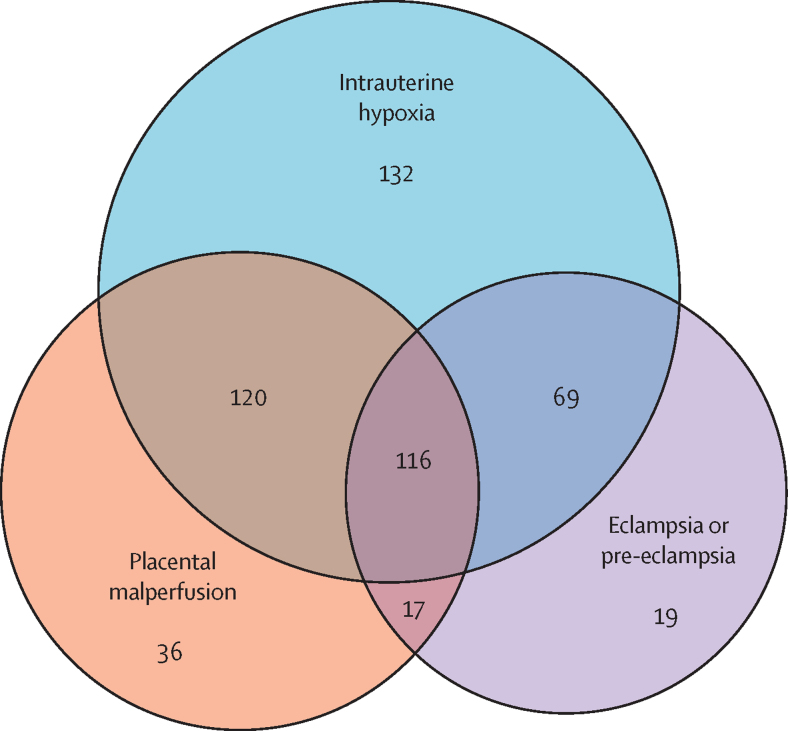
Between Sept 1, 2018, and Feb 12, 2020, 981 stillborns were included and, of those, 611 were reviewed by the expert panel. The primary maternal causes of stillbirth were hypertensive disease in 221 (36%) of 611 stillbirths, followed by severe anaemia in 66 (11%) stillbirths. The primary placental causes were maternal and fetal vascular malperfusion, in 289 (47%) stillbirths. The primary fetal cause of stillbirth was intrauterine hypoxia, in 437 (72%) stillbirths. We assessed the overlap of main causes and 116 (19%) stillbirths had intrauterine hypoxia, placental malperfusion, and eclampsia or pre-eclampsia indicated as primary causes of death. Infection (including of the placenta, its membranes, and in the fetus) and congenital anomalies also were causative of stillbirth.
In south Asia, fetal asphyxia is the major cause of stillbirth. Several placental lesions, especially those associated with maternal and fetal vascular malperfusion and placental abruption, have an important role in asphyxia and fetal death. Maternal hypertension, and especially pre-eclampsia, is often the primary maternal condition associated with this pathway.
Bill & Melinda Gates Foundation.
南亚地区的全球死胎发生率超过三分之一,但该地区对死胎的病因仍缺乏深入研究。新的研究,包括对胎盘和胎儿组织的新评估,有助于更准确地确定死胎的根本原因。我们试图评估印度和巴基斯坦部分地区死胎的根本原因和促成原因。
在这项前瞻性队列研究(PURPOSe)中,我们报告了印度中央邦和巴基斯坦南部(印度的达万格雷[三家公立医院和私立医院]和巴基斯坦的卡拉奇[一家公立医院和一家儿童医院])医院中死胎的死因。本研究纳入了年龄在 15 岁及以上、已知死产(定义为妊娠 20 周或以上,胎儿在子宫内死亡)、体重 1000 克及以上的女性。研究采用了母体临床因素、胎盘评估、胎儿组织评估(微创组织取样)和微生物病原体 PCR 来确定死因。一个专家小组审查了所有死胎的现有数据,以确定死胎的主要和促成性母体、胎盘和胎儿病因。
在 2018 年 9 月 1 日至 2020 年 2 月 12 日期间,共纳入了 981 例死产儿,其中有 611 例由专家小组进行了审查。死胎的主要母体病因是高血压疾病,占 611 例死胎的 221 例(36%),其次是严重贫血,占 66 例(11%)。主要胎盘病因是母体和胎儿血管灌注不良,占 289 例(47%)死胎。死胎的主要胎儿病因是宫内缺氧,占 437 例(72%)死胎。我们评估了主要病因的重叠情况,有 116 例(19%)死胎的宫内缺氧、胎盘灌注不良、子痫或先兆子痫被列为死亡的主要原因。感染(包括胎盘、胎膜和胎儿)和先天性异常也是导致死胎的原因。
在南亚地区,胎儿窒息是死胎的主要原因。几种胎盘病变,尤其是与母体和胎儿血管灌注不良以及胎盘早剥相关的病变,在窒息和胎儿死亡中起着重要作用。母体高血压,尤其是子痫前期,往往是与该途径相关的主要母体疾病。
比尔及梅琳达·盖茨基金会。