International Business and Economics Department, The Bucharest University of Economic Studies, 010374, Bucharest, Romania.
Management Information Systems Department, The Bucharest University of Economic Studies, 010374, Bucharest, Romania.
Sci Rep. 2022 Jun 17;12(1):10253. doi: 10.1038/s41598-022-13663-7.
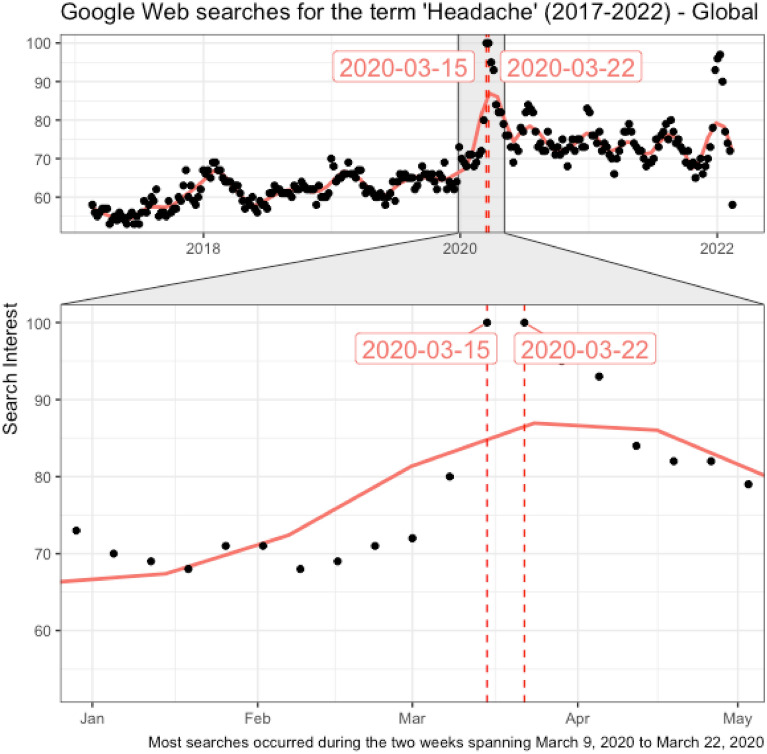
The analysis of the public interest as reflected by Internet queries has become a highly valuable tool in many fields. The Google Trends platform, providing timely and informative data, has become increasingly popular in health and medical studies. This study explores whether Internet search frequencies for the keyword "headache" have been increasing after the COVID-19 pandemic outbreak, which could signal an increased incidence of the health problem. Weekly search volume data for 5 years spanning February 2017 to February 2022 were sourced from Google Trends. Six statistical and machine-learning methods were implemented on training and testing sets via pre-set automated forecasting algorithms. Holt-Winters has been identified as overperforming in predicting web query trends through several accuracy measures and the DM test for forecasting superiority and has been employed for producing the baseline level in the estimation of excess query level over the first pandemic wave. Findings indicate that the COVID-19 pandemic resulted in an increased global incidence of headache (as proxied by related web queries) in the first 6 months after its outbreak, with an excess occurrence of 4.53% globally. However, the study also concludes that the increasing trend in headache incidence at the world level would have continued in the absence of the pandemic, but it has been accelerated by the pandemic event. Results further show mixed correlations at the country-level between COVID-19 infection rates and population web-search behavior, suggesting that the increased headache incidence is caused by pandemic-related factors (i.e. increased stress and mental health problems), rather than a direct effect of coronavirus infections. Other noteworthy findings entail that in the Philippines, the term "headache" was the most frequently searched term in the period spanning February 2020 to February 2022, indicating that headache occurrences are a significant aspect that defines population health at the country level. High relative interest is also detected in Kenya and South Africa after the pandemic outbreak. Additionally, research findings indicate that the relative interest has decreased in some countries (i.e. US, Canada, and Australia), whereas it has increased in others (i.e. India and Pakistan) after the pandemic outbreak. We conclude that observing Internet search habits can provide timely information for policymakers on collective health trends, as opposed to ex-post statistics, and can furthermore yield valuable information for the pain management drug market key players about aggregate consumer behavior.
互联网查询反映的公共利益分析已成为许多领域非常有价值的工具。Google Trends 平台提供及时且丰富的信息,在健康和医学研究中越来越受欢迎。本研究探讨了 COVID-19 大流行爆发后,关键字“头痛”的互联网搜索频率是否增加,这可能表明该健康问题的发病率增加。我们从 Google Trends 中获取了 2017 年 2 月至 2022 年 2 月 5 年的每周搜索量数据。通过预设的自动预测算法,在训练和测试集上实施了六种统计和机器学习方法。通过多个准确性度量和用于预测优势的 DM 检验,Holt-Winters 被确定为在预测网络查询趋势方面表现出色,并被用于产生基线水平,以估计首次大流行浪潮期间超过查询水平的过量水平。研究结果表明,COVID-19 大流行导致大流行爆发后 6 个月内全球头痛发病率(通过相关网络查询代理)增加,全球发病率增加 4.53%。然而,研究还得出结论,即使没有大流行,全球头痛发病率的上升趋势也会继续,但大流行事件加速了这一趋势。结果进一步表明,在国家层面上,COVID-19 感染率和人口网络搜索行为之间存在混合相关性,这表明头痛发病率的增加是由大流行相关因素(即增加的压力和心理健康问题)引起的,而不是冠状病毒感染的直接影响。其他值得注意的发现包括,在菲律宾,“头痛”一词是 2020 年 2 月至 2022 年 2 月期间搜索次数最多的词,这表明头痛发作是定义国家层面人口健康的一个重要方面。大流行爆发后,肯尼亚和南非的相对关注度也很高。此外,研究结果表明,大流行爆发后,一些国家(即美国、加拿大和澳大利亚)的相对关注度有所下降,而另一些国家(即印度和巴基斯坦)的相对关注度有所上升。我们的结论是,观察互联网搜索习惯可以为政策制定者提供关于集体健康趋势的及时信息,而不是事后统计信息,并且可以为疼痛管理药物市场的主要参与者提供有关总体消费者行为的有价值信息。