• 文献检索
  • 文档翻译
  • 深度研究
  • 学术资讯
  • Suppr Zotero 插件Zotero 插件
  • 邀请有礼
  • 套餐&价格
  • 历史记录
应用&插件
Suppr Zotero 插件Zotero 插件浏览器插件Mac 客户端Windows 客户端微信小程序
定价
高级版会员购买积分包购买API积分包
服务
文献检索文档翻译深度研究API 文档MCP 服务
关于我们
关于 Suppr公司介绍联系我们用户协议隐私条款
关注我们

Suppr 超能文献

核心技术专利:CN118964589B侵权必究
粤ICP备2023148730 号-1Suppr @ 2026

文献检索

告别复杂PubMed语法,用中文像聊天一样搜索,搜遍4000万医学文献。AI智能推荐,让科研检索更轻松。

立即免费搜索

文件翻译

保留排版,准确专业,支持PDF/Word/PPT等文件格式,支持 12+语言互译。

免费翻译文档

深度研究

AI帮你快速写综述,25分钟生成高质量综述,智能提取关键信息,辅助科研写作。

立即免费体验

美国胃肠道症状搜索查询兴趣与 COVID-19 诊断的关联:信息流行病学研究。

Association of Search Query Interest in Gastrointestinal Symptoms With COVID-19 Diagnosis in the United States: Infodemiology Study.

机构信息

Department of Gastroenterology and Hepatology, Weill Cornell Medicine, New York, NY, United States.

Division of Digestive and Liver Disease, Columbia University Medical Center, New York, NY, United States.

出版信息

JMIR Public Health Surveill. 2020 Jul 17;6(3):e19354. doi: 10.2196/19354.

DOI:10.2196/19354
PMID:32640418
原文链接:https://pmc.ncbi.nlm.nih.gov/articles/PMC7371406/
Abstract

BACKGROUND

Coronavirus disease (COVID-19) is a novel viral illness that has rapidly spread worldwide. While the disease primarily presents as a respiratory illness, gastrointestinal symptoms such as diarrhea have been reported in up to one-third of confirmed cases, and patients may have mild symptoms that do not prompt them to seek medical attention. Internet-based infodemiology offers an approach to studying symptoms at a population level, even in individuals who do not seek medical care.

OBJECTIVE

This study aimed to determine if a correlation exists between internet searches for gastrointestinal symptoms and the confirmed case count of COVID-19 in the United States.

METHODS

The search terms chosen for analysis in this study included common gastrointestinal symptoms such as diarrhea, nausea, vomiting, and abdominal pain. Furthermore, the search terms fever and cough were used as positive controls, and constipation was used as a negative control. Daily query shares for the selected symptoms were obtained from Google Trends between October 1, 2019 and June 15, 2020 for all US states. These shares were divided into two time periods: pre-COVID-19 (prior to March 1) and post-COVID-19 (March 1-June 15). Confirmed COVID-19 case numbers were obtained from the Johns Hopkins University Center for Systems Science and Engineering data repository. Moving averages of the daily query shares (normalized to baseline pre-COVID-19) were then analyzed against the confirmed disease case count and daily new cases to establish a temporal relationship.

RESULTS

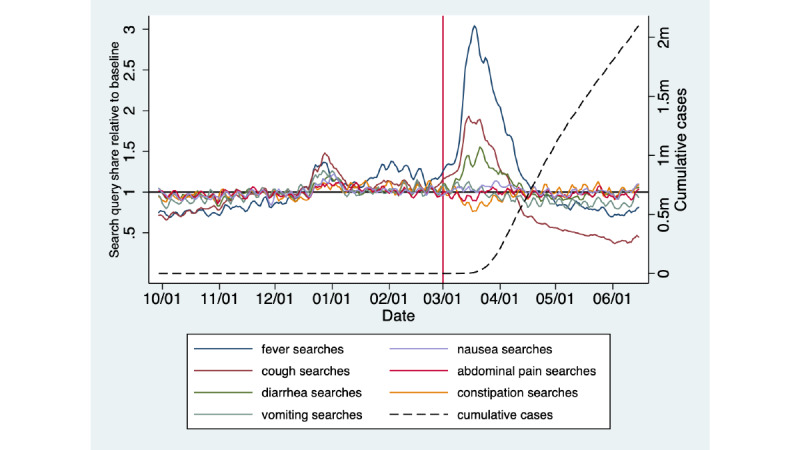
The relative search query shares of many symptoms, including nausea, vomiting, abdominal pain, and constipation, remained near or below baseline throughout the time period studied; however, there were notable increases in searches for the positive control symptoms of fever and cough as well as for diarrhea. These increases in daily search queries for fever, cough, and diarrhea preceded the rapid rise in number of cases by approximately 10 to 14 days. The search volumes for these terms began declining after mid-March despite the continued rises in cumulative cases and daily new case counts.

CONCLUSIONS

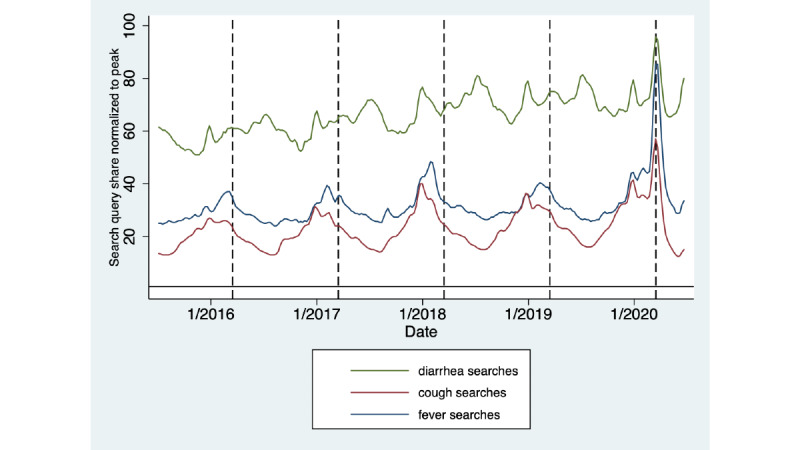
Google searches for symptoms may precede the actual rises in cases and hospitalizations during pandemics. During the current COVID-19 pandemic, this study demonstrates that internet search queries for fever, cough, and diarrhea increased prior to the increased confirmed case count by available testing during the early weeks of the pandemic in the United States. While the search volumes eventually decreased significantly as the number of cases continued to rise, internet query search data may still be a useful tool at a population level to identify areas of active disease transmission at the cusp of new outbreaks.
https://cdn.ncbi.nlm.nih.gov/pmc/blobs/6054/7371406/c1e945f5379f/publichealth_v6i3e19354_fig2.jpg
https://cdn.ncbi.nlm.nih.gov/pmc/blobs/6054/7371406/0ed8f9c6ad01/publichealth_v6i3e19354_fig1.jpg
https://cdn.ncbi.nlm.nih.gov/pmc/blobs/6054/7371406/c1e945f5379f/publichealth_v6i3e19354_fig2.jpg
https://cdn.ncbi.nlm.nih.gov/pmc/blobs/6054/7371406/0ed8f9c6ad01/publichealth_v6i3e19354_fig1.jpg
https://cdn.ncbi.nlm.nih.gov/pmc/blobs/6054/7371406/c1e945f5379f/publichealth_v6i3e19354_fig2.jpg
摘要

背景

冠状病毒病(COVID-19)是一种新型病毒性疾病,已在全球迅速传播。尽管该疾病主要表现为呼吸道疾病,但多达三分之一的确诊病例报告了胃肠道症状,如腹泻,并且患者可能有轻微症状,不会促使他们寻求医疗。基于互联网的传染病学提供了一种在人群水平上研究症状的方法,即使是那些没有寻求医疗的人也是如此。

目的

本研究旨在确定美国与胃肠道症状相关的互联网搜索与 COVID-19 确诊病例数之间是否存在相关性。

方法

本研究选择了腹泻、恶心、呕吐和腹痛等常见胃肠道症状作为分析的搜索词。此外,发烧和咳嗽被用作阳性对照,便秘被用作阴性对照。从 2019 年 10 月 1 日至 2020 年 6 月 15 日,从 Google Trends 获得了美国所有州的选定症状的每日查询份额。这些份额分为两个时间段:COVID-19 之前(3 月 1 日之前)和 COVID-19 之后(3 月 1 日至 6 月 15 日)。从约翰霍普金斯大学系统科学与工程数据存储库获得了 COVID-19 确诊病例数。然后,将每日查询份额的移动平均值(归一化为 COVID-19 之前的基线)与确诊疾病病例数和每日新增病例进行分析,以建立时间关系。

结果

许多症状的相对搜索查询份额,包括恶心、呕吐、腹痛和便秘,在整个研究期间仍接近或低于基线;然而,发烧和咳嗽以及腹泻等阳性对照症状的搜索量显著增加。这些每日发烧、咳嗽和腹泻搜索查询量的增加早于病例数的快速上升,大约提前 10 到 14 天。尽管累计病例数和每日新增病例数持续上升,但这些术语的搜索量在 3 月中旬后开始下降。

结论

在大流行期间,症状的谷歌搜索可能早于病例和住院人数的实际上升。在当前的 COVID-19 大流行期间,本研究表明,在美国 COVID-19 大流行的早期,通过现有检测方法,发烧、咳嗽和腹泻的互联网搜索查询在确诊病例数增加之前就有所增加。尽管随着病例数的继续增加,搜索量最终显著下降,但互联网查询搜索数据仍然是人群水平上识别新爆发前疾病传播活跃地区的有用工具。

相似文献

1
Association of Search Query Interest in Gastrointestinal Symptoms With COVID-19 Diagnosis in the United States: Infodemiology Study.美国胃肠道症状搜索查询兴趣与 COVID-19 诊断的关联:信息流行病学研究。
JMIR Public Health Surveill. 2020 Jul 17;6(3):e19354. doi: 10.2196/19354.
2
Correlations of Online Search Engine Trends With Coronavirus Disease (COVID-19) Incidence: Infodemiology Study.在线搜索引擎趋势与冠状病毒病(COVID-19)发病的相关性:信息流行病学研究。
JMIR Public Health Surveill. 2020 May 21;6(2):e19702. doi: 10.2196/19702.
3
Understanding the Community Risk Perceptions of the COVID-19 Outbreak in South Korea: Infodemiology Study.了解韩国新冠疫情的社区风险认知:信息流行病学研究
J Med Internet Res. 2020 Sep 29;22(9):e19788. doi: 10.2196/19788.
4
Increased Internet Searches for Insomnia as an Indicator of Global Mental Health During the COVID-19 Pandemic: Multinational Longitudinal Study.新冠疫情期间,互联网上对失眠的搜索增加作为全球心理健康指标的跨国纵向研究
J Med Internet Res. 2020 Sep 21;22(9):e22181. doi: 10.2196/22181.
5
Public Interest in Immunity and the Justification for Intervention in the Early Stages of the COVID-19 Pandemic: Analysis of Google Trends Data.公众对免疫的关注和在 COVID-19 大流行早期阶段进行干预的正当性:谷歌趋势数据分析。
J Med Internet Res. 2021 Jun 18;23(6):e26368. doi: 10.2196/26368.
6
Collateral Crises of Gun Preparation and the COVID-19 Pandemic: Infodemiology Study.枪支准备的附带危机与 COVID-19 大流行:信息流行病学研究。
JMIR Public Health Surveill. 2020 May 28;6(2):e19369. doi: 10.2196/19369.
7
Silver lining of COVID-19: Heightened global interest in pneumococcal and influenza vaccines, an infodemiology study.COVID-19 的一线希望:对肺炎球菌和流感疫苗的兴趣日益增加,一项信息流行病学研究。
Vaccine. 2020 Jul 22;38(34):5430-5435. doi: 10.1016/j.vaccine.2020.06.069. Epub 2020 Jun 25.
8
Regional Infoveillance of COVID-19 Case Rates: Analysis of Search-Engine Query Patterns.新型冠状病毒肺炎病例发生率的区域信息监测:搜索引擎查询模式分析
J Med Internet Res. 2020 Jul 30;22(7):e19483. doi: 10.2196/19483.
9
The Influence of Media Coverage and Governmental Policies on Google Queries Related to COVID-19 Cutaneous Symptoms: Infodemiology Study.媒体报道和政府政策对与 COVID-19 皮肤症状相关的谷歌查询的影响:信息流行病学研究。
JMIR Public Health Surveill. 2021 Feb 25;7(2):e25651. doi: 10.2196/25651.
10
Understanding Health Communication Through Google Trends and News Coverage for COVID-19: Multinational Study in Eight Countries.通过谷歌趋势和新冠疫情新闻报道理解健康传播:八国跨国研究。
JMIR Public Health Surveill. 2021 Dec 21;7(12):e26644. doi: 10.2196/26644.

引用本文的文献

1
Assessment of the Quality and Readability of Web-Based Arabic Health Information on Halitosis: Infodemiological Study.基于网络的口臭阿拉伯文健康信息质量和可读性评估:信息流行病学研究。
J Med Internet Res. 2024 Aug 28;26:e54072. doi: 10.2196/54072.
2
Changes to Public Health Surveillance Methods Due to the COVID-19 Pandemic: Scoping Review.因 COVID-19 大流行而改变的公共卫生监测方法:范围综述。
JMIR Public Health Surveill. 2024 Jan 19;10:e49185. doi: 10.2196/49185.
3
Quality and readability of web-based information on dental caries in Arabic: an infodemiological study.

本文引用的文献

1
Correlations of Online Search Engine Trends With Coronavirus Disease (COVID-19) Incidence: Infodemiology Study.在线搜索引擎趋势与冠状病毒病(COVID-19)发病的相关性:信息流行病学研究。
JMIR Public Health Surveill. 2020 May 21;6(2):e19702. doi: 10.2196/19702.
2
Don't Overlook Digestive Symptoms in Patients With 2019 Novel Coronavirus Disease (COVID-19).不要忽视2019新型冠状病毒病(COVID-19)患者的消化症状。
Clin Gastroenterol Hepatol. 2020 Jun;18(7):1636-1637. doi: 10.1016/j.cgh.2020.03.043. Epub 2020 Mar 20.
3
COVID-19: Gastrointestinal Manifestations and Potential Fecal-Oral Transmission.
基于网络的阿拉伯文龋齿信息的质量和可读性:一项信息流行病学研究。
BMC Oral Health. 2023 Oct 25;23(1):797. doi: 10.1186/s12903-023-03547-1.
4
Population Interest in Information on Obesity, Nutrition, and Occupational Health and Its Relationship with the Prevalence of Obesity: An Infodemiological Study.人群对肥胖、营养和职业健康信息的关注及其与肥胖流行率的关系:一项信息流行病学研究。
Nutrients. 2023 Aug 29;15(17):3773. doi: 10.3390/nu15173773.
5
Changes in digital healthcare search behavior during the early months of the COVID-19 pandemic: A study of six English-speaking countries.2019冠状病毒病大流行最初几个月期间数字医疗搜索行为的变化:一项对六个英语国家的研究。
PLOS Digit Health. 2023 May 1;2(5):e0000241. doi: 10.1371/journal.pdig.0000241. eCollection 2023 May.
6
Forecasting and Surveillance of COVID-19 Spread Using Google Trends: Literature Review.利用谷歌趋势预测和监测 COVID-19 传播:文献综述。
Int J Environ Res Public Health. 2022 Sep 29;19(19):12394. doi: 10.3390/ijerph191912394.
7
Early warning of COVID-19 hotspots using human mobility and web search query data.利用人类流动性和网络搜索查询数据对新冠疫情热点地区进行早期预警。
Comput Environ Urban Syst. 2022 Mar;92:101747. doi: 10.1016/j.compenvurbsys.2021.101747. Epub 2021 Dec 15.
8
Relationship between internet research data of oral neoplasms and public health programs in the European Union.口腔肿瘤互联网研究数据与欧盟公共卫生计划之间的关系。
BMC Oral Health. 2021 Dec 17;21(1):648. doi: 10.1186/s12903-021-02022-z.
9
Online Search Behavior Related to COVID-19 Vaccines: Infodemiology Study.与新冠疫苗相关的在线搜索行为:信息流行病学研究
JMIR Infodemiology. 2021 Nov 12;1(1):e32127. doi: 10.2196/32127. eCollection 2021 Jan-Dec.
10
The relationship between Google search interest for pulmonary symptoms and COVID-19 cases using dynamic conditional correlation analysis.使用动态条件相关分析研究肺部症状的谷歌搜索量与 COVID-19 病例之间的关系。
Sci Rep. 2021 Jul 13;11(1):14387. doi: 10.1038/s41598-021-93836-y.
新型冠状病毒肺炎:胃肠道表现及潜在的粪-口传播
Gastroenterology. 2020 May;158(6):1518-1519. doi: 10.1053/j.gastro.2020.02.054. Epub 2020 Mar 3.
4
Clinical Characteristics of 138 Hospitalized Patients With 2019 Novel Coronavirus-Infected Pneumonia in Wuhan, China.《武汉 2019 年新型冠状病毒感染的肺炎 138 例住院患者临床特征分析》
JAMA. 2020 Mar 17;323(11):1061-1069. doi: 10.1001/jama.2020.1585.
5
Clinical features of patients infected with 2019 novel coronavirus in Wuhan, China.中国武汉地区 2019 年新型冠状病毒感染患者的临床特征。
Lancet. 2020 Feb 15;395(10223):497-506. doi: 10.1016/S0140-6736(20)30183-5. Epub 2020 Jan 24.
6
Associations of Topics of Discussion on Twitter With Survey Measures of Attitudes, Knowledge, and Behaviors Related to Zika: Probabilistic Study in the United States.推特上讨论话题与寨卡病毒相关态度、知识及行为的调查指标之间的关联:美国的概率研究
JMIR Public Health Surveill. 2018 Feb 9;4(1):e16. doi: 10.2196/publichealth.8186.
7
Too Far to Care? Measuring Public Attention and Fear for Ebola Using Twitter.关心过度?利用推特衡量公众对埃博拉的关注与恐惧。
J Med Internet Res. 2017 Jun 13;19(6):e193. doi: 10.2196/jmir.7219.
8
Risk of MERS importation and onward transmission: a systematic review and analysis of cases reported to WHO.中东呼吸综合征输入及进一步传播的风险:对向世界卫生组织报告病例的系统评价与分析
BMC Infect Dis. 2016 Aug 25;16(1):448. doi: 10.1186/s12879-016-1787-5.
9
Traditional and syndromic surveillance of infectious diseases and pathogens.传染病和病原体的传统监测与综合征监测。
Int J Infect Dis. 2016 Jul;48:22-8. doi: 10.1016/j.ijid.2016.04.021. Epub 2016 Apr 30.
10
Norovirus disease surveillance using Google Internet query share data.利用谷歌互联网查询份额数据进行诺如病毒病监测。
Clin Infect Dis. 2012 Oct;55(8):e75-8. doi: 10.1093/cid/cis579. Epub 2012 Jun 19.