Boston Univ., United States.
Brigham and Women's Hospital, United States.
J Biomed Opt. 2022 Jun;27(6). doi: 10.1117/1.JBO.27.6.066003.
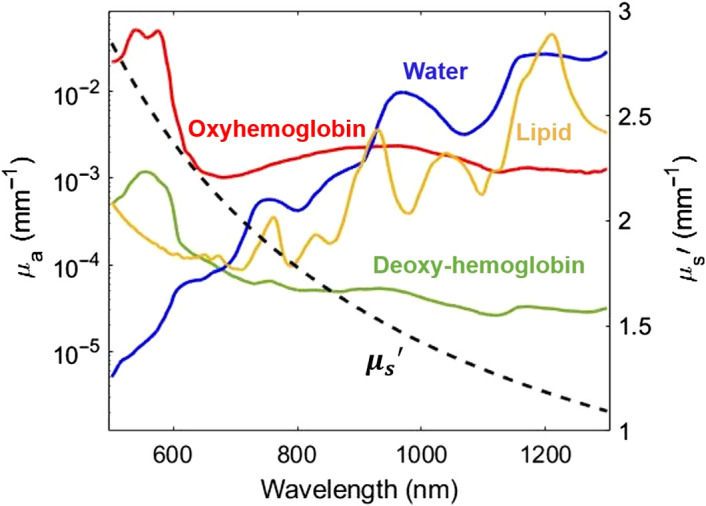
The shortwave infrared (SWIR) optical window (∼900 to 2000 nm) has attracted interest for deep tissue imaging due to the lower scattering of light. SWIR spatial frequency domain imaging (SWIR SFDI) provides wide-field tissue optical property measurements in this wavelength band. Key design and performance characteristics, such as portability, wavelength selection, measurement resolution, and the effect of skin have not yet been addressed for SWIR SFDI.
To fabricate and characterize a SWIR SFDI system for clinical use.
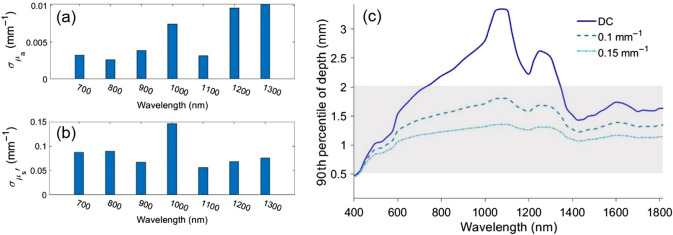
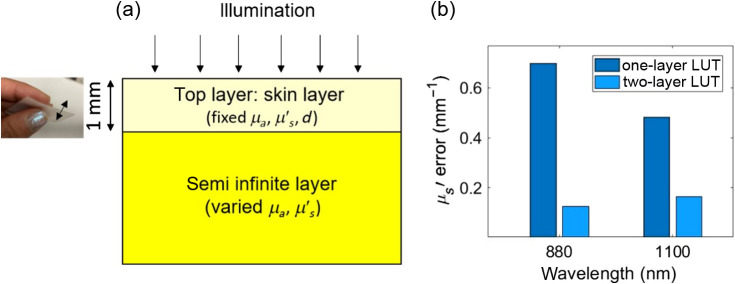
The optimal choice of wavelengths was identified based on optical property uncertainty estimates and imaging depth. A compact light-emitting diode-based dual wavelength SWIR SFDI system was fabricated. A two-layer inverse model was developed to account for the layered structure of skin. Performance was validated using tissue-simulating phantoms and in-vivo measurements from three healthy subjects.
The SWIR SFDI system had a μs' resolution of at least 0.03 mm - 1 at 880 nm and 0.02 mm - 1 at 1100 nm. The two-layer inverse model reduced the error in deeper layer μs' extractions by at least 24% in the phantom study. The two-layer model also increased the contrast between superficial vessels and the surrounding tissue for in-vivo measurements.
The clinic-ready SWIR SFDI device is sensitive to small optical property alterations in diffuse media, provides enhanced accuracy in quantifying optical properties in the deeper layers in phantoms, and provided enhanced contrast of subcutaneous blood vessels.
由于光的散射较低,短波红外(SWIR)光学窗口(~900 至 2000nm)引起了人们对深层组织成像的兴趣。SWIR 空间频域成像(SWIR SFDI)在该波长带中提供了广泛的组织光学特性测量。SWIR SFDI 的关键设计和性能特性,如便携性、波长选择、测量分辨率以及皮肤的影响,尚未得到解决。
制作和表征用于临床的 SWIR SFDI 系统。
根据光学特性不确定性估计和成像深度,确定了最佳波长选择。制作了一种紧凑的基于发光二极管的双波长 SWIR SFDI 系统。开发了一个两层逆模型来解释皮肤的分层结构。使用组织模拟体模和来自三个健康受试者的体内测量来验证性能。
SWIR SFDI 系统在 880nm 时的分辨率至少为 0.03 mm - 1,在 1100nm 时的分辨率至少为 0.02 mm - 1。在体模研究中,两层逆模型将深层μs'提取误差至少降低了 24%。两层模型还增加了体内测量中浅层血管和周围组织之间的对比度。
这种可用于临床的 SWIR SFDI 设备对漫射介质中的小光学特性变化敏感,在体模中量化深层光学特性的准确性更高,并增强了皮下血管的对比度。