Department of Neuroscience, Rehabilitation, Ophthalmology, Genetics, Maternal and Child Health, University of Genova, Genova, Italy.
MIDA, Dipartimento di Matematica Università di Genova, Genova, Italy.
J Neurol Sci. 2022 Aug 15;439:120315. doi: 10.1016/j.jns.2022.120315. Epub 2022 Jun 3.
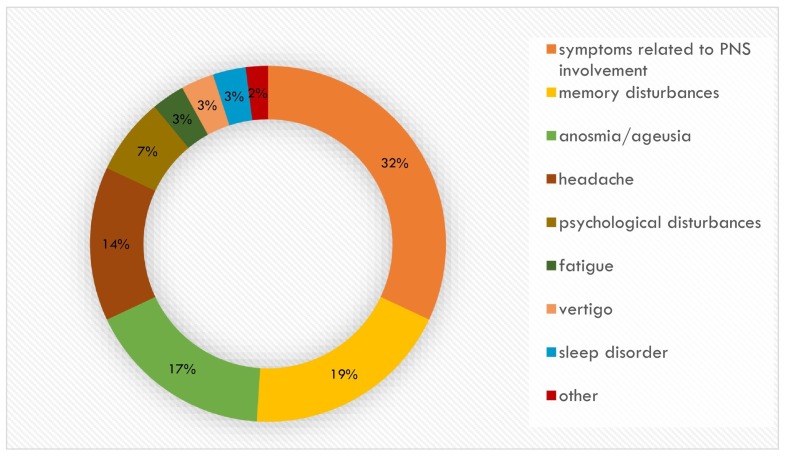
Symptoms referable to central and peripheral nervous system involvement are often evident both during the acute phase of COVID-19 infection and during long-COVID. In this study, we evaluated a population of patients with prior COVID-19 infection who showed signs and symptoms consistent with neurological long-COVID.
We prospectively collected demographic and acute phase course data from patients with prior COVID-19 infection who showed symptoms related to neurological involvement in the long-COVID phase. Firstly, we performed a multivariate logistic linear regression analysis to investigate the impact of demographic and clinical data, the severity of the acute COVID-19 infection and hospitalization course, on the post-COVID neurological symptoms at three months follow-up. Secondly, we performed an unsupervised clustering analysis to investigate whether there was evidence of different subtypes of neurological long COVID-19.
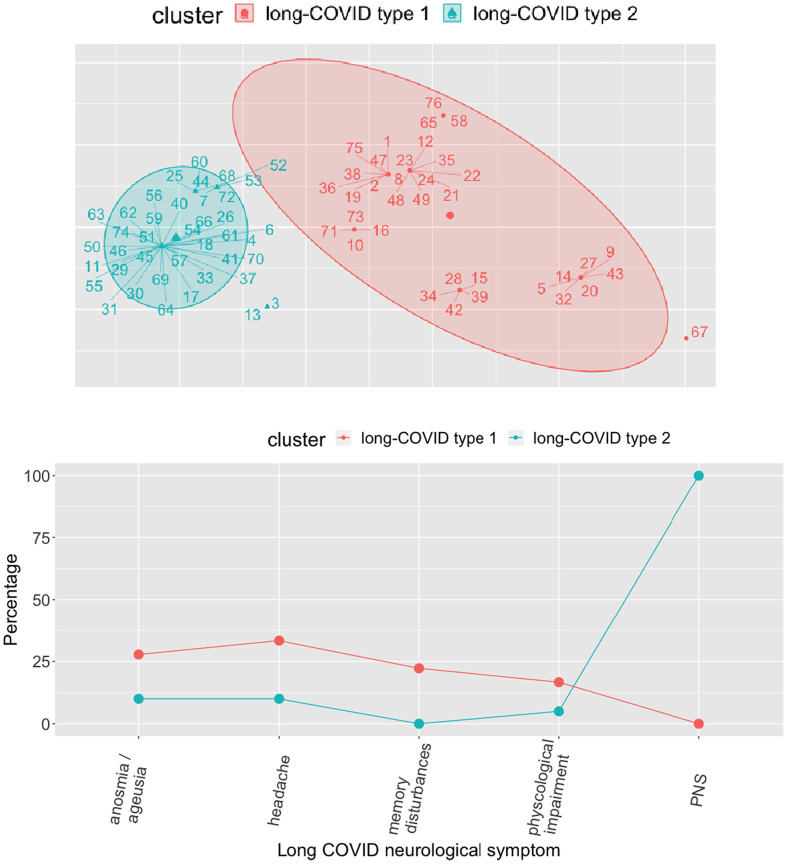
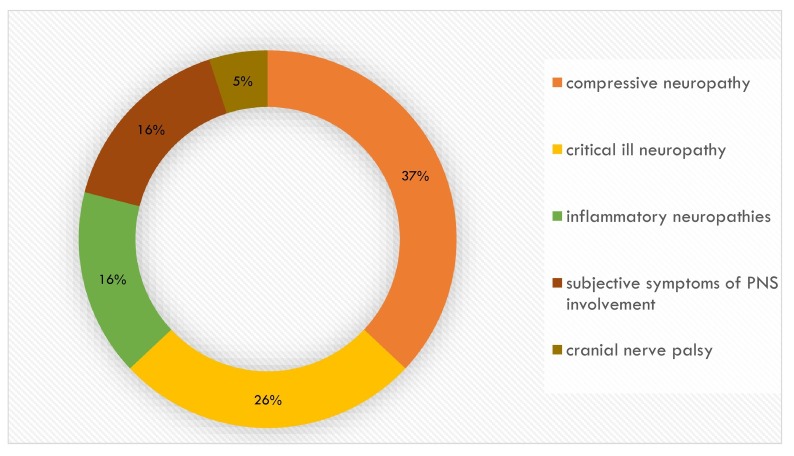
One hundred and nine patients referred to the neurological post-COVID outpatient clinic. Clustering analysis on the most common neurological symptoms returned two well-separated and well-balanced clusters: long-COVID type 1 contains the subjects with memory disturbances, psychological impairment, headache, anosmia and ageusia, while long-COVID type 2 contains all the subjects with reported symptoms related to PNS involvement. The analysis of potential risk-factors among the demographic, clinical presentation, COVID 19 severity and hospitalization course variables showed that the number of comorbidities at onset, the BMI, the number of COVID-19 symptoms, the number of non-neurological complications and a more severe course of the acute infection were all, on average, higher for the cluster of subjects with reported symptoms related to PNS involvement.
We analyzed the characteristics of neurological long-COVID and presented a method to identify well-defined patient groups with distinct symptoms and risk factors. The proposed method could potentially enable treatment deployment by identifying the optimal interventions and services for well-defined patient groups, so alleviating long-COVID and easing recovery.
在 COVID-19 感染的急性期和长新冠期间,经常出现与中枢和外周神经系统受累相关的症状。在这项研究中,我们评估了一组既往 COVID-19 感染的患者,这些患者表现出与长新冠相关的神经系统症状。
我们前瞻性地收集了既往 COVID-19 感染患者的人口统计学和急性期数据,这些患者在长新冠阶段出现与神经系统受累相关的症状。首先,我们进行了多变量逻辑线性回归分析,以调查人口统计学和临床数据、急性 COVID-19 感染的严重程度和住院过程对 COVID 后三个月神经系统症状的影响。其次,我们进行了无监督聚类分析,以调查是否存在不同类型的长新冠神经系统疾病的证据。
109 名患者被转介到神经科新冠后门诊。对最常见的神经系统症状进行聚类分析,得到了两个分离良好、平衡的聚类:长新冠 1 型包含有记忆障碍、心理障碍、头痛、嗅觉和味觉丧失的患者,而长新冠 2 型包含有报告与周围神经系统受累相关症状的所有患者。对人口统计学、临床表现、COVID-19 严重程度和住院过程变量中的潜在风险因素进行分析表明,发病时的合并症数量、BMI、COVID-19 症状数量、非神经系统并发症数量以及急性感染的严重程度,对于报告与周围神经系统受累相关症状的患者群体,平均来说都更高。
我们分析了长新冠神经系统疾病的特征,并提出了一种识别具有不同症状和风险因素的明确患者群体的方法。该方法可通过识别针对明确患者群体的最佳干预措施和服务,从而缓解长新冠并促进康复。