Aliño-Dies María, Sánchez-Ortí Joan Vicent, Correa-Ghisays Patricia, Balanzá-Martínez Vicent, Vila-Francés Joan, Selva-Vera Gabriel, Correa-Estrada Paulina, Forés-Martos Jaume, San-Martín Valenzuela Constanza, Monfort-Pañego Manuel, Ayesa-Arriola Rosa, Ruiz-Veguilla Miguel, Crespo-Facorro Benedicto, Tabarés-Seisdedos Rafael
Department of Medicine, Faculty of Medicine and Dentistry, University of Valencia, Valencia, Spain.
Faculty of Psychology, University of Valencia, Valencia, Spain.
Front Psychol. 2020 Nov 25;11:525231. doi: 10.3389/fpsyg.2020.525231. eCollection 2020.
Frailty is a common syndrome among older adults and patients with several comorbidities. Grip strength (GS) is a representative parameter of frailty because it is a valid indicator of current and long-term physical conditions in the general population and patients with severe mental illnesses (SMIs). Physical and cognitive capacities of people with SMIs are usually impaired; however, their relationship with frailty or social functioning have not been studied to date. The current study aimed to determine if GS is a valid predictor of changes in cognitive performance and social functioning in patients with type-2 diabetes mellitus and SMIs.
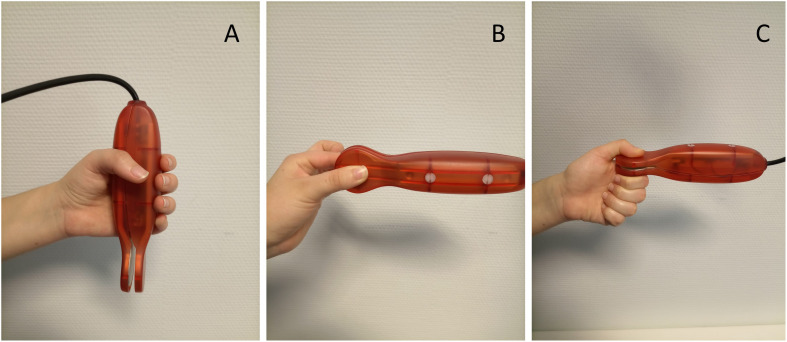
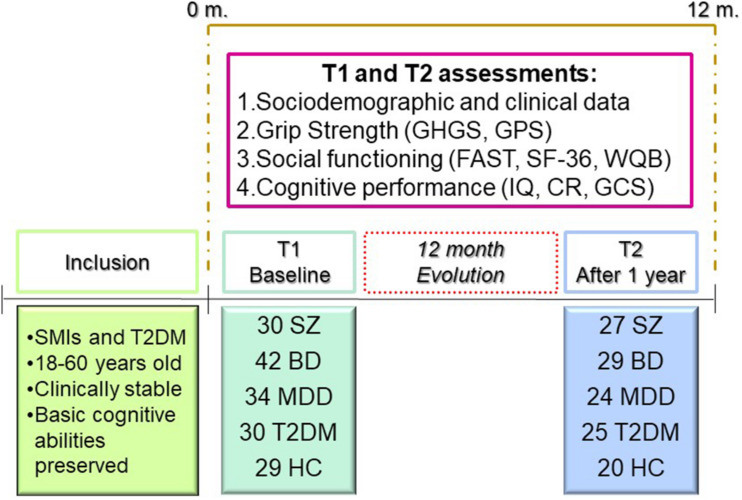
Assessments of social functioning, cognitive performance, and GS (measured with an electronic dynamometer) were conducted in 30 outpatients with type 2 diabetes mellitus, 35 with major depressive disorder, 42 with bipolar disorder, 30 with schizophrenia, and 28 healthy controls, twice during 1-year, follow-up period. Descriptive analyses were conducted using a one-way analysis of variance for continuous variables and the chi-squared test for categorical variables. Differences between groups for the motor, cognitive, and social variables at T1 and T2 were assessed using a one-way analysis of covariance, with sex and age as co-variates ( < 0.01). To test the predictive capacity of GS at baseline to explain the variance in cognitive performance and social functioning at T2, a linear regression analysis was performed ( < 0.05).
Predictive relationships were found among GS when implicated with clinical, cognitive, and social variables. These relationships explained changes in cognitive performance after one year of follow-up; the variability percentage was 67.7%, in patients with type-2 diabetes mellitus and 89.1% in patients with schizophrenia. Baseline GS along with other variables, also predicted changes in social functioning in major depressive disorder, bipolar disorder, and schizophrenia, with variability percentages of 67.3, 36, and 59%, respectively.
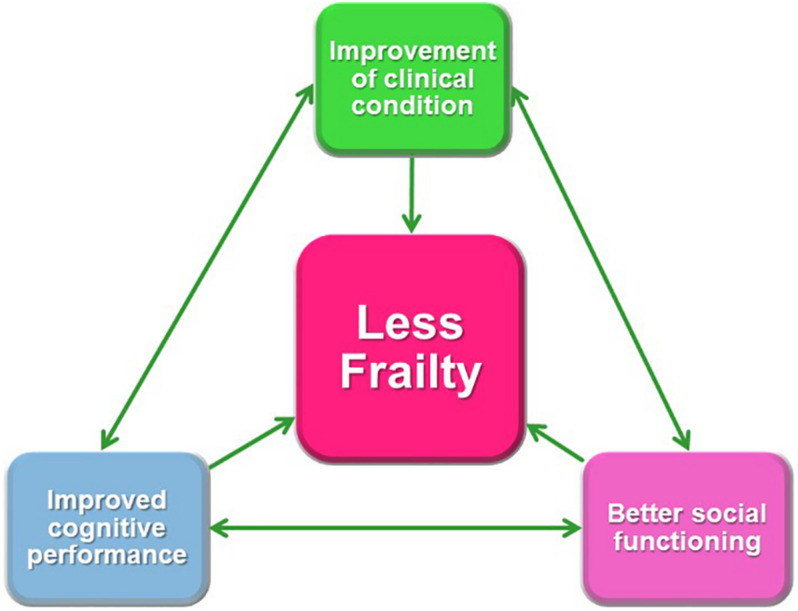
GS combined with other variables significantly predicted changes in cognitive performance and social functioning in people with SMIs or type-2 diabetes mellitus. Interventions aimed to improve the overall physical conditions of patients who have poor GS could be a therapeutic option that confers positive effects on cognitive performance and social functioning.
衰弱是老年人及患有多种合并症患者中的常见综合征。握力(GS)是衰弱的一个代表性参数,因为它是普通人群和重度精神疾病(SMI)患者当前及长期身体状况的有效指标。SMI患者的身体和认知能力通常受损;然而,迄今为止,它们与衰弱或社会功能的关系尚未得到研究。本研究旨在确定GS是否是2型糖尿病和SMI患者认知表现及社会功能变化的有效预测指标。
对30名2型糖尿病门诊患者、35名重度抑郁症患者、42名双相情感障碍患者、30名精神分裂症患者和28名健康对照者进行了社会功能、认知表现和GS(使用电子测力计测量)评估,在1年的随访期内进行了两次。连续变量采用单因素方差分析进行描述性分析,分类变量采用卡方检验。以性别和年龄作为协变量(<0.01),使用单因素协方差分析评估T1和T2时运动、认知和社会变量在组间的差异。为了检验基线时GS解释T2时认知表现和社会功能方差的预测能力,进行了线性回归分析(<0.05)。
在涉及临床、认知和社会变量时,发现了GS之间的预测关系。这些关系解释了随访一年后认知表现的变化;2型糖尿病患者的变异百分比为67.7%,精神分裂症患者为89.1%。基线GS与其他变量一起,还预测了重度抑郁症、双相情感障碍和精神分裂症患者社会功能的变化,变异百分比分别为67.3%、36%和59%。
GS与其他变量相结合,显著预测了SMI患者或2型糖尿病患者认知表现和社会功能的变化。旨在改善握力较差患者整体身体状况的干预措施可能是一种对认知表现和社会功能有积极影响的治疗选择。