Lukács Andrea
Institute of Theoretical Health Sciences, Faculty of Healthcare, University of Miskolc, Miskolc, Hungary.
J King Saud Univ Sci. 2021 Sep;33(6):101531. doi: 10.1016/j.jksus.2021.101531. Epub 2021 Jun 29.
To investigate changes in moderate and vigorous physical activity (PA), and find correlation with psychological well-being and perceived health status in university students prior to versus 4-6 weeks following the outbreak of coronavirus pandemic.
Registered students to the 2020/2021 academic year participated in an online survey representing four Hungarian universities in the framework of "COVID-19 International Student Well-being Study" project. Moderate and vigorous PA were measured with a single question, psychological well-being was evaluated using the Center for Epidemiological Studies - Depression Scale (CES-D) short form and perceived health status on the 11-point Cantril ladder respectively. Statistical analyses were calculated using SPSS 26.0 software.
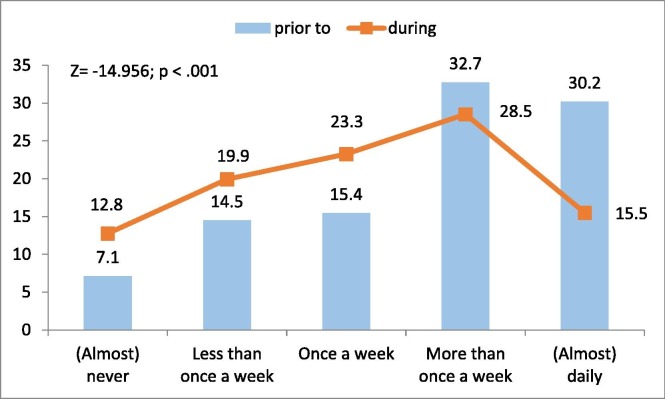
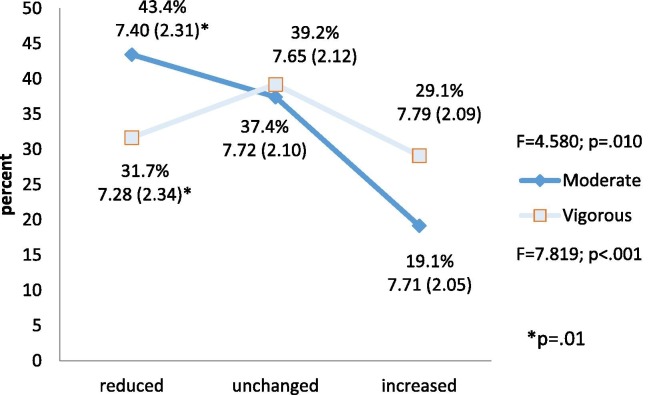
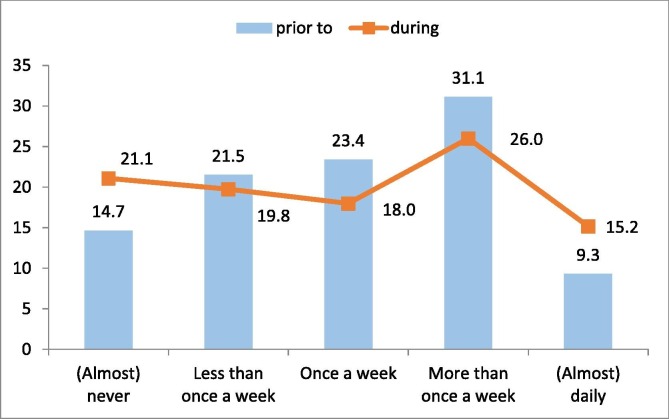
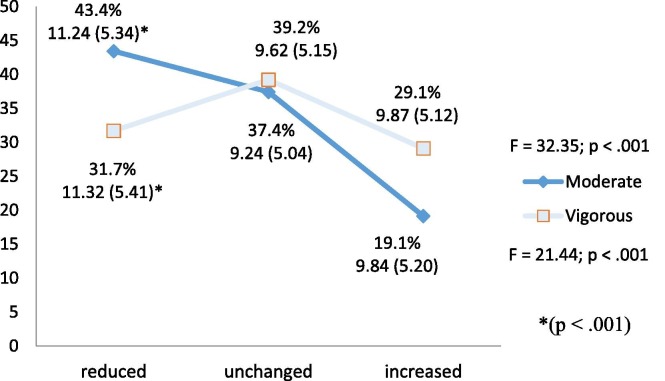
A total of 2779 Hungarian citizen students completed the questionnaire and 2162 (27.7% males) provided full information on PA. Mean age was 24.52 (SD = 7.15) years. A significant decrease was observed in moderate PA prior to and during social isolation (Z = -14.956; p < .001). Students mean well-being was 10.23, SD = 5.28)/32. After analyzing changes (decreased, unchanged, increased) of PA in the context of well-being, it was found students with reduced PA had significantly less favorable scores on well-being scale than students who unchanged or increased their PA level, both in moderate (F = 32.35; p < .001) and vigorous (F = 21.44; p < .001) PA. Regarding the perceived health status there was significant reduction during the pandemic (M = 7.58, SD = 2.19) compared to the preceding period (M = 7.94, SD = 1.85; p < .001). This reduction was most notable in the group that reduced PA.
The closure of universities and sport facilities unfavorably influenced the students' previous PA level. Based on the result, there is a negative relationship between PA and psychological wellbeing also between PA and perceived health status. Universities may pay more attention to keep their students physically active even during a pandemic as it may be far from being over yet.
调查新型冠状病毒大流行爆发前与爆发后4 - 6周大学生中、高强度身体活动(PA)的变化情况,并找出其与心理健康及自我感知健康状况之间的相关性。
在“COVID - 19国际学生福祉研究”项目框架下,2020/2021学年注册的学生参与了一项在线调查,该调查涵盖了四所匈牙利大学。通过一个单一问题测量中、高强度PA,分别使用流行病学研究中心抑郁量表(CES - D)简表评估心理健康状况,以及使用11点坎特里尔阶梯量表评估自我感知健康状况。使用SPSS 26.0软件进行统计分析。
共有2779名匈牙利公民学生完成了问卷,其中2162名(27.7%为男性)提供了关于PA的完整信息。平均年龄为24.52岁(标准差 = 7.15)。在社交隔离之前和期间,中强度PA显著下降(Z = -14.956;p <.001)。学生的平均幸福感为10.23(标准差 = 5.28)/32。在分析幸福感背景下PA的变化(减少、不变、增加)后发现,PA减少的学生在幸福感量表上的得分显著低于PA水平不变或增加的学生,无论是在中强度(F = 32.35;p <.001)还是高强度(F = 21.44;p <.001)PA方面。关于自我感知健康状况,与大流行前相比,大流行期间显著下降(M = 7.58,标准差 = 2.19)(M = 7.94,标准差 = 1.85;p <.001)。这种下降在PA减少的组中最为明显。
大学和体育设施的关闭对学生之前的PA水平产生了不利影响。基于结果,PA与心理健康之间以及PA与自我感知健康状况之间存在负相关关系。即使在大流行期间,大学也可能需要更加关注保持学生的身体活动,因为大流行可能远未结束。