Gao Weiran, Fan Xiangyi, Bi Yunlong, Zhou Zipeng, Yuan Yajiang
Department of Oncology, First Affiliated Hospital of Jinzhou Medical University, Jinzhou, China.
Department of Otolaryngology-Head and Neck Surgery, First Affiliated Hospital of Jinzhou Medical University, Jinzhou, China.
Front Chem. 2022 Jun 2;10:926002. doi: 10.3389/fchem.2022.926002. eCollection 2022.
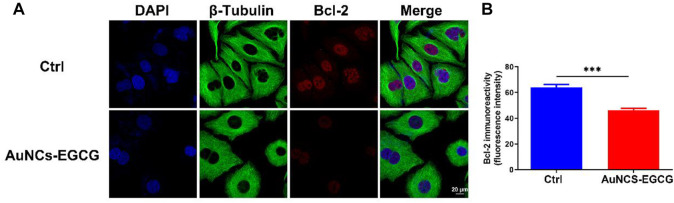
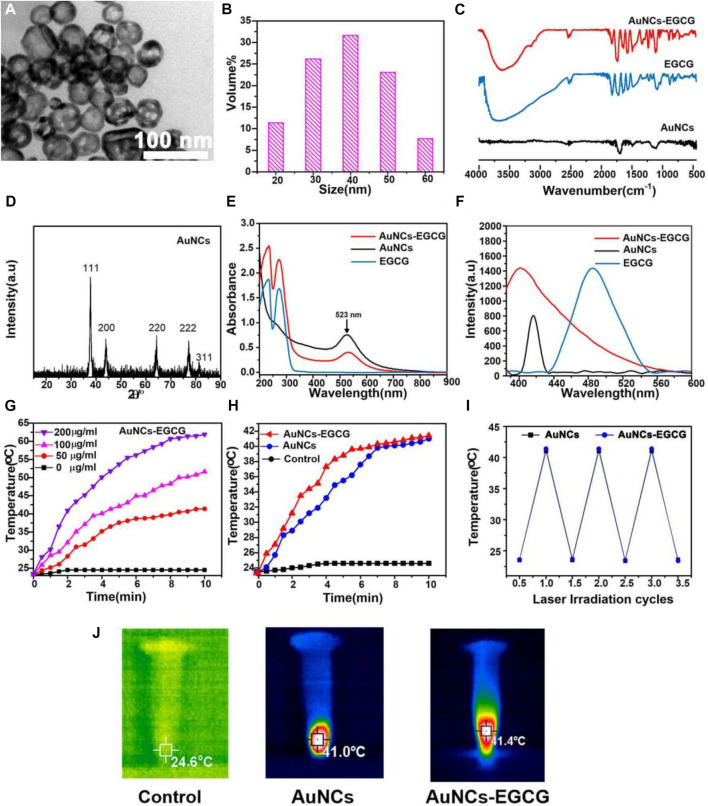
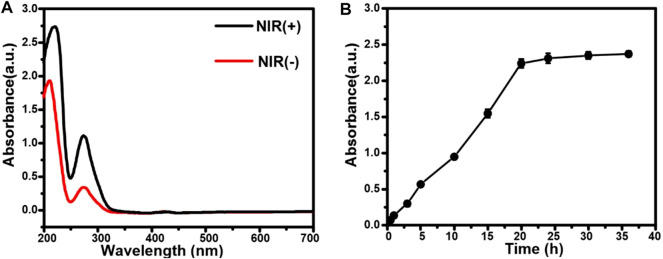
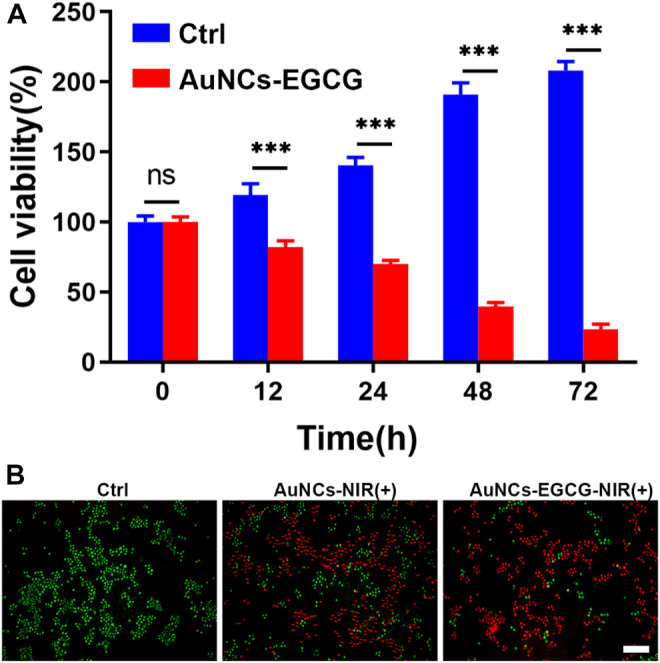
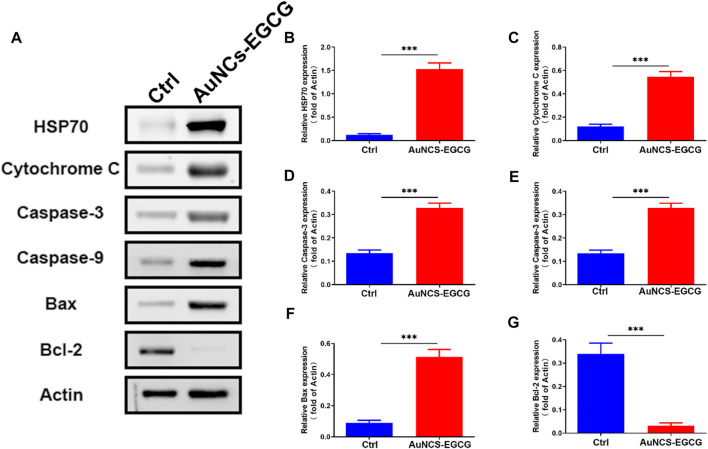
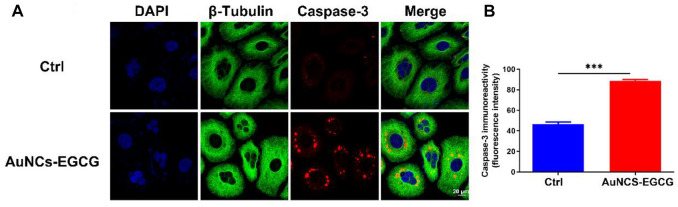
Hepatocellular carcinoma (HCC) is a type of cancer that has a restricted therapy option. Epigallocatechin gallate (EGCG) is one of the main biologically active ingredients in tea. A large number of studies have shown that EGCG has preventive and therapeutic effects on various tumors. In addition, the development of near-infrared (NIR)-responsive nano-platforms has been attracting cancer treatment. In this work, we designed and synthesized a strategy of gold nanocages (AuNCs) as an efficient carrier for controlling release of EGCG for anti-tumor to achieve the synergistic functions of NIR-response and inhibited tumor cell proliferation. The diameter of AuNCs is about 50 nm and has a hollow porous (8 nm) structure. Thermal imaging-graphic studies proved that the AuNCs-EGCG obtained have photothermal response to laser irradiation under near-infrared light and still maintain light stability after multiple cycles of laser irradiation. The resulted AuNCs-EGCG reduced the proliferation rate of HepG2 cells to 50% at 48 h. Western blot analysis showed that NIR-responsive AuNCs-EGCG can promote the expression of HepG2 cell apoptosis-related proteins HSP70, Cytochrome C, Caspase-9, Caspase-3, and Bax, while the expression of Bcl-2 is inhibited. Cell confocal microscopy analysis proved that AuNCs-EGCG irradiated by NIR significantly upregulates Caspase-3 by nearly 2-fold and downregulates Bcl-2 by nearly 0.33-fold, which is beneficial to promote HepG2 cell apoptosis. This study provides useful information for the NIR-responsive AuNCs-EGCG as a new type of nanomedicine for HCC.
肝细胞癌(HCC)是一种治疗选择有限的癌症类型。表没食子儿茶素没食子酸酯(EGCG)是茶叶中的主要生物活性成分之一。大量研究表明,EGCG对各种肿瘤具有预防和治疗作用。此外,近红外(NIR)响应纳米平台的开发一直吸引着癌症治疗领域的关注。在这项工作中,我们设计并合成了一种策略,即以金纳米笼(AuNCs)作为控制EGCG释放以实现抗肿瘤作用的有效载体,从而实现近红外响应和抑制肿瘤细胞增殖的协同功能。AuNCs的直径约为50纳米,具有中空多孔(8纳米)结构。热成像研究证明,所获得的AuNCs-EGCG在近红外光下对激光照射具有光热响应,并且在多次激光照射循环后仍保持光稳定性。所得的AuNCs-EGCG在48小时时将HepG2细胞的增殖率降低至50%。蛋白质印迹分析表明,近红外响应的AuNCs-EGCG可促进HepG2细胞凋亡相关蛋白HSP70、细胞色素C、半胱天冬酶-9、半胱天冬酶-3和Bax的表达,而Bcl-2的表达受到抑制。细胞共聚焦显微镜分析证明,近红外照射的AuNCs-EGCG可使半胱天冬酶-3显著上调近2倍,使Bcl-2下调近0.33倍,这有利于促进HepG2细胞凋亡。本研究为近红外响应的AuNCs-EGCG作为一种新型的HCC纳米药物提供了有用信息。