Department of Ophthalmology, Amasya University, Sabuncuoglu Serafeddin Training and Research Hospital, Amasya, Turkey.
Department of Internal Medicine, Amasya University, Sabuncuoglu Serafeddin Training and Research Hospital, Amasya, Turkey.
Photodiagnosis Photodyn Ther. 2022 Sep;39:102976. doi: 10.1016/j.pdpdt.2022.102976. Epub 2022 Jun 17.
To evaluate the effects of COVID-19 infection on the ocular vascular structure including choroidal thickness and retrobulbar blood flow values in comparison with healthy subjects.
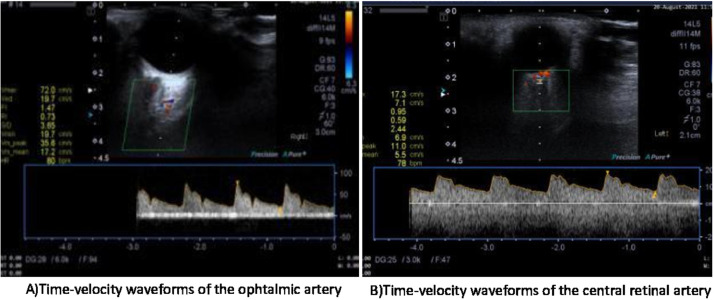
Ninety eyes of 90 patients were included in this study. Participants were divided into Group 1 (n = 30) with mild COVID-19 infection, Group 2 (n = 31) with moderate disease, and Group 3 with age- and sex-matched healthy subjects (n = 29). Choroidal thickness was measured at the subfoveal area and at 500-µm intervals nasal and temporal to the fovea up to a distance of 1500 µm, using the enhanced depth imaging (EDI) technique of spectral coherence tomography (SD-OCT). The peak systolic velocity (PSV), end diastolic velocity (EDV), resistive index (RI), and pulsatility index (PI) values of the central retinal artery (CRA) and ophthalmic artery (OA) were evaluated with color Doppler ultrasonography (CDU).
The choroidal thickness was significantly thinner in Group 1 and Group 2 than in Group 3 at all measurement points (p <0.001). This difference was not present between Group 1 and Group 2 who had COVID-19 disease of different severity (p>0.05).Among the retrobulbar blood flow parameters, OA PSV value was significantly lower in Group 1 and Group 2 compared to Group 3 (p = 0.025, p = 0.016, respectively). However, the CRA PSV and EDV and OA EDV values, and the CRA and OA PI and RI values were not statistically different between the groups (p> 0.05).
COVID-19 infection may predispose patients to ocular vascular pathologies by affecting both choroidal and retrobulbar blood flow.
评估 COVID-19 感染对眼血管结构的影响,包括脉络膜厚度和球后血流值,并与健康受试者进行比较。
本研究纳入 90 例患者的 90 只眼。参与者分为三组:第 1 组(n=30)为轻度 COVID-19 感染,第 2 组(n=31)为中度疾病,第 3 组为年龄和性别匹配的健康受试者(n=29)。使用光谱相干断层扫描(SD-OCT)的增强深度成像(EDI)技术,在黄斑下区域和距黄斑鼻侧和颞侧 500µm 处,每隔 500µm 测量脉络膜厚度,直至 1500µm 处。使用彩色多普勒超声(CDU)评估视网膜中央动脉(CRA)和眼动脉(OA)的收缩期峰值速度(PSV)、舒张末期速度(EDV)、阻力指数(RI)和搏动指数(PI)。
与第 3 组相比,第 1 组和第 2 组在所有测量点的脉络膜厚度均明显变薄(p<0.001)。但 COVID-19 严重程度不同的第 1 组和第 2 组之间没有差异(p>0.05)。在球后血流参数中,第 1 组和第 2 组的 OA PSV 值明显低于第 3 组(p=0.025,p=0.016)。然而,CRA PSV 和 EDV 以及 OA EDV 值,以及 CRA 和 OA PI 和 RI 值在各组之间没有统计学差异(p>0.05)。
COVID-19 感染可能通过影响脉络膜和球后血流,使患者易患眼部血管病变。