Department of Nursing, Faculty of Allied Health Sciences, University of Ruhuna, Galle, Sri Lanka.
Department of Psychiatry, Faculty of Medicine, University of Ruhuna, Galle, Sri Lanka.
BMC Psychol. 2022 Jun 20;10(1):157. doi: 10.1186/s40359-022-00863-z.
Coping strategies play a vital role in cancer management and has been an integral part in the recovery process of cancer patients worldwide. Coping refers to specific efforts; both behavioral and psychological, that diminishes stresses emerged in cancer patients. This study evaluated the psychometric properties of the Sinhalese version of the Coping Orientation to Problems Experienced Inventory (S-BC) which was developed based on the Brief COPE scale for cancer patients in Sri Lanka.
The original Brief COPE is a self-administered tool with 28 items designed to measure coping methods used by people in stressful life events. It consisted of statements related to adaptive and maladaptive coping strategies. Forty patients with cancer who were registered at the Oncology ward, Teaching Hospital, Galle, Sri Lanka were included in the study. A cross-cultural adaptation of the Brief COPE was done using WHO guidelines. Reliability of the S-BC was assessed using test-retest and internal consistency procedures. The construct validity of the tool was assessed by performing exploratory factor analysis (EFA) and confirmatory factor analysis (CFA). Convergent and discriminant validity of the S-BC was tested using World Health Organization-Quality of Life-Brief scale (WHOQOL-BREF) and Centre for Epidemiological Studies-Depression scale (CES-D).
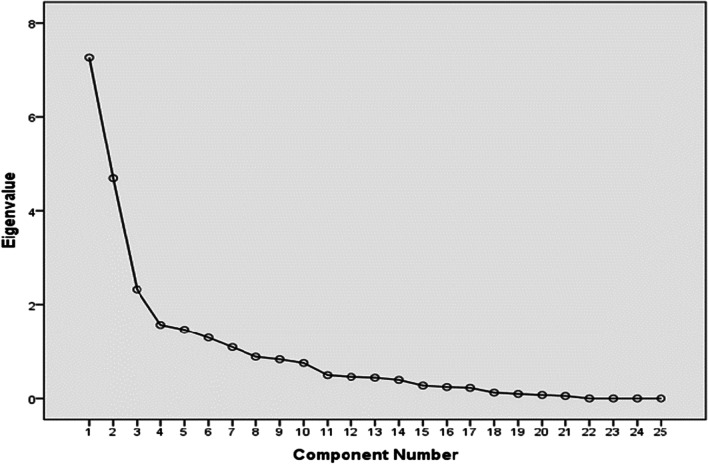
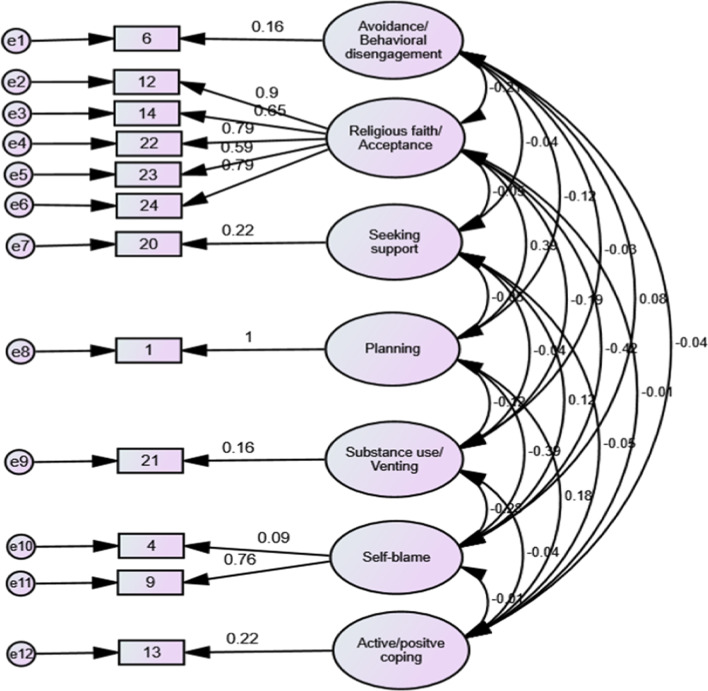
The mean (± SD) age of the sample was 61(± 12) years, and 52.5% (n = 21) of the participants were men. Eighty percent (n = 32) of the participants were more than one year of treatment from diagnosing as a cancer patient. The test-retest reliability of the S-BC was 0.66, and the internal consistency of the S-BC was good (Cronbach's alpha - 0.819). Both EFA and CFA revealed a structure comprised of seven factors. Such factors were Avoidance/Behavioral disengagement, Religious faith/Acceptance, Seeking support, Planning, Substance use/Venting, Self-blame and Active/positive coping. The scores of the adaptive coping of the S-BC was negatively and the scores of the maladaptive coping of the S-BC was positively correlated with the CES-D score. The scores of the adaptive coping of the S-BC was positively correlated with the total score of the WHOQOL-BREF questionnaire indicating the S-BC's convergent and discriminant validity properties.
The Sinhalese version of the Brief COPE is found to be a valid and a reliable measure to assess coping strategies used by patients with cancer in Sri Lanka.
应对策略在癌症管理中起着至关重要的作用,并且是全球癌症患者康复过程中的一个组成部分。应对是指减轻癌症患者出现的压力的特定努力,包括行为和心理方面。本研究评估了基于Brief COPE 量表为斯里兰卡癌症患者开发的僧伽罗语版应对体验问题取向量表(S-BC)的心理测量特性。
原始的 Brief COPE 是一种自我管理工具,包含 28 个项目,旨在衡量人们在压力生活事件中使用的应对方法。它由与适应性和适应性应对策略相关的陈述组成。该研究纳入了 40 名在斯里兰卡加勒教学医院肿瘤病房登记的癌症患者。使用世界卫生组织指南对 Brief COPE 进行了跨文化适应性改编。使用重测信度和内部一致性程序评估 S-BC 的信度。通过进行探索性因素分析(EFA)和验证性因素分析(CFA)来评估工具的构念效度。使用世界卫生组织生活质量简表(WHOQOL-BREF)和流行病学研究中心抑郁量表(CES-D)测试 S-BC 的收敛和判别效度。
样本的平均(±SD)年龄为 61(±12)岁,52.5%(n=21)的参与者为男性。80%(n=32)的参与者在被诊断为癌症患者后接受了一年以上的治疗。S-BC 的重测信度为 0.66,S-BC 的内部一致性良好(Cronbach's alpha-0.819)。EFA 和 CFA 均显示出由七个因素组成的结构。这些因素包括回避/行为脱离、宗教信仰/接受、寻求支持、计划、物质使用/发泄、自责和积极/积极应对。S-BC 的适应性应对得分与 CES-D 得分呈负相关,而 S-BC 的不适应应对得分与 CES-D 得分呈正相关。S-BC 的适应性应对得分与 WHOQOL-BREF 问卷的总分呈正相关,表明 S-BC 具有收敛和判别效度。
僧伽罗语版 Brief COPE 被发现是一种有效的、可靠的衡量斯里兰卡癌症患者应对策略的工具。