• 文献检索
  • 文档翻译
  • 深度研究
  • 学术资讯
  • Suppr Zotero 插件Zotero 插件
  • 邀请有礼
  • 套餐&价格
  • 历史记录
应用&插件
Suppr Zotero 插件Zotero 插件浏览器插件Mac 客户端Windows 客户端微信小程序
定价
高级版会员购买积分包购买API积分包
服务
文献检索文档翻译深度研究API 文档MCP 服务
关于我们
关于 Suppr公司介绍联系我们用户协议隐私条款
关注我们

Suppr 超能文献

核心技术专利:CN118964589B侵权必究
粤ICP备2023148730 号-1Suppr @ 2026

文献检索

告别复杂PubMed语法,用中文像聊天一样搜索,搜遍4000万医学文献。AI智能推荐,让科研检索更轻松。

立即免费搜索

文件翻译

保留排版,准确专业,支持PDF/Word/PPT等文件格式,支持 12+语言互译。

免费翻译文档

深度研究

AI帮你快速写综述,25分钟生成高质量综述,智能提取关键信息,辅助科研写作。

立即免费体验

预测肾移植的存活率:基于智能手机的应用程序的设计与评估。

Predicting the survival of kidney transplantation: design and evaluation of a smartphone-based application.

机构信息

Department of Health Information Management and Medical Informatics, School of Allied Medical Sciences, Tehran University of Medical Sciences, Tehran, Iran.

Department of Health Information Management and Medical Informatics, School of Health Management and Information Science, Iran University of Medical Sciences, Tehran, Iran.

出版信息

BMC Nephrol. 2022 Jun 21;23(1):219. doi: 10.1186/s12882-022-02841-4.

DOI:10.1186/s12882-022-02841-4
PMID:35729490
原文链接:https://pmc.ncbi.nlm.nih.gov/articles/PMC9210621/
Abstract

BACKGROUND

Prediction of graft survival for Kidney Transplantation (KT) is considered a risky task due to the scarcity of donating organs and the use of health care resources. The present study aimed to design and evaluate a smartphone-based application to predict the survival of KT in patients with End-Stage Renal Disease (ESRD).

METHOD

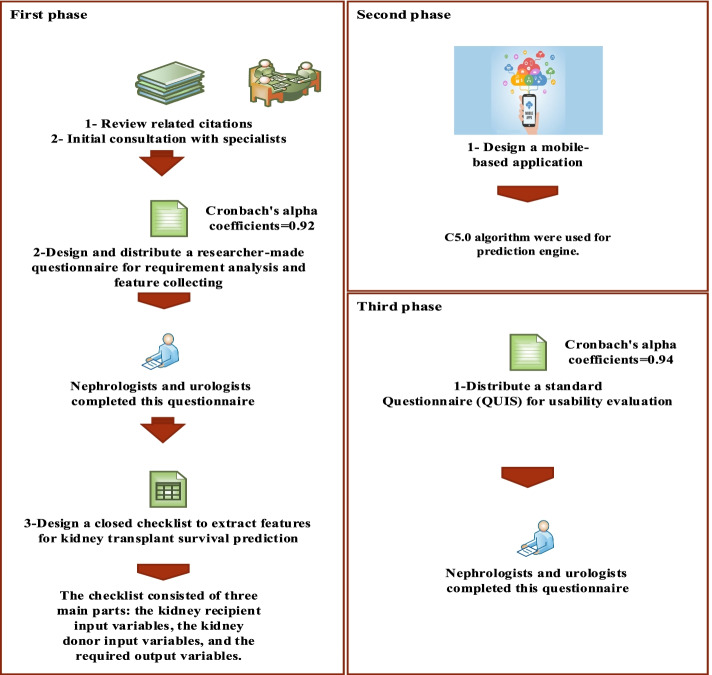
Based on the initial review, a researcher-made questionnaire was developed to assess the information needs of the application through urologists and nephrologists. By using information obtained from the questionnaire, a checklist was prepared, and the information of 513 patients with kidney failure was collected from their records at Sina Urological Research Center. Then, three data mining algorithms were applied to them. The smartphone-based application for the prediction of kidney transplant survival was designed, and a standard usability assessment questionnaire was used to evaluate the designed application.

RESULTS

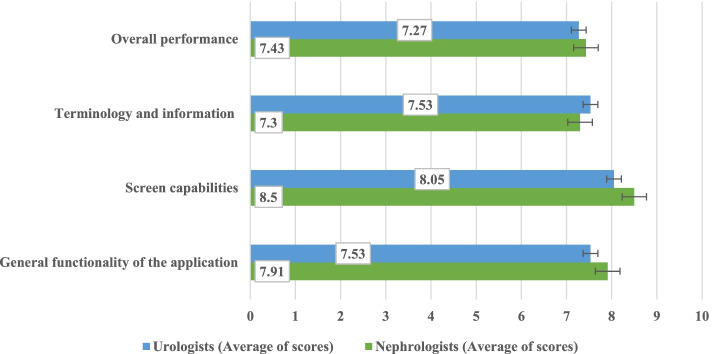
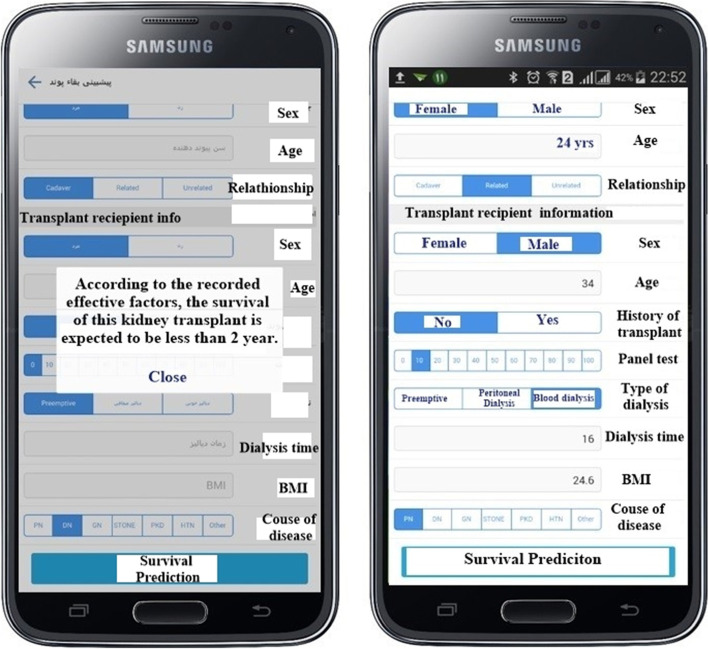
Three information elements related to the required data in different sections of demographic information, sixteen information elements related to patient clinical information, and four critical capabilities were determined for the design of the smartphone-based application. C5.0 algorithm with the highest accuracy (87.21%) was modeled as the application inference engine. The application was developed based on the PhoneGap framework. According to the participants' scores (urologists and nephrologists) regarding the usability evaluation of the application, it can be concluded that both groups participating in the study could use the program, and they rated the application at a "good" level.

CONCLUSION

Since the overall performance or usability of the smartphone-based app was evaluated at a reasonable level, it can be used with certainty to predict kidney transplant survival.

摘要

背景

由于捐赠器官的稀缺性和医疗资源的使用,预测肾移植(KT)的移植物存活率被认为是一项风险任务。本研究旨在设计和评估一种基于智能手机的应用程序,以预测终末期肾病(ESRD)患者 KT 的存活率。

方法

基于初步审查,研究人员制作了一份问卷,通过泌尿科医生和肾病学家评估应用程序的信息需求。通过使用从问卷中获得的信息,编制了一份清单,并从 Sina 泌尿科研究中心的记录中收集了 513 名肾衰竭患者的信息。然后,将三种数据挖掘算法应用于这些患者。设计了一种基于智能手机的预测肾移植存活率的应用程序,并使用标准的可用性评估问卷对设计的应用程序进行了评估。

结果

确定了三个与人口统计学信息不同部分所需数据相关的信息元素、与患者临床信息相关的十六个信息元素以及四个与设计基于智能手机的应用程序相关的关键功能。C5.0 算法以最高的准确性(87.21%)被建模为应用程序推理引擎。该应用程序是基于 PhoneGap 框架开发的。根据参与者(泌尿科医生和肾病学家)对应用程序可用性评估的评分,可以得出结论,参与研究的两组人员都可以使用该程序,他们将应用程序评为“良好”水平。

结论

由于智能手机应用程序的整体性能或可用性评估达到了合理的水平,因此可以肯定地用于预测肾移植的存活率。
https://cdn.ncbi.nlm.nih.gov/pmc/blobs/c3a2/9210621/7fc0488537d9/12882_2022_2841_Fig3_HTML.jpg
https://cdn.ncbi.nlm.nih.gov/pmc/blobs/c3a2/9210621/200db11b21d3/12882_2022_2841_Fig1_HTML.jpg
https://cdn.ncbi.nlm.nih.gov/pmc/blobs/c3a2/9210621/fcecae811fdf/12882_2022_2841_Fig2_HTML.jpg
https://cdn.ncbi.nlm.nih.gov/pmc/blobs/c3a2/9210621/7fc0488537d9/12882_2022_2841_Fig3_HTML.jpg
https://cdn.ncbi.nlm.nih.gov/pmc/blobs/c3a2/9210621/200db11b21d3/12882_2022_2841_Fig1_HTML.jpg
https://cdn.ncbi.nlm.nih.gov/pmc/blobs/c3a2/9210621/fcecae811fdf/12882_2022_2841_Fig2_HTML.jpg
https://cdn.ncbi.nlm.nih.gov/pmc/blobs/c3a2/9210621/7fc0488537d9/12882_2022_2841_Fig3_HTML.jpg

相似文献

1
Predicting the survival of kidney transplantation: design and evaluation of a smartphone-based application.预测肾移植的存活率:基于智能手机的应用程序的设计与评估。
BMC Nephrol. 2022 Jun 21;23(1):219. doi: 10.1186/s12882-022-02841-4.
2
Smartphone-based application to control and prevent overweight and obesity in children: design and evaluation.基于智能手机的应用程序控制和预防儿童超重和肥胖:设计与评估。
BMC Med Inform Decis Mak. 2023 Oct 4;23(1):201. doi: 10.1186/s12911-023-02304-2.
3
Patients' and Nephrologists' Evaluation of Patient-Facing Smartphone Apps for CKD.患者和肾脏病医生对面向患者的 CKD 智能手机应用程序的评价。
Clin J Am Soc Nephrol. 2019 Apr 5;14(4):523-529. doi: 10.2215/CJN.10370818. Epub 2019 Mar 21.
4
Prevention and control of urinary tract stones using a smartphone-based self-care application: design and evaluation.基于智能手机的自我护理应用程序预防和控制尿路结石:设计与评估。
BMC Med Inform Decis Mak. 2021 Nov 1;21(1):299. doi: 10.1186/s12911-021-01661-0.
5
A smartphone-based self-care application for patients with urinary tract stones: identification of information content and functional capabilities.基于智能手机的尿路结石患者自我护理应用程序:信息内容和功能能力的识别。
BMC Urol. 2022 Nov 15;22(1):181. doi: 10.1186/s12894-022-01127-z.
6
Enhancing Asthma Patients' Self-Management through Smartphone-Based Application: Design, Usability Evaluation, and Educational Intervention.通过基于智能手机的应用程序增强哮喘患者的自我管理:设计、可用性评估和教育干预。
Appl Clin Inform. 2019 Oct;10(5):870-878. doi: 10.1055/s-0039-1700866. Epub 2019 Nov 13.
7
Reusable Software Usability Specifications for mHealth Applications.可复用软件的移动医疗应用可用性规范
J Med Syst. 2018 Jan 25;42(3):45. doi: 10.1007/s10916-018-0902-0.
8
Usability Testing of a Smartphone Application for Delivering Qigong Training.智能手机应用程序提供气功训练的可用性测试。
J Med Syst. 2018 Sep 5;42(10):191. doi: 10.1007/s10916-018-1048-9.
9
Smartphone-based application for self-management of patients with colorectal cancer: development and usability evaluation.基于智能手机的结直肠癌患者自我管理应用程序的开发和可用性评估。
Support Care Cancer. 2022 Apr;30(4):3249-3258. doi: 10.1007/s00520-021-06754-0. Epub 2022 Jan 4.
10
Comparing Three Data Mining Methods to Predict Kidney Transplant Survival.比较三种数据挖掘方法以预测肾移植存活率。
Acta Inform Med. 2016 Oct;24(5):322-327. doi: 10.5455/aim.2016.24.322-327. Epub 2016 Nov 1.

引用本文的文献

1
Predictive Factors of Length of Stay in Intensive Care Unit after Coronary Artery Bypass Graft Surgery based on Machine Learning Methods.基于机器学习方法的冠状动脉旁路移植术后重症监护病房住院时间的预测因素
Arch Acad Emerg Med. 2025 Feb 17;13(1):e35. doi: 10.22037/aaemj.v13i1.2595. eCollection 2025.
2
Design and Evaluation of ACAFiB-APP, a clinical decision support system for anticoagulant considerations in patients with atrial fibrillation.ACAFiB-APP的设计与评估,一种用于心房颤动患者抗凝治疗考量的临床决策支持系统。
BMC Cardiovasc Disord. 2025 Mar 8;25(1):166. doi: 10.1186/s12872-025-04615-w.
3
A mobile application for postoperative education of caregivers of children with congenital hypospadias: Requirement analysis.

本文引用的文献

1
Use of a Mobile App for the Process Evaluation of an Intervention in Health Care: Development and Usability Study.使用移动应用程序进行医疗保健干预的过程评估:开发与可用性研究。
JMIR Form Res. 2021 Oct 28;5(10):e20739. doi: 10.2196/20739.
2
Worldwide Epidemiology of Diabetes-Related End-Stage Renal Disease, 2000-2015.2000 - 2015年全球糖尿病相关终末期肾病流行病学
Diabetes Care. 2021 Jan;44(1):89-97. doi: 10.2337/dc20-1913. Epub 2020 Nov 17.
3
Class II HLA mismatch improves outcomes following haploidentical transplantation with posttransplant cyclophosphamide.
一款用于先天性尿道下裂患儿照顾者术后教育的移动应用程序:需求分析
Health Sci Rep. 2024 Mar 11;7(3):e1942. doi: 10.1002/hsr2.1942. eCollection 2024 Mar.
4
Smartphone-based application to control and prevent overweight and obesity in children: design and evaluation.基于智能手机的应用程序控制和预防儿童超重和肥胖:设计与评估。
BMC Med Inform Decis Mak. 2023 Oct 4;23(1):201. doi: 10.1186/s12911-023-02304-2.
5
A smartphone-based self-care application for patients with urinary tract stones: identification of information content and functional capabilities.基于智能手机的尿路结石患者自我护理应用程序:信息内容和功能能力的识别。
BMC Urol. 2022 Nov 15;22(1):181. doi: 10.1186/s12894-022-01127-z.
HLA Ⅱ类错配联合移植后环磷酰胺可改善haploidentical 移植的预后。
Blood Adv. 2020 Oct 27;4(20):5311-5321. doi: 10.1182/bloodadvances.2020003110.
4
Association Between Dialysis Facility Ownership and Access to Kidney Transplantation.透析中心所有权与肾移植机会之间的关联。
JAMA. 2019 Sep 10;322(10):957-973. doi: 10.1001/jama.2019.12803.
5
Dialysis initiation, modality choice, access, and prescription: conclusions from a Kidney Disease: Improving Global Outcomes (KDIGO) Controversies Conference.透析起始、方式选择、通路和处方:肾脏病:改善全球预后组织(KDIGO)争议会议的结论。
Kidney Int. 2019 Jul;96(1):37-47. doi: 10.1016/j.kint.2019.01.017. Epub 2019 Apr 13.
6
Long-term outcome of kidney transplantation in AL amyloidosis.AL 淀粉样变性患者肾移植的长期预后。
Kidney Int. 2019 Feb;95(2):405-411. doi: 10.1016/j.kint.2018.09.021. Epub 2018 Dec 21.
7
Design and evaluation of a mobile application to assist the self-monitoring of the chronic kidney disease in developing countries.设计和评估一款移动应用程序,以辅助发展中国家的慢性肾脏病自我监测。
BMC Med Inform Decis Mak. 2018 Jan 12;18(1):7. doi: 10.1186/s12911-018-0587-9.
8
Comparing Three Data Mining Methods to Predict Kidney Transplant Survival.比较三种数据挖掘方法以预测肾移植存活率。
Acta Inform Med. 2016 Oct;24(5):322-327. doi: 10.5455/aim.2016.24.322-327. Epub 2016 Nov 1.
9
Guideline-based Clinical Decision Support Systems as an Inseparable Tool for Better Cancer Care Management.基于指南的临床决策支持系统作为改善癌症护理管理的不可或缺工具。
Iran J Public Health. 2016 Jul;45(7):962-3.
10
Health information technology (IT) to improve the care of patients with chronic kidney disease (CKD).利用健康信息技术(IT)改善慢性肾脏病(CKD)患者的护理。
BMC Nephrol. 2014 Jan 9;15:7. doi: 10.1186/1471-2369-15-7.