Schöttl Stefanie E, Niedermeier Martin, Kopp-Wilfling Prisca, Frühauf Anika, Bichler Carina S, Edlinger Monika, Holzner Bernhard, Kopp Martin
Department of Sport Science, University of Innsbruck, Fürstenweg 185, 6020, Innsbruck, Austria.
Department of Psychiatry, Psychotherapy and Psychosomatics, Psychiatry I, Medical University of Innsbruck, Anichstraße 35, 6020, Innsbruck, Austria.
BMC Sports Sci Med Rehabil. 2022 Jun 21;14(1):115. doi: 10.1186/s13102-022-00498-y.
Smoking is the most common substance use disorder among people with mental illness. In contrast to people without mental illness, among whom the proportion of smokers has declined in recent decades, the proportion of smokers among people with mental illness remains high. There is a growing body of literature suggesting the use of exercise interventions in combination with smoking cessation in people without mental illness, but to our knowledge the available studies on this treatment option in people with mental illness have not been systematically reviewed. Therefore, this systematic review and meta-analysis aims to assess the effectiveness of exercise interventions as an adjunctive treatment for smoking cessation in people with mental illness.
Electronic databases (PubMed, Web of Science, PsycInfo, Sport Discus and Base) were searched for randomised controlled trials and prospective single-group studies that investigated exercise interventions in combination with smoking cessation programmes alone or in comparison with a control group in people with mental illness. A meta-analysis using the Mantel-Haenszel fixed-effect model was conducted to estimate the overall effect of treatment on smoking cessation (abstinence rate at the end of the intervention and at 6-month follow-up).
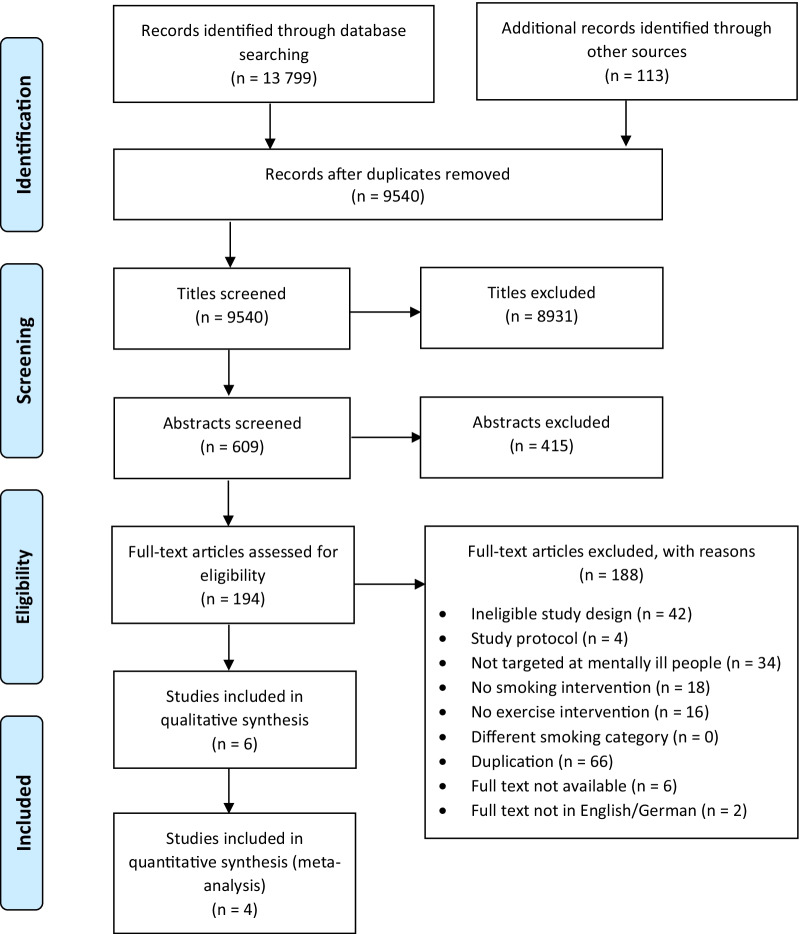
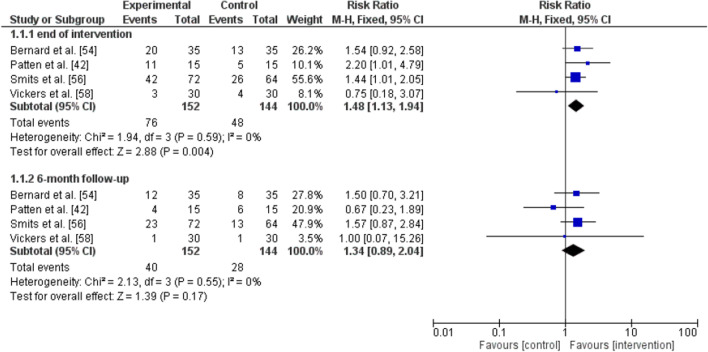
Six studies, five randomised controlled trials and one study with a prospective single-group design, were included in the systematic review and four randomised controlled trials were included in the meta-analysis. The meta-analysis found a significantly higher abstinence rate after additional exercise at the end of the intervention [risk ratio (RR) 1.48, 95% confidence interval (CI) 1.13-1.94], but not at the 6-month follow-up (RR 1.34, 95% CI 0.89-2.04).
Exercise appears to be an effective adjunctive therapy to temporarily increase abstinence rates in individuals with mental illness at the end of the intervention. However, due to the small number of included studies and some risk of bias in the included studies, the results should be treated with caution. Therefore, future studies with larger samples are needed to provide a more accurate estimate of the effect in people with mental illness. Registration The systematic review and meta-analysis were registered in the International Prospective Register of Systematic Reviews (PROSPERO) (registration number: CRD42020178630).
吸烟是精神疾病患者中最常见的物质使用障碍。与无精神疾病的人群不同,近几十年来无精神疾病人群中的吸烟者比例有所下降,而精神疾病患者中的吸烟者比例仍然很高。越来越多的文献表明,在无精神疾病的人群中,运动干预可与戒烟相结合使用,但据我们所知,关于这种治疗方案在精神疾病患者中的现有研究尚未得到系统评价。因此,本系统评价和荟萃分析旨在评估运动干预作为精神疾病患者戒烟辅助治疗的有效性。
检索电子数据库(PubMed、科学网、PsycInfo、体育文摘数据库和Base),查找随机对照试验和前瞻性单组研究,这些研究调查了单独将运动干预与戒烟计划相结合,或与精神疾病患者的对照组进行比较的情况。采用Mantel-Haenszel固定效应模型进行荟萃分析,以估计治疗对戒烟的总体效果(干预结束时和6个月随访时的戒断率)。
六项研究,五项随机对照试验和一项具有前瞻性单组设计的研究,被纳入系统评价,四项随机对照试验被纳入荟萃分析。荟萃分析发现,干预结束时额外运动后的戒断率显著更高[风险比(RR)1.48,95%置信区间(CI)1.13-1.94],但在6个月随访时并非如此(RR 1.34,95%CI 0.89-2.04)。
运动似乎是一种有效的辅助治疗方法,可在干预结束时暂时提高精神疾病患者的戒断率。然而,由于纳入研究的数量较少且存在一些偏倚风险,结果应谨慎对待。因此,需要未来进行更大样本量的研究,以更准确地估计对精神疾病患者的影响。注册 本系统评价和荟萃分析已在国际前瞻性系统评价注册库(PROSPERO)中注册(注册号:CRD42020178630)。