Verstraeten Helma M F, Ziylan Canan, Gerritsen Debby L, Huijsman Robbert, Nakanishi Miharu, Smalbrugge Martin, van der Steen Jenny T, Zuidema Sytse U, Achterberg Wilco P, Bakker Ton J E M
Department of Public Health and Primary Care, Leiden University Medical Center, Leiden, The Netherlands.
Research Centre Innovations in Care, Rotterdam University of Applied Sciences, Rotterdam, The Netherlands.
JMIR Res Protoc. 2022 Jun 22;11(6):e34550. doi: 10.2196/34550.
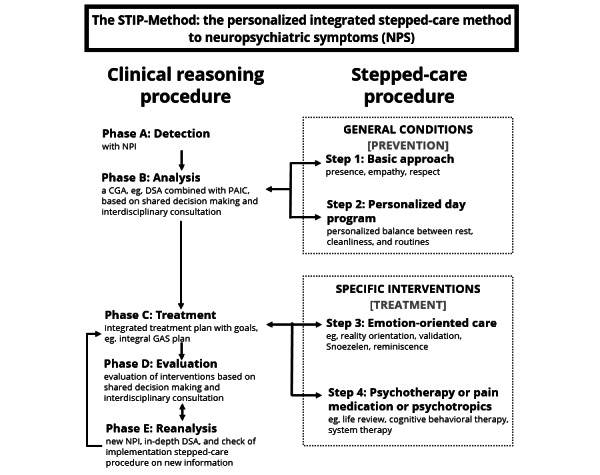
Neuropsychiatric symptoms occur frequently in many nursing home residents with dementia. Despite the availability of multidisciplinary guidelines, neuropsychiatric symptoms are often inadequately managed. Three proven effective methods for managing neuropsychiatric symptoms were integrated into a single intervention method: the STIP-Method, a personalized integrated stepped-care method to prevent and treat neuropsychiatric symptoms. The STIP-Method comprises 5 phases of clinical reasoning to neuropsychiatric symptoms and 4 stepped-care interventions and is supported with a web application.
This study aims to identify the facilitators and barriers in the implementation of the STIP-Method in nursing homes.
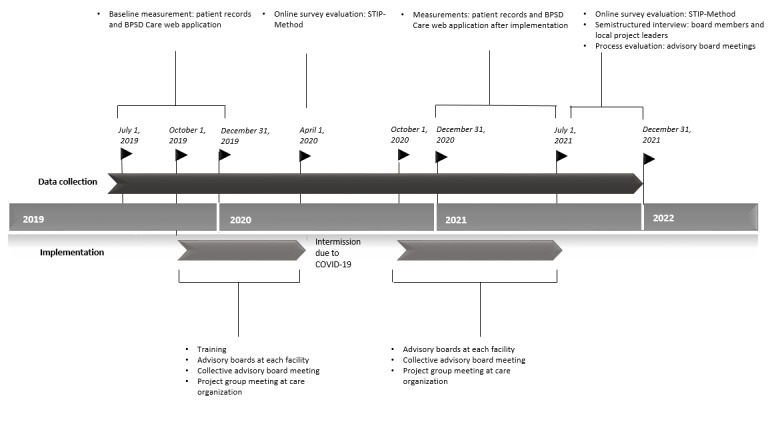
A mixed methods design within a participatory action research was used to implement the STIP-Method in 4 facilities of 2 Dutch nursing home organizations. In total, we aimed at participation of 160-200 persons with dementia and expected an intervention fidelity of 50% or more, based on earlier studies regarding implementation of effective psychosocial interventions to manage neuropsychiatric symptoms. All involved managers and professionals were trained in the principles of the STIP-Method and in using the web application. An advisory board of professionals, managers, and informal caregivers in each facility supported the implementation during 21 months, including an intermission of 6 months due to the COVID-19 pandemic. In these 6-weekly advisory board meetings, 2 researchers stimulated the members to reflect on progress of the implementation by making use of available data from patient records and the web application. Additionally, the 2 researchers invited the members to suggest how to improve the implementation. Data analysis will involve (1) analysis of facilitators and barriers to the implementation derived from verbatim text reports of advisory board meetings to better understand the implementation process; (2) analysis of patient records in accordance with multidisciplinary guidelines to neuropsychiatric symptoms: personalized, interdisciplinary, and proactive management of neuropsychiatric symptoms; (3) evaluation of the web application in terms of usability scores; (4) pre- and postimplementation analysis of patient records and the web application to evaluate the impact of the STIP-Method, such as changes in neuropsychiatric symptoms and informal caregiver burden.
We enrolled 328 persons with dementia. Data collection started in July 2019 and ended in December 2021. The first version of this manuscript was submitted in October 2021. The first results of data analysis are expected to be published in December 2022 and final results in June 2023.
Our study may increase understanding of facilitators and barriers to the prevention and treatment of neuropsychiatric symptoms in nursing home residents with dementia by implementing the integrated STIP-Method. The need for well-designed implementation studies is of importance to provide nursing homes with optimal tools to prevent and treat neuropsychiatric symptoms.
INTERNATIONAL REGISTERED REPORT IDENTIFIER (IRRID): DERR1-10.2196/34550.
神经精神症状在许多患有痴呆症的养老院居民中经常出现。尽管有多学科指南,但神经精神症状的管理往往不足。三种已被证明有效的管理神经精神症状的方法被整合为一种单一的干预方法:STIP 方法,一种用于预防和治疗神经精神症状的个性化综合阶梯式护理方法。STIP 方法包括针对神经精神症状的 5 个临床推理阶段和 4 种阶梯式护理干预措施,并由一个网络应用程序提供支持。
本研究旨在确定养老院实施 STIP 方法的促进因素和障碍。
在参与式行动研究中采用混合方法设计,在荷兰两个养老院组织的 4 个机构中实施 STIP 方法。根据早期关于实施有效心理社会干预措施以管理神经精神症状的研究,我们总共旨在让 160 - 200 名痴呆症患者参与,并期望干预保真度达到 50%或更高。所有参与的管理人员和专业人员都接受了 STIP 方法的原则和网络应用程序使用方面的培训。每个机构的专业人员、管理人员和非正式护理人员组成的咨询委员会在 21 个月内支持实施工作,其中由于 COVID - 19 大流行有 6 个月的间歇期。在这些每 6 周一次的咨询委员会会议上,两名研究人员通过利用患者记录和网络应用程序中的可用数据,促使成员反思实施进展情况。此外,两名研究人员邀请成员提出如何改进实施的建议。数据分析将包括:(1)分析咨询委员会会议逐字记录报告中得出的实施促进因素和障碍,以更好地理解实施过程;(2)根据针对神经精神症状的多学科指南分析患者记录:神经精神症状的个性化、跨学科和主动管理;(3)根据可用性得分评估网络应用程序;(4)对患者记录和网络应用程序进行实施前和实施后分析,以评估 STIP 方法的影响,如神经精神症状和非正式护理人员负担的变化。
我们招募了 328 名痴呆症患者。数据收集于 2019 年 7 月开始,2021 年 12 月结束。本手稿的第一版于 2021 年 10 月提交。数据分析的初步结果预计于 2022 年 12 月发表,最终结果于 2023 年 6 月发表。
我们的研究可能会通过实施综合的 STIP 方法,增加对患有痴呆症的养老院居民预防和治疗神经精神症状的促进因素和障碍的理解。设计良好的实施研究的必要性对于为养老院提供预防和治疗神经精神症状的最佳工具至关重要。
国际注册报告识别码(IRRID):DERR1 - 10.2196/34550。