Max Planck Institute of Molecular Cell Biology and Genetics, Pfotenhauerstrasse 108, 01307, Dresden, Germany.
Lipotype GmbH, Tatzberg 47, 01307, Dresden, Germany.
Sci Rep. 2022 Jun 22;12(1):10533. doi: 10.1038/s41598-022-14690-0.
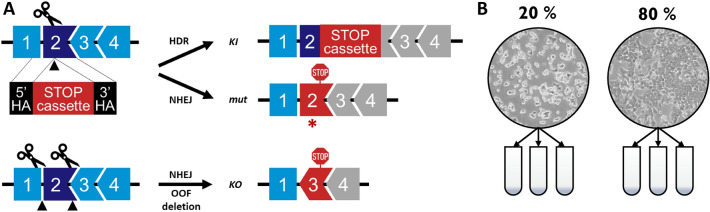
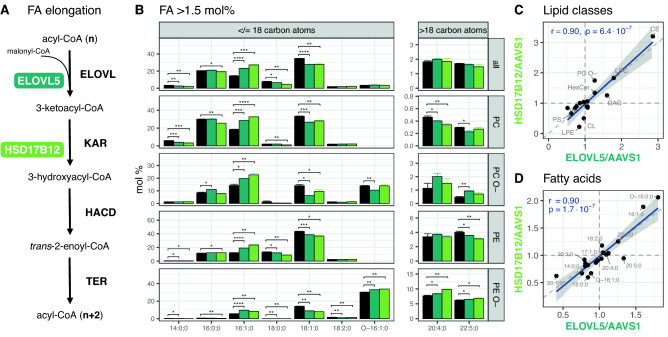
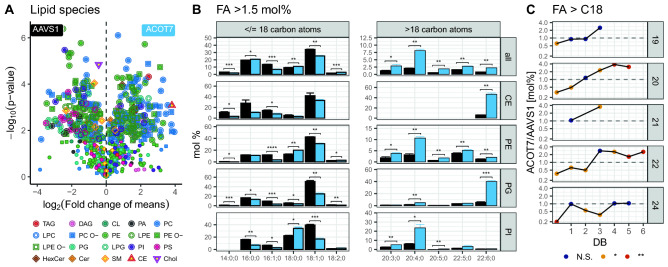
Enzyme specificity in lipid metabolic pathways often remains unresolved at the lipid species level, which is needed to link lipidomic molecular phenotypes with their protein counterparts to construct functional pathway maps. We created lipidomic profiles of 23 gene knockouts in a proof-of-concept study based on a CRISPR/Cas9 knockout screen in mammalian cells. This results in a lipidomic resource across 24 lipid classes. We highlight lipid species phenotypes of multiple knockout cell lines compared to a control, created by targeting the human safe-harbor locus AAVS1 using up to 1228 lipid species and subspecies, charting lipid metabolism at the molecular level. Lipid species changes are found in all knockout cell lines, however, some are most apparent on the lipid class level (e.g., SGMS1 and CEPT1), while others are most apparent on the fatty acid level (e.g., DECR2 and ACOT7). We find lipidomic phenotypes to be reproducible across different clones of the same knockout and we observed similar phenotypes when two enzymes that catalyze subsequent steps of the long-chain fatty acid elongation cycle were targeted.
在脂质代谢途径中,酶的特异性在脂质种类水平上通常仍未得到解决,这是将脂质组学分子表型与其蛋白质对应物联系起来构建功能途径图谱所必需的。我们在基于哺乳动物细胞 CRISPR/Cas9 敲除筛选的概念验证研究中,对 23 个基因敲除进行了脂质组学分析。这导致了跨越 24 个脂质类别的脂质组学资源。我们突出显示了与对照相比的多种敲除细胞系的脂质物种表型,这是通过针对人类安全港基因座 AAVS1 使用多达 1228 种脂质物种和亚种来靶向,从而在分子水平上绘制脂质代谢图。在所有敲除细胞系中都发现了脂质物种的变化,但在某些情况下,脂质种类水平上的变化最为明显(例如 SGMS1 和 CEPT1),而在其他情况下,脂肪酸水平上的变化最为明显(例如 DECR2 和 ACOT7)。我们发现脂质组学表型在同一敲除的不同克隆之间具有可重复性,并且当靶向长链脂肪酸延伸循环的后续步骤的两个酶时,观察到了类似的表型。