Jia Junxiao, Zhang Junbo, Zeng Zhengang, Shen Hong, Wang Chengyuan, Chen Jian, Xiao Shuifang
Department of Otolaryngology, Head and Neck Surgery Peking University First Hospital Beijing China.
Department of Otolaryngology, Head and Neck Surgery China-Japan Friendship Hospital Beijing China.
Laryngoscope Investig Otolaryngol. 2022 Apr 19;7(3):702-706. doi: 10.1002/lio2.781. eCollection 2022 Jun.
Hemorrhage is the most common complication caused by transoral laryngopharyngeal surgery. It is believed that proper management of the superior laryngeal artery (SLA), the main feeding artery for the larynx and pharynx, may reduce intra- and postoperative hemorrhage incidence. The aim of this study was to illustrate the anatomy of the SLA via transoral endoscopic approach.
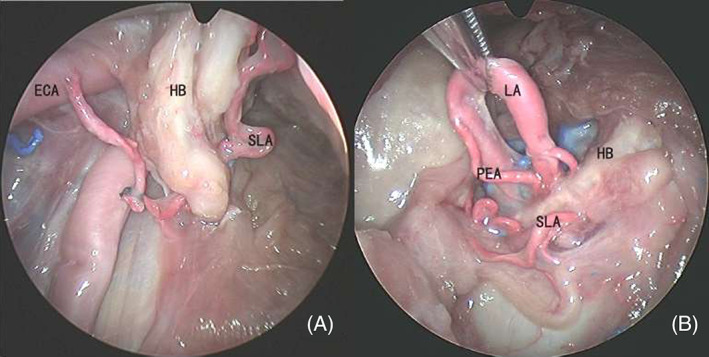
Fourteen sides of SLA from heads of seven fresh-frozen and silicone-injected cadavers were dissected. Transoral dissections were performed for the intra-laryngeal segment of SLA, and transcervical dissections were performed to confirm the anatomical measurements.
SLA had a slightly descending course from the origin to the larynx, and there was a major branch supplying the epiglottis, named pharyngo-epiglottic artery (PEA). Parallel with the internal superior laryngeal nerve (ISLN), SLA passed through the thyrohyoid membrane and ended into the hypopharynx. The distance from SLA to the superior horn of thyroid cartilage (SHTC) was (9.11 ± 0.58)mm on the left and (9.01 ± 0.37)mm on the right; the distance from SLA to the inferior margin of the hyoid bone (IMHB) was (2.00 ± 0.11)mm on the left and (1.95 ± 0.08)mm on the right; the distance from SLA to ISLN was (5.98 ± 0.48)mm on the left and (5.78 ± 0.36)mm on the right. No significant difference was found between bilateral sides ( > 0.05). Moreover, the distance from SLA to superior margin of thyroid cartilage (SMTC) was (5.52 ± 0.24)mm on the left and (5.80 ± 0.15)mm on the right. A significant difference was also found between bilateral sides ( = 0.03), which might suggest the SLA is located further from the SMTC on the right side.
SHTC, SMTC, and IMHB could be regarded as anatomical landmarks to locate SLA when applying a transoral approach. Moreover, a complete understanding of the detailed anatomy of the superior laryngeal artery may improve the detection of hemostasis in transoral laryngeal or hypo-pharyngeal surgery.
出血是经口喉咽手术最常见的并发症。据信,妥善处理喉上动脉(SLA),即喉和咽的主要供血动脉,可能会降低术中和术后出血的发生率。本研究的目的是通过经口内镜方法阐明SLA的解剖结构。
对7具新鲜冷冻并注入硅胶的尸体头部的14侧SLA进行解剖。对SLA的喉内段进行经口解剖,并进行经颈解剖以确认解剖学测量结果。
SLA从起点到喉部有轻微下降的走行,并且有一个供应会厌的主要分支,称为咽会厌动脉(PEA)。SLA与喉上神经内支(ISLN)平行,穿过甲状舌骨膜并终止于下咽。SLA到甲状软骨上角(SHTC)的距离左侧为(9.11±0.58)mm,右侧为(9.01±0.37)mm;SLA到舌骨下缘(IMHB)的距离左侧为(2.00±0.11)mm,右侧为(1.95±0.08)mm;SLA到ISLN的距离左侧为(5.98±0.48)mm,右侧为(5.78±0.36)mm。双侧之间未发现显著差异(>0.05)。此外,SLA到甲状软骨上缘(SMTC)的距离左侧为(5.52±0.24)mm,右侧为(5.80±0.15)mm。双侧之间也发现了显著差异(=0.03),这可能表明右侧的SLA距离SMTC更远。
在应用经口入路时,SHTC、SMTC和IMHB可被视为定位SLA的解剖标志。此外,全面了解喉上动脉的详细解剖结构可能会改善经口喉部或下咽手术中的止血检测。