Lopes Bruno A, Poubel Caroline Pires, Teixeira Cristiane Esteves, Caye-Eude Aurélie, Cavé Hélène, Meyer Claus, Marschalek Rolf, Boroni Mariana, Emerenciano Mariana
Acute Leukemia RioSearch Group, Division of Clinical Research and Technological Development, Instituto Nacional de Câncer José Alencar Gomes da Silva (INCA), Rio de Janeiro, Brazil.
Bioinformatics and Computational Biology Laboratory, Instituto Nacional de Câncer José Alencar Gomes da Silva (INCA), Rio de Janeiro, Brazil.
Front Pharmacol. 2022 Jun 6;13:749472. doi: 10.3389/fphar.2022.749472. eCollection 2022.
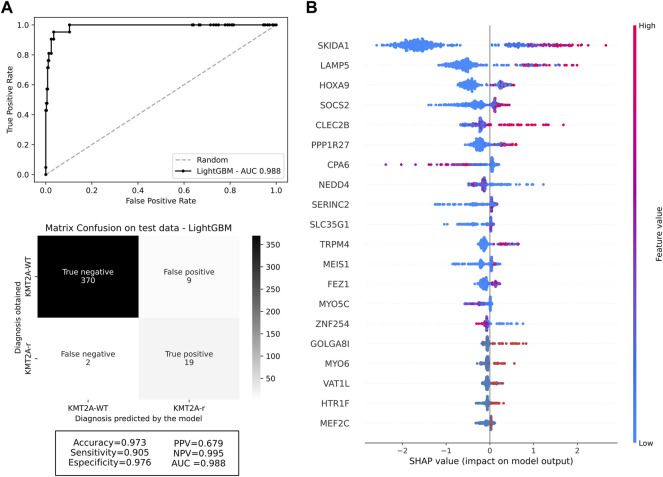
The () gene rearrangements (-r) are associated with a diverse spectrum of acute leukemias. Although most -r are restricted to nine partner genes, we have recently revealed that - fusions are often missed during FISH screening of these genetic alterations. Therefore, complementary methods are important for appropriate detection of any -r. Here we use a machine learning model to unravel the most appropriate markers for prediction of -r in various types of acute leukemia. A Random Forest and LightGBM classifier was trained to predict -r in patients with acute leukemia. Our results revealed a set of 20 genes capable of accurately estimating -r. The (AUC: 0.839; CI: 0.799-0.879) and (AUC: 0.746; CI: 0.685-0.806) overexpression were the better markers associated with -r compared to (also named ; AUC: 0.722; CI: 0.659-0.784), regardless of the type of acute leukemia. Of importance, high expression levels of estimated the occurrence of all fusions. Also, we performed drug sensitivity analysis using IC50 data from 345 drugs available in the GDSC database to identify which ones could be used to treat -r leukemia. We observed that -r cell lines were more sensitive to 5-Fluorouracil (5FU), Gemcitabine (both antimetabolite chemotherapy drugs), WHI-P97 (JAK-3 inhibitor), Foretinib (MET/VEGFR inhibitor), SNX-2112 (Hsp90 inhibitor), AZD6482 (PI3Kβ inhibitor), KU-60019 (ATM kinase inhibitor), and Pevonedistat (NEDD8-activating enzyme (NAE) inhibitor). Moreover, IC50 data from analyses of drug sensitivity to small-molecule inhibitors reveals that Foretinib is a promising drug option for AML patients carrying activating mutations. Thus, we provide novel and accurate options for the diagnostic screening and therapy of -r leukemia, regardless of leukemia subtype.
()基因重排(-r)与多种急性白血病相关。尽管大多数-r局限于九个伙伴基因,但我们最近发现,在这些基因改变的荧光原位杂交(FISH)筛查过程中,-融合常常被遗漏。因此,补充方法对于准确检测任何-r很重要。在此,我们使用机器学习模型来揭示预测各种类型急性白血病中-r的最合适标志物。训练了随机森林和LightGBM分类器以预测急性白血病患者的-r。我们的结果揭示了一组能够准确估计-r的20个基因。与(也称为;曲线下面积(AUC):0.722;可信区间(CI):0.659 - 0.784)相比,(AUC:0.839;CI:0.799 - 0.879)和(AUC:0.746;CI:0.685 - 0.806)的过表达是与-r相关的更好标志物,无论急性白血病的类型如何。重要的是,的高表达水平估计了所有融合的发生情况。此外,我们使用来自基因表达综合数据库(GDSC)中345种可用药物的半数抑制浓度(IC50)数据进行药物敏感性分析,以确定哪些药物可用于治疗-r白血病。我们观察到,-r细胞系对5-氟尿嘧啶(5FU)、吉西他滨(两种抗代谢化疗药物)、WHI-P97(JAK-3抑制剂)、福瑞替尼(MET/血管内皮生长因子受体(VEGFR)抑制剂)、SNX-2112(热休克蛋白90(Hsp90)抑制剂)、AZD6482(磷脂酰肌醇-3激酶β(PI3Kβ)抑制剂)、KU-60019(共济失调毛细血管扩张症突变基因(ATM)激酶抑制剂)和pevonedistat(NEDD8激活酶(NAE)抑制剂)更敏感。此外,对小分子抑制剂药物敏感性分析的IC50数据表明,福瑞替尼是携带激活突变的急性髓系白血病(AML)患者的一种有前景的药物选择。因此,无论白血病亚型如何,我们为-r白血病的诊断筛查和治疗提供了新的、准确的选择。