Lymperaki Evgenia, Stalika Evangelia, Tzavelas George, Tormpantoni Efthymia, Samara Diana, Vagdatli Eleni, Tsamesidis Ioannis
Department of Biomedical Sciences, International Hellenic University, 57001 Thessaloniki, Greece.
Lab of Computing and Medical Informatics, Medical School, Aristotle University of Thessaloniki, 54124 Thessaloniki, Greece.
Clin Pract. 2022 Jun 7;12(3):406-418. doi: 10.3390/clinpract12030045.
The objective of this study is to further highlight the differences between different ABO blood groups and Rhesus types with health biomarkers.
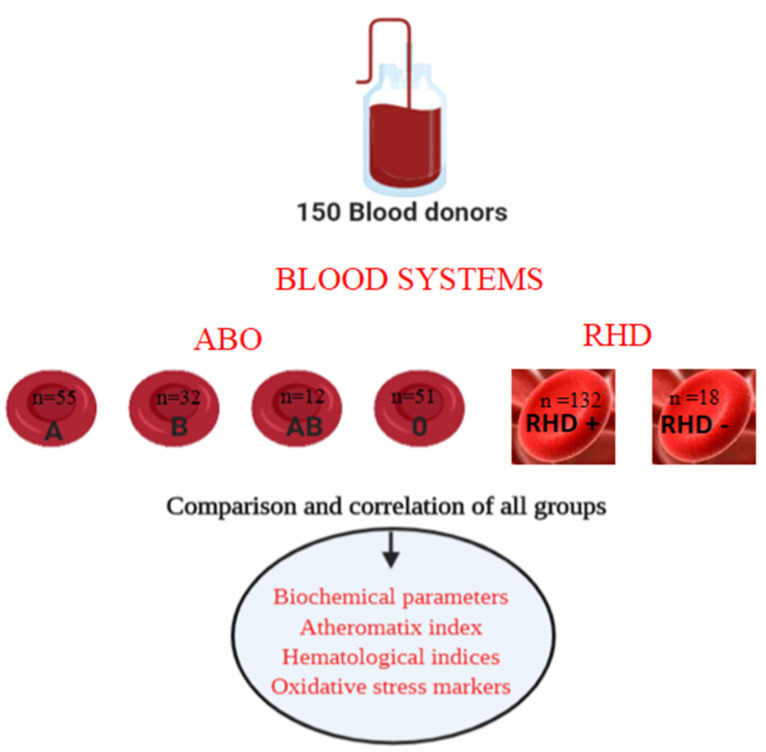
In total 150 active healthy blood donors participated in our study comprising of 80 males from 19-61 years and 70 females aged from 21 to 64. Participants carrying blood group A were 55 individuals, blood group B 32, blood group O 51, and blood group AB 12, RHD+ 132, and RHD- 18. All the volunteer regular blood donors were selected recognizing them as a healthy population excluding drug and supplements intake. Their blood samples were analyzed just before blood donation for biochemical, hematological, and antioxidant markers. Statistical computations were performed using the SPSS tool, specifically, the one-way ANOVA test, Chi-square statistics, and logistic regression were used as statistical models.
O blood donors presented better iron absorption and the worst lipid profile. Indeed, a significant trend of high atheromatic index values revealed an increased risk for hyperlipidemia, in contrast with blood group A presenting a better lipid profile with lower atheromatic index values. There was also a gender related association for blood group A compared with O that was further highlighted using binary logistic regression.
In this study, a significant difference was observed among the ABO blood groups in several of the examined biochemical and hematological biomarkers. O blood group appeared different behavior in comparison to all the tested blood groups and furthermore the RHD-group presented a better lipid profile in comparison to the RHD+ group. In order to obtain a more comprehensive view of the correlation between the ABO blood group and biochemical markers, further studies are required.
本研究的目的是进一步突出不同ABO血型和恒河猴血型与健康生物标志物之间的差异。
共有150名健康的现役献血者参与了我们的研究,其中包括80名年龄在19至61岁之间的男性和70名年龄在21至64岁之间的女性。携带A型血的参与者有55人,B型血32人,O型血51人,AB型血12人,RHD阳性132人,RHD阴性18人。所有志愿定期献血者均被选为健康人群,排除了药物和补充剂的摄入。他们的血样在献血前进行了生化、血液学和抗氧化标志物分析。使用SPSS工具进行统计计算,具体而言,单向方差分析测试、卡方统计和逻辑回归被用作统计模型。
O型血献血者的铁吸收较好,但血脂状况最差。事实上,高动脉粥样硬化指数值的显著趋势表明高脂血症风险增加,相比之下,A型血的血脂状况较好,动脉粥样硬化指数值较低。与O型血相比,A型血还存在与性别相关的关联,使用二元逻辑回归进一步突出了这一点。
在本研究中,在几个检测的生化和血液学生物标志物中,ABO血型之间存在显著差异。与所有测试血型相比,O型血表现出不同的行为,此外,RHD阴性组的血脂状况比RHD阳性组更好。为了更全面地了解ABO血型与生化标志物之间的相关性,还需要进一步的研究。