Institute of Zoology, University of Innsbruck, 6020 Innsbruck, Austria.
Center of Molecular Biosciences Innsbruck, University of Innsbruck, 6020 Innsbruck, Austria.
Mar Drugs. 2022 May 27;20(6):359. doi: 10.3390/md20060359.
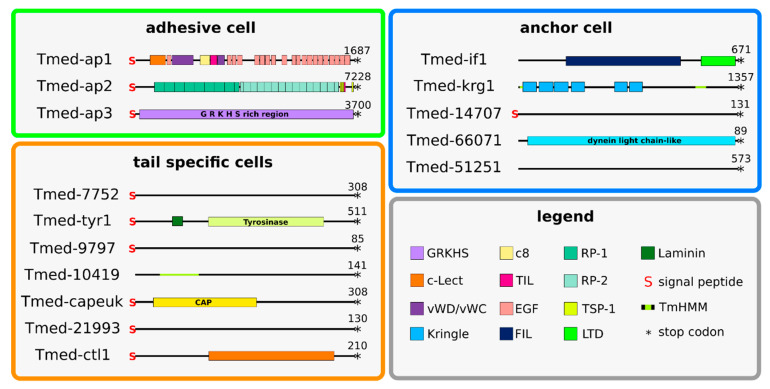
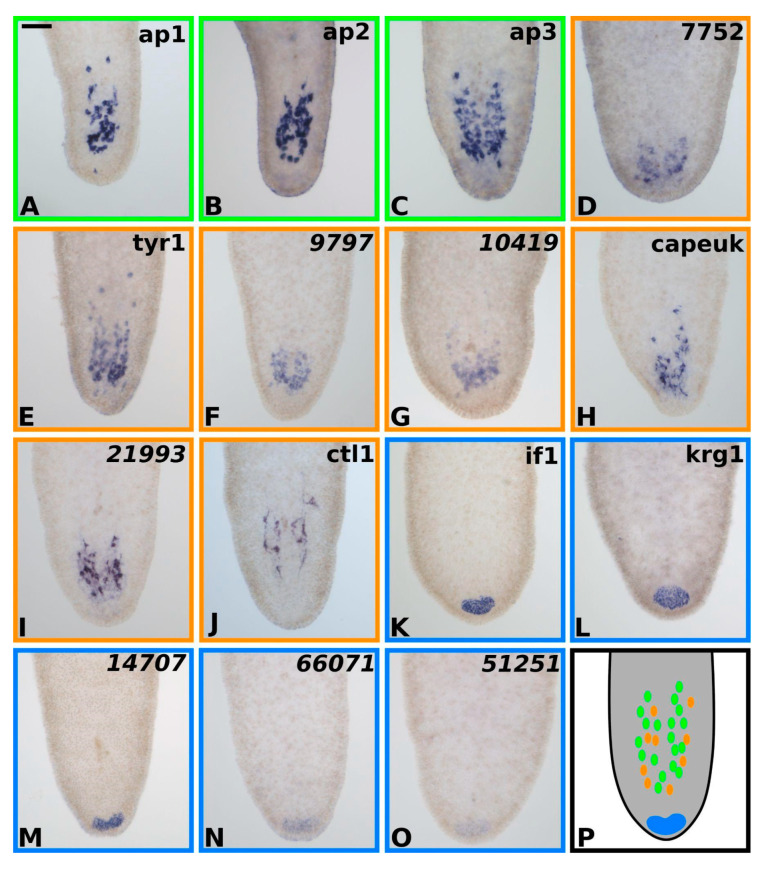
Non-parasitic flatworms are known to temporarily attach to the substrate by secreting a multicomponent bioadhesive to counteract water movements. However, to date, only species of two higher-level flatworm taxa (Macrostomorpha and Proseriata) have been investigated for their adhesive proteins. Remarkably, the surface-binding protein is not conserved between flatworm taxa. In this study, we sequenced and assembled a draft genome, as well as a transcriptome, and generated a tail-specific positional RNA sequencing dataset of the polyclad . This led to the identification of 15 candidate genes potentially involved in temporary adhesion. Using in situ hybridisation and RNA interference, we determined their expression and function. Of these 15 genes, 4 are homologues of adhesion-related genes found in other flatworms. With this work, we provide two novel key components on the flatworm temporary adhesion system. First, we identified a Kringle-domain-containing protein (Tmed-krg1), which was expressed exclusively in the anchor cell. This in silico predicted membrane-bound Tmed-krg1 could potentially bind to the cohesive protein, and a knockdown led to a non-adhesive phenotype. Secondly, a secreted tyrosinase (Tmed-tyr1) was identified, which might crosslink the adhesive proteins. Overall, our findings will contribute to the future development of reversible synthetic glues with desirable properties for medical and industrial applications.
无寄生虫扁形动物已知通过分泌多成分生物黏附物来临时附着在基质上,以抵消水流的作用。然而,迄今为止,仅对两个高级扁形动物类群(Macro stomorpha 和 Proseriata)的黏附蛋白进行了研究。值得注意的是,扁形动物类群之间的表面结合蛋白并不保守。在这项研究中,我们对多肠目扁形动物进行了测序和组装基因组草图以及转录组,并生成了其尾部特异性位置 RNA 测序数据集,从而鉴定出 15 个可能参与临时黏附的候选基因。通过原位杂交和 RNA 干扰,我们确定了它们的表达和功能。在这 15 个基因中,有 4 个与其他扁形动物中发现的黏附相关基因具有同源性。通过这项工作,我们为扁形动物临时黏附系统提供了两个新的关键组成部分。首先,我们鉴定了一种含有 Kringle 结构域的蛋白(Tmed-krg1),它仅在锚细胞中表达。这种计算机预测的膜结合 Tmed-krg1 可能与黏附蛋白结合,敲低该基因会导致非黏附表型。其次,鉴定出一种分泌型酪氨酸酶(Tmed-tyr1),它可能交联黏附蛋白。总的来说,我们的发现将有助于未来开发具有医疗和工业应用所需特性的可逆合成胶。