Ortega Miguel A, Fraile-Martinez Oscar, Garcia-Montero Cielo, Alvarez-Mon Miguel Angel, Gomez-Lahoz Ana Maria, Albillos Agustin, Lahera Guillermo, Quintero Javier, Monserrat Jorge, Guijarro Luis G, Alvarez-Mon Melchor
Department of Medicine and Medical Specialities, Faculty of Medicine and Health Sciences, University of Alcala, 28801 Alcala de Henares, Spain.
Ramón y Cajal Institute of Sanitary Research (IRYCIS), 28034 Madrid, Spain.
Membranes (Basel). 2022 May 25;12(6):552. doi: 10.3390/membranes12060552.
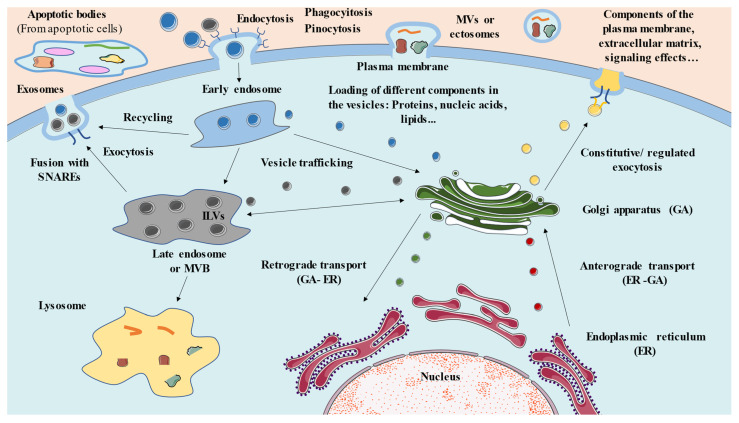
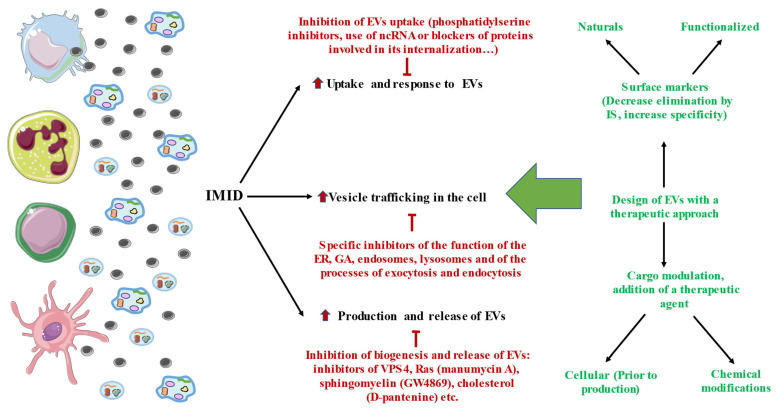
Cellular trafficking is the set of processes of distributing different macromolecules by the cell. This process is highly regulated in cells, involving a system of organelles (endomembranous system), among which are a great variety of vesicles that can be secreted from the cell, giving rise to different types of extracellular vesicles (EVs) that can be captured by other cells to modulate their function. The cells of the immune system are especially sensitive to this cellular traffic, producing and releasing different classes of EVs, especially in disease states. There is growing interest in this field due to the therapeutic and translational possibilities it offers. Different ways of taking advantage of the understanding of cell trafficking and EVs are being investigated, and their use as biomarkers or therapeutic targets is being investigated. The objective of this review is to collect the latest results and knowledge in this area with a specific focus on immune-mediated diseases. Although some promising results have been obtained, further knowledge is still needed, at both the basic and translational levels, to understand and modulate cellular traffic and EVs for better clinical management of these patients.
细胞运输是细胞分配不同大分子的一系列过程。这一过程在细胞中受到高度调控,涉及一个细胞器系统(内膜系统),其中有各种各样的囊泡,这些囊泡可以从细胞中分泌出来,产生不同类型的细胞外囊泡(EVs),其他细胞可以捕获这些囊泡来调节其功能。免疫系统的细胞对这种细胞运输特别敏感,会产生和释放不同类别的EVs,尤其是在疾病状态下。由于该领域提供的治疗和转化可能性,人们对它的兴趣与日俱增。目前正在研究利用对细胞运输和EVs的理解的不同方法,并研究将它们用作生物标志物或治疗靶点。本综述的目的是收集该领域的最新结果和知识,特别关注免疫介导的疾病。尽管已经取得了一些有希望的结果,但在基础和转化层面仍需要进一步了解,以理解和调节细胞运输及EVs,从而更好地对这些患者进行临床管理。