Peretti Débora E, Vállez García David, Renken Remco J, Reesink Fransje E, Doorduin Janine, de Jong Bauke M, De Deyn Peter P, Dierckx Rudi A J O, Boellaard Ronald
Department of Nuclear Medicine and Molecular Imaging, University Medical Center Groningen, University of Groningen, Groningen, The Netherlands.
Department of Biomedical Sciences of Cells and Systems, Cognitive Neuroscience Center, University Medical Center Groningen, University of Groningen, Groningen, The Netherlands.
EJNMMI Res. 2022 Jun 23;12(1):37. doi: 10.1186/s13550-022-00909-8.
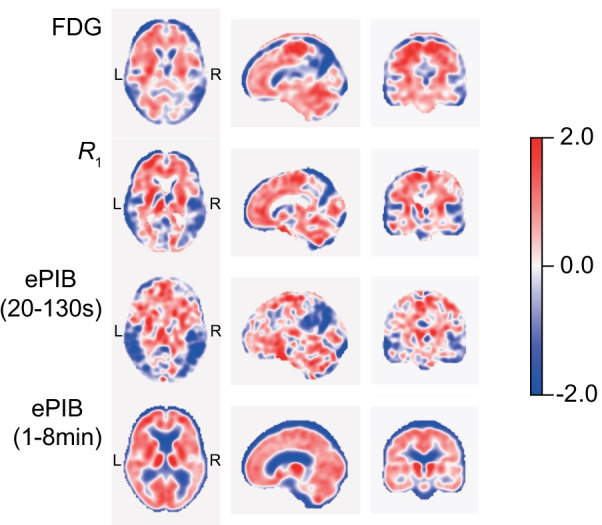
2-Deoxy-2-[F]fluoroglucose (FDG) PET is an important tool for the identification of Alzheimer's disease (AD) patients through the characteristic neurodegeneration pattern that these patients present. Regional cerebral blood flow (rCBF) images derived from dynamic C-labelled Pittsburgh Compound B (PIB) have been shown to present a similar pattern as FDG. Moreover, multivariate analysis techniques, such as scaled subprofile modelling using principal component analysis (SSM/PCA), can be used to generate disease-specific patterns (DP) that may aid in the classification of subjects. Therefore, the aim of this study was to compare rCBF AD-DPs with FDG AD-DP and their respective performances. Therefore, 52 subjects were included in this study. Fifteen AD and 16 healthy control subjects were used to generate four AD-DP: one based on relative cerebral trace blood (R), two based on time-weighted average of initial frame intervals (ePIB), and one based on FDG images. Furthermore, 21 subjects diagnosed with mild cognitive impairment were tested against these AD-DPs.
In general, the rCBF and FDG AD-DPs were characterized by a reduction in cortical frontal, temporal, and parietal lobes. FDG and rCBF methods presented similar score distribution.
rCBF images may provide an alternative for FDG PET scans for the identification of AD patients through SSM/PCA.
2-脱氧-2-[F]氟葡萄糖(FDG)正电子发射断层扫描(PET)是通过阿尔茨海默病(AD)患者呈现的特征性神经退行性变模式来识别这类患者的重要工具。源自动态C标记匹兹堡化合物B(PIB)的局部脑血流量(rCBF)图像已显示出与FDG类似的模式。此外,多变量分析技术,如使用主成分分析的缩放子轮廓建模(SSM/PCA),可用于生成有助于受试者分类的疾病特异性模式(DP)。因此,本研究的目的是比较rCBF AD-DP与FDG AD-DP及其各自的性能。本研究纳入了52名受试者。15名AD患者和16名健康对照受试者用于生成四种AD-DP:一种基于相对脑微量血液(R),两种基于初始帧间隔的时间加权平均值(ePIB),一种基于FDG图像。此外,对21名被诊断为轻度认知障碍的受试者针对这些AD-DP进行了测试。
总体而言,rCBF和FDG AD-DP的特征是额叶、颞叶和顶叶皮质减少。FDG和rCBF方法呈现出相似的分数分布。
rCBF图像可通过SSM/PCA为FDG PET扫描提供一种替代方法来识别AD患者。