Linping Campus, The Second Affiliated Hospital of Zhejiang University School of Medicine, Hangzhou, China.
Key Laboratory of Respiratory Disease of Zhejiang Province, Department of Respiratory and Critical Care Medicine, The Second Affiliated Hospital of Zhejiang University School of Medicine, Hangzhou, Zhejiang, China.
J Med Virol. 2022 Oct;94(10):4850-4859. doi: 10.1002/jmv.27955. Epub 2022 Jul 9.
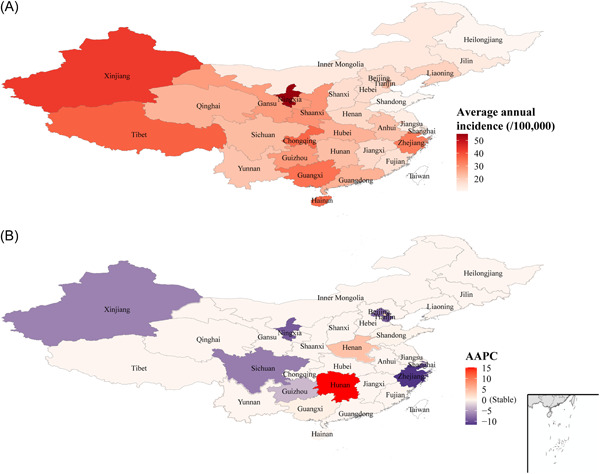
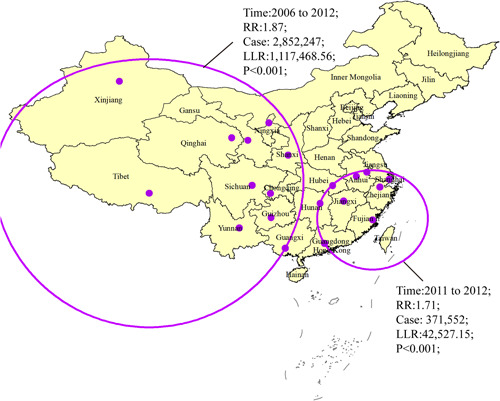
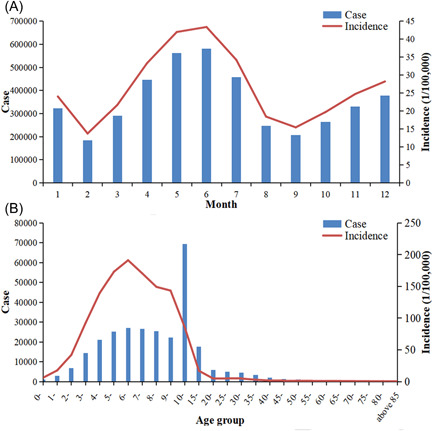
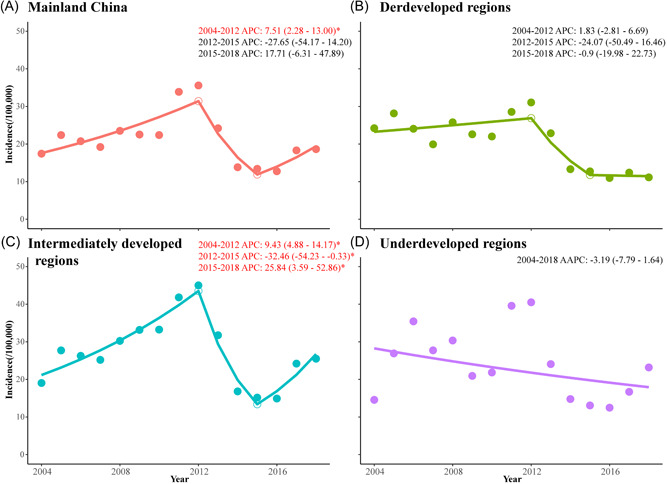
Mumps is an acute infectious disease that spreads widely around the world. The aim of this study was to investigate the epidemiological features and sociodemographic factors associated with mumps in mainland China from 2004 to 2018. Incidence data for mumps during the period 2004-2018 were collected from the Public Health Sciences Data Center of China. Joinpoint regression analysis was performed to explore the trends of mumps. Space-time clustering analysis was conducted to spatial and temporal aggregation areas of mumps. A generalized linear model was used to explore sociodemographic factors associated with the incidence of mumps. The average annual incidence of mumps was 21.44/100 000 in mainland China. It was increased dramatically during 2004-2012 (annual percentage change [APC] = 7.51, 95% confidence interval [CI]: 2.28-13.00). After 2012, it remained stable, however, significantly increased in intermediately developed regions from 2015 to 2018 (APC = 25.84, 95% CI: 3.59-52.86). The first-level spatial and temporal aggregation areas were distributed in Xinjiang, Gansu, Qinghai, Ningxia and Shaanxi, Tibet, Sichuan, Yunnan, Chongqing, Guizhou, and Guangxi, with gathering times from January 1, 2006 to December 31, 2012 (relative risk [RR] = 1.87, p < 0.001). The percentage of the population aged 0-14 years, number of health workers per capital, and number of passengers were found to be positively associated with the incidence of mumps. Overall, after 2012, the incidence of mumps in mainland China remained stable. High-risk periods, clusters of regions, and sociodemographic factors for mumps were identified, which will help the government develop the disease- and location-specific interventive measures.
流行性腮腺炎是一种广泛传播的急性传染病。本研究旨在探讨 2004 年至 2018 年中国大陆流行性腮腺炎的流行病学特征和社会人口学因素。从中国公共卫生科学数据中心收集了 2004-2018 年期间流行性腮腺炎的发病率数据。采用 Joinpoint 回归分析探讨流行性腮腺炎的趋势。采用时空聚类分析方法对流行性腮腺炎的时空聚集区进行分析。采用广义线性模型探讨与流行性腮腺炎发病率相关的社会人口学因素。中国大陆流行性腮腺炎的平均年发病率为 21.44/10 万。2004-2012 年期间发病率急剧上升(年变化百分比[APC] = 7.51,95%置信区间[CI]:2.28-13.00)。2012 年后,发病率保持稳定,但 2015 年至 2018 年期间中度发达地区的发病率显著上升(APC = 25.84,95%CI:3.59-52.86)。一级时空聚集区分布在新疆、甘肃、青海、宁夏、陕西、西藏、四川、云南、重庆、贵州和广西,聚集时间为 2006 年 1 月 1 日至 2012 年 12 月 31 日(相对风险[RR] = 1.87,p < 0.001)。0-14 岁人口比例、人均卫生工作者数量和旅客数量与流行性腮腺炎发病率呈正相关。总体而言,2012 年后,中国大陆流行性腮腺炎发病率保持稳定。确定了流行性腮腺炎的高危期、聚集区和社会人口学因素,这将有助于政府制定针对疾病和地理位置的干预措施。