Ganse Bergita, Cucchiarini Magali, Madry Henning
Werner Siemens Foundation Endowed Chair of Innovative Implant Development (Fracture Healing), Clinics and Institutes of Surgery, Saarland University, 66421 Homburg, Germany.
Department of Trauma, Hand and Reconstructive Surgery, Clinics and Institutes of Surgery, Saarland University Medical Center, 66421 Homburg, Germany.
Biomedicines. 2022 Jun 8;10(6):1356. doi: 10.3390/biomedicines10061356.
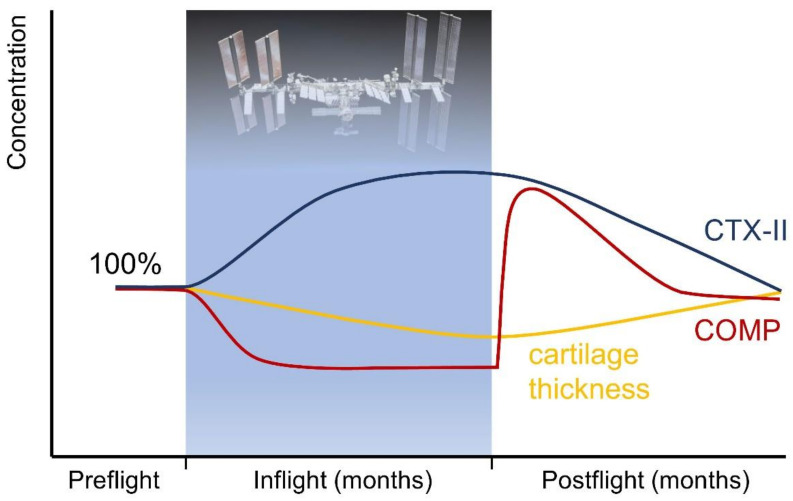
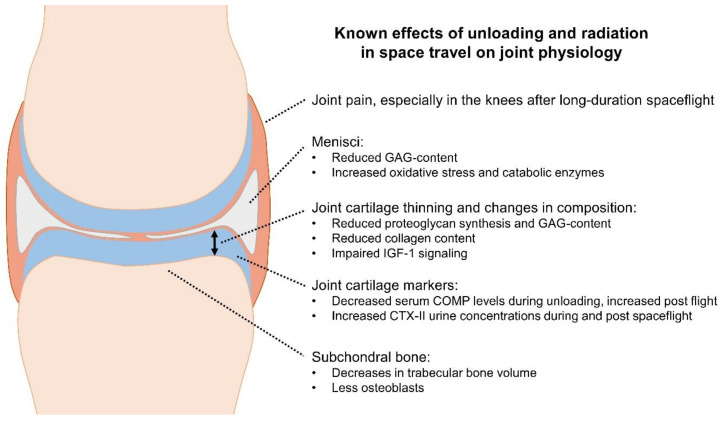
This review summarizes the current literature available on joint cartilage alterations in long-duration spaceflight. Evidence from spaceflight participants is currently limited to serum biomarker data in only a few astronauts. Findings from analogue model research, such as bed rest studies, as well as data from animal and cell research in real microgravity indicate that unloading and radiation exposure are associated with joint degeneration in terms of cartilage thinning and changes in cartilage composition. It is currently unknown how much the individual cartilage regions in the different joints of the human body will be affected on long-term missions beyond the Low Earth Orbit. Given the fact that, apart from total joint replacement or joint resurfacing, currently no treatment exists for late-stage osteoarthritis, countermeasures might be needed to avoid cartilage damage during long-duration missions. To plan countermeasures, it is important to know if and how joint cartilage and the adjacent structures, such as the subchondral bone, are affected by long-term unloading, reloading, and radiation. The use of countermeasures that put either load and shear, or other stimuli on the joints, shields them from radiation or helps by supporting cartilage physiology, or by removing oxidative stress possibly help to avoid OA in later life following long-duration space missions. There is a high demand for research on the efficacy of such countermeasures to judge their suitability for their implementation in long-duration missions.
本综述总结了目前关于长期太空飞行中关节软骨改变的现有文献。目前,来自太空飞行参与者的证据仅限于少数宇航员的血清生物标志物数据。模拟模型研究(如卧床休息研究)的结果,以及真实微重力环境下动物和细胞研究的数据表明,失重和辐射暴露与关节退变有关,表现为软骨变薄和软骨成分改变。目前尚不清楚在低地球轨道以外的长期任务中,人体不同关节的各个软骨区域会受到多大影响。鉴于除了全关节置换或关节表面置换外,目前尚无针对晚期骨关节炎的治疗方法,可能需要采取对策以避免在长期任务中软骨受损。为了制定对策,了解关节软骨及相邻结构(如软骨下骨)是否以及如何受到长期失重、重新加载和辐射的影响非常重要。使用对关节施加负荷和剪切力或其他刺激、使关节免受辐射或通过支持软骨生理功能或消除氧化应激来提供帮助的对策,可能有助于避免长期太空任务后晚年出现骨关节炎。对于此类对策的效果进行研究的需求很高,以便判断它们是否适合在长期任务中实施。