Folch Cinta, González-Casals Helena, Colom Joan, Bosque-Prous Marina, Barón-Garcia Tivy, Álvarez-Vargas Anaís, Casabona Jordi, Espelt Albert
Centre d'Estudis Epidemiològics sobre les Infeccions de Transmissió Sexual i Sida de Catalunya (CEEISCAT), Departament de Salut, Generalitat de Catalunya, 08916 Badalona, Spain.
Centro de Investigación Biomédica en Red de Epidemiología y Salud Pública (CIBERESP), C/Monforte de Lemos, 3 Pabellón 11, 28029 Madrid, Spain.
Children (Basel). 2022 May 26;9(6):783. doi: 10.3390/children9060783.
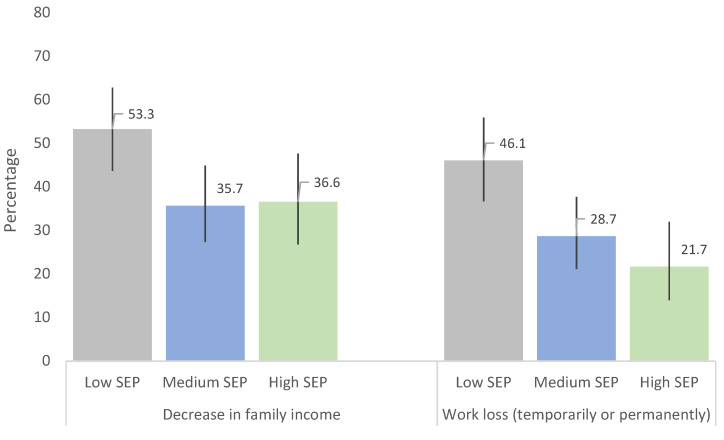
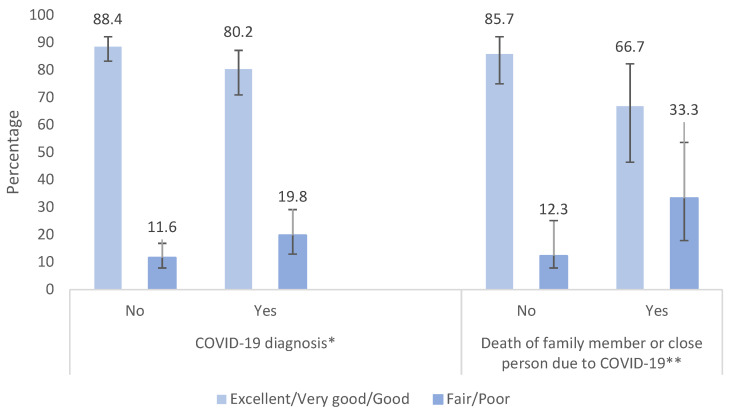
This study aimed to describe the impact of the COVID-19 pandemic on the social situation, self-perceived health status, and mental well-being of adolescents in Catalonia during home confinement, and to evaluate factors that are associated with poor overall mental well-being. An online cross-sectional study among a cohort of students (14-18 years old) of central Catalonia (DESKcohort) was performed during June-July 2020. Poisson regression models with robust variance were used to identify variables associated with "poor overall well-being," measured by the short version of the Warwick-Edinburgh Mental Wellbeing Scale. Out of 303 participants, 42.1% reported a decrease in family income, and 32.8% a loss of parental employment due to the COVID-19 pandemic, and these percentages were higher among people living in low socioeconomic neighborhoods (53.3% and 43.2%, respectively). Overall, 56.8% presented a poor overall well-being. Participants reporting a decrease in their family's income (aPR = 1.33) and those knowing a close person or family who died of COVID-19 (aPR = 1.42) were more likely to report a poor overall well-being. This study highlights the patterns of inequality and social vulnerability for COVID-19 pandemic outcomes. Considering social inequalities, interventions are needed to mitigate the impact of COVID-19 pandemic on the physical and the psychological wellbeing of children and their families.
本研究旨在描述新冠疫情居家隔离期间对加泰罗尼亚青少年社会状况、自我感知健康状况及心理健康的影响,并评估与整体心理健康状况不佳相关的因素。2020年6月至7月期间,对加泰罗尼亚中部一组14至18岁的学生(DESK队列)进行了一项在线横断面研究。采用具有稳健方差的泊松回归模型来识别与“整体幸福感差”相关的变量,该变量通过沃里克-爱丁堡心理健康量表简版进行测量。在303名参与者中,42.1%的人报告家庭收入减少,32.8%的人报告因新冠疫情导致父母失业,且这些比例在社会经济地位较低社区的人群中更高(分别为53.3%和43.2%)。总体而言,56.8%的人整体幸福感较差。报告家庭收入减少的参与者(调整后风险比=1.33)以及那些认识死于新冠的亲密人士或家人的参与者(调整后风险比=1.42)更有可能报告整体幸福感较差。本研究突出了新冠疫情结果中的不平等模式和社会脆弱性。考虑到社会不平等,需要采取干预措施来减轻新冠疫情对儿童及其家庭身心健康的影响。